Practise 21 questions on Congruent triangles for Year 9 Maths. Write your answer and get it marked in seconds against the mark scheme, point by point, with the Study Helper on hand if you get stuck.
21 questions
1–5 marks each
Instant marking
No sign-up needed
20 questions, marked as you go
Sample questions with model answers
Here are 4 of the questions in this topic, each with a model answer, an explanation of why it earns the marks and the mark scheme.
Question 1
1 mark
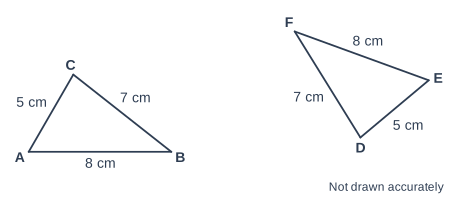
The diagram shows triangles ABC and DEF.
Which condition shows that the two triangles are congruent? Write SSS, SAS, ASA or RHS.
Model answer
SSS. Both triangles have sides of 5 cm, 7 cm and 8 cm.
Explanation
All three sides of triangle ABC are equal to the three sides of triangle DEF, so the triangles are congruent by SSS (side, side, side). Triangle DEF is turned round, but that does not matter: only the lengths count. A common mistake is to compare the positions of the triangles instead of their measurements.
Mark scheme
1 mark
SSS
Accept 'side, side, side' or 'three pairs of equal sides'. SAS, ASA or RHS scores 0: no angles are given.
Question 2
2 marks
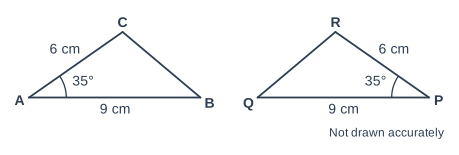
The diagram shows triangles ABC and PQR.
Kofi says, "These triangles are not congruent, because triangle PQR is a mirror image of triangle ABC."
Is Kofi right? Give a reason for your answer.
Model answer
No. Both triangles have sides of 9 cm and 6 cm with an angle of \(35^\circ\) between them, so they are congruent by SAS. A reflection does not change any lengths or angles, so a mirror image is congruent to the shape it came from.
Explanation
Congruent means exactly the same shape and size. Turning a shape over, as a reflection does, keeps every side and angle the same, so congruent shapes can be mirror images of each other. Here two sides and the angle between them match, so SAS shows the triangles are congruent. A common mistake is to think congruent shapes must face the same way.
Mark scheme
1 mark
No, with a relevant but incomplete reason, e.g. 'the sides and the angle are the same' or 'SAS' with no more
'No' on its own scores 0.
1 mark
A complete correct reason: both triangles have sides of 9 cm and 6 cm with an angle of \(35^\circ\) between them, so they are congruent by SAS; or a reflection does not change any lengths or angles, so a mirror image is congruent to the original
Either idea in full scores this mark. For SAS, the answer must show that the angle is between the two sides. A complete correct reason on its own scores both marks.
Question 3
3 marks
In triangle ABC, angle A \(= 45^\circ\), angle B \(= 75^\circ\) and AB = 9 cm. In triangle PQR, angle P \(= 75^\circ\), angle R \(= 60^\circ\) and PQ = 9 cm.
Ella says, "We cannot tell if these triangles are congruent, because we do not know the angle at Q."
Show that the triangles are congruent, and give the condition.
Model answer
Angle Q \(= 180 - 75 - 60 = 45^\circ\) Triangle PQR has \(75^\circ\) at P and \(45^\circ\) at Q, with PQ = 9 cm between them. Triangle ABC has \(45^\circ\) at A and \(75^\circ\) at B, with AB = 9 cm between them. Two angles and the side between them are equal, so the triangles are congruent by ASA.
Explanation
If you know two angles of a triangle, you can always work out the third, so Ella's problem is easy to fix. Once you know angle Q, check where the 9 cm side is: in both triangles it is between the \(45^\circ\) and \(75^\circ\) angles. A common mistake is to stop at matching angles: you must also check that the equal sides are in matching places.
Uses the angles in a triangle to find a missing angle. This is a 'show that' question: an answer of 'ASA' with no working scores 0.
1 mark
Shows that the 9 cm side is between the \(45^\circ\) and \(75^\circ\) angles in both triangles (AB is between A and B; PQ is between P and Q)
May be shown by matching A with Q and B with P, with AB matching QP. For the AAS route (after finding angle C \(= 60^\circ\)), accept showing that the 9 cm side is opposite the \(60^\circ\) angle in both triangles.
1 mark
Congruent by ASA
Needs the mark before. Accept AAS (two angles and a matching side). A correct conclusion with no working scores 0.
Question 4
4 marks
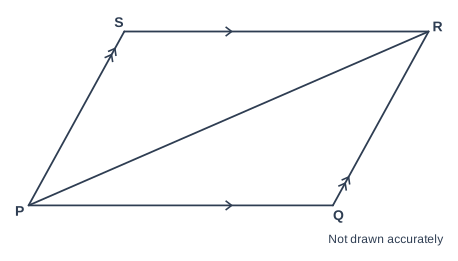
PQRS is a parallelogram: PQ is parallel to SR, and PS is parallel to QR. The diagonal PR is drawn, as the diagram shows.
Use congruent triangles to prove that PQ = SR. You must not use the fact that opposite sides of a parallelogram are equal. This proof shows why that fact is true.
Model answer
Angle QPR = angle SRP (alternate angles are equal, because PQ is parallel to SR) Angle QRP = angle SPR (alternate angles are equal, because QR is parallel to PS) PR is a side of both triangles. So triangles PQR and RSP are congruent (ASA). So PQ = RS, because matching sides of congruent triangles are equal.
Explanation
You only know about the parallel lines, so use them. The diagonal PR crosses both pairs of parallel sides and makes two pairs of alternate angles, and PR is the side between those angles in both triangles, so ASA proves the triangles congruent. Then every pair of matching sides is equal. A common mistake is to start with 'opposite sides of a parallelogram are equal': that assumes the very fact you are proving.
Mark scheme
1 mark
Angle QPR = angle SRP, because alternate angles are equal (PQ is parallel to SR)
Points 1 to 3 may be awarded for correct facts, but a full proof gives a reason in words for each fact. Max 3 if a reason is missing or wrong (for example 'Z angles' instead of 'alternate angles'). Max 2 if no reasons are given. Max 1 if the proof uses the fact that opposite sides of a parallelogram are equal (that is what is being proved). Accept 'alternate angles' as the reason. Measuring the diagram or checking one example is not a proof and scores 0.
1 mark
Angle QRP = angle SPR, because alternate angles are equal (QR is parallel to PS)
Accept 'alternate angles'. 'Z angles' is not an acceptable reason.
1 mark
PR is a side of both triangles, so triangles PQR and RSP are congruent (ASA: two angles and the side between them)
Accept 'PR is common' or 'PR is shared'. Accept AAS. SSS or SAS scores 0 for this point: PR is the only pair of sides known to be equal.
1 mark
So PQ = RS, because matching sides of congruent triangles are equal
Needs the congruent triangles from the point before. P matches R and Q matches S, so PQ matches RS.
Ready to try the rest? Every answer you write is marked against the mark scheme, so you can see exactly where the marks are.
Ctrl + Enter to check
Study HelperHints first, answers after you try
Stuck on this one? Ask for a hint and I’ll point you in the right direction, without giving the answer away. Once you’ve checked your answer, I’ll show you how the marks are awarded.