Level:
Correct: 0
Incorrect: 0
Marks: 0/0
Practice
Course:
Topics:
Year 9 Maths Smart practice A mixed round aimed at your weak spots
Unit 1
Number: standard form, indices and accuracy
Unit 2
Percentages and money
Unit 3
Algebraic expressions and proof
Unit 4
Equations and inequalities
Unit 5
Graphs and sequences
Unit 6
Ratio, proportion and rates
Unit 7
Congruence, similarity and transformations
Unit 8
Pythagoras' theorem and trigonometry
Unit 9
3D shapes and measures
Unit 10
Probability
Unit 11
Statistics
Avg
score:
–
Topics
done:
0/46

Tree diagrams

Practise 26 questions on Tree diagrams for Year 9 Maths. Write your answer and get it marked in seconds against the mark scheme, point by point, with the Study Helper on hand if you get stuck.

  • 26 questions
  • 1–5 marks each
  • Instant marking
  • No sign-up needed
20 questions, marked as you go

Sample questions with model answers

Here are 4 of the questions in this topic, each with a model answer, an explanation of why it earns the marks and the mark scheme.

Question 1

1 mark

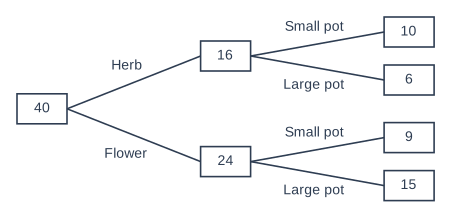
A garden centre sold 40 plants on Monday. Each plant was a herb or a flower. Each plant was sold in a small pot or a large pot.

The frequency tree shows this information.

Max is making a probability tree for one of these 40 plants chosen at random. What probability should he write on the branch for 'Herb'?

A frequency tree drawn from left to right with 2 stages of branches. It starts from a box containing 40 on the left. From the first box, branches labelled "Herb" and "Flower" lead to a box containing 16 and a box containing 24 respectively. From the "Herb" box, branches labelled "Small pot" and "Large pot" lead to a box containing 10 and a box containing 6 respectively. From the "Flower" box, branches labelled "Small pot" and "Large pot" lead to a box containing 9 and a box containing 15 respectively.

Model answer

16 of the 40 plants are herbs.
P(herb) \(= \dfrac{16}{40} = \dfrac{2}{5}\)

Explanation

A frequency tree shows how many are in each group; a probability tree shows what fraction of the group goes along each branch. 16 out of the 40 plants are herbs, so the probability is \(\dfrac{16}{40}\), which simplifies to \(\dfrac{2}{5}\). A common mistake is to copy the frequency, 16, onto the probability tree.

Mark scheme
  1. 1 mark

    \(\dfrac{16}{40}\)

    Accept any equivalent fraction (\(\dfrac{2}{5}\)), 0.4 or 40%. Do not accept 16 on its own (a frequency, not a probability), \(\dfrac{16}{24}\) (herbs compared with flowers), \(\dfrac{10}{16}\) (a second-stage branch), a ratio (16 : 24 or 2 : 3) or words ('2 in 5'). A correct answer with no working scores full marks.

Question 2

2 marks

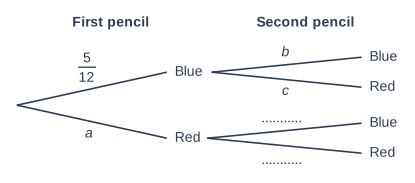
Fran has a box of 12 pencils. 5 of the pencils are blue and the rest are red. She takes a pencil at random, writes down its colour and puts it back. She then takes a second pencil at random.

Fran starts to make a tree diagram. Some of the probabilities are shown by letters.

Work out the values of \(a\), \(b\) and \(c\).

A probability tree diagram drawn from left to right with 2 stages of branches, headed "First pencil" and "Second pencil". Each branch has its outcome written at its end and its probability written beside it. First stage, 2 branches: "Blue" with probability 5/12, "Red" with probability a. After "Blue", the second stage branches are "Blue" with probability b, "Red" with probability c. After "Red", the second stage branches are "Blue" with probability left blank (a dotted line to fill in), "Red" with probability left blank (a dotted line to fill in).

Model answer

There are \(12 - 5 = 7\) red pencils, so \(a = \dfrac{7}{12}\).
The pencil is put back, so the second pick has the same probabilities as the first:
\(b = \dfrac{5}{12}\) and \(c = \dfrac{7}{12}\)

Explanation

There are 7 red pencils out of 12, so \(a = \dfrac{7}{12}\); check that \(\dfrac{5}{12} + \dfrac{7}{12} = 1\). Because Fran puts the first pencil back, the box is the same for the second pick, so the second set of branches repeats the first. A common mistake is to change to elevenths, which is only right when the pencil is not put back.

Mark scheme
  1. 1 mark

    \(a = \dfrac{7}{12}\); or all three correct values with no working

    From \(1 - \dfrac{5}{12}\), or 7 red pencils out of 12. Accept equivalent fractions, or decimals or percentages correct to 2 significant figures or better (0.58 or 58%). A ratio (7 : 5) or words ('7 in 12') do not score.

  2. 1 mark

    \(b = \dfrac{5}{12}\) and \(c = \dfrac{7}{12}\)

    Both needed. The pencil is put back, so the second pick has the same probabilities as the first. Accept equivalent fractions, or decimals or percentages correct to 2 significant figures or better (0.42 and 0.58, or 42% and 58%). A ratio (5 : 7) or words ('5 in 12') do not score. Do not accept \(b = \dfrac{4}{11}\) (as if the pencil were not put back). The values must be clearly matched to their letters. A correct answer with no working scores full marks.

Question 3

3 marks

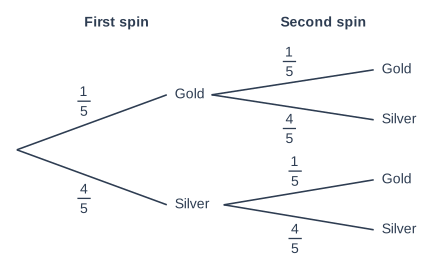
A fair spinner has five equal sections. One section is gold and the other four are silver. Kemi spins the spinner twice.

The tree diagram shows the probabilities.

Work out the probability that the spinner lands on gold at least once.

A probability tree diagram drawn from left to right with 2 stages of branches, headed "First spin" and "Second spin". Each branch has its outcome written at its end and its probability written beside it. First stage, 2 branches: "Gold" with probability 1/5, "Silver" with probability 4/5. After "Gold", the second stage branches are "Gold" with probability 1/5, "Silver" with probability 4/5. After "Silver", the second stage branches are "Gold" with probability 1/5, "Silver" with probability 4/5.

Model answer

P(silver, silver) \(= \dfrac{4}{5} \times \dfrac{4}{5} = \dfrac{16}{25}\)
P(gold at least once) \(= 1 - \dfrac{16}{25} = \dfrac{9}{25}\)

Explanation

'At least once' means once or twice. The only path with no gold is silver then silver, so the quickest way is 1 minus P(silver, silver). You can check by adding the three paths with gold: \(\dfrac{1}{25} + \dfrac{4}{25} + \dfrac{4}{25} = \dfrac{9}{25}\). A common mistake is to add \(\dfrac{1}{5} + \dfrac{1}{5}\) and get \(\dfrac{2}{5}\).

Mark scheme
  1. 1 mark

    \(\dfrac{4}{5} \times \dfrac{4}{5}\) or \(\dfrac{16}{25}\) (silver both times); or the correct answer \(\dfrac{9}{25}\) with no working

    Or the probability of one of the paths with gold, e.g. \(\dfrac{1}{5} \times \dfrac{1}{5} = \dfrac{1}{25}\) or \(\dfrac{1}{5} \times \dfrac{4}{5} = \dfrac{4}{25}\).

  2. 1 mark

    \(1 - \dfrac{16}{25}\) or \(\dfrac{1}{25} + \dfrac{4}{25} + \dfrac{4}{25}\)

    A complete method: 1 minus the probability of silver both times, or adding the three paths that include gold.

  3. 1 mark

    \(\dfrac{9}{25}\)

    Accept any equivalent fraction, 0.36 or 36%. Do not accept \(\dfrac{2}{5}\) (\(\dfrac{1}{5} + \dfrac{1}{5}\)), \(\dfrac{8}{25}\) (exactly once), \(\dfrac{1}{25}\), a ratio or words ('9 in 25'). A correct answer with no working scores full marks.

Question 4

4 marks

A science club enters two robots, Robot A and Robot B, in a contest. Each robot tries to complete an obstacle course.
The probability that Robot A completes the course is 0.6.
The probability that Robot B completes the course is 0.7.
The two robots work independently.

The club gets a certificate if at least one of its robots completes the course.

Lucy says, "The probability that the club gets a certificate is more than 0.8."

Is Lucy right? Show how you decide.

Model answer

P(Robot A does not complete) \(= 0.4\), P(Robot B does not complete) \(= 0.3\)
P(neither completes) \(= 0.4 \times 0.3 = 0.12\)
P(at least one completes) \(= 1 - 0.12 = 0.88\)
0.88 is more than 0.8, so Lucy is right.

Explanation

'At least one' is every outcome except 'neither', so work out the probability that neither robot completes the course and take it away from 1. Neither: \(0.4 \times 0.3 = 0.12\), so at least one: \(1 - 0.12 = 0.88\), which is more than 0.8. A common mistake is to work out \(0.6 \times 0.7 = 0.42\); that is the probability that both robots complete the course.

Mark scheme
  1. 1 mark

    \(0.4 \times 0.3\) (neither robot completes the course); or a correct product for a path where at least one robot completes: \(0.6 \times 0.7\), \(0.6 \times 0.3\) or \(0.4 \times 0.7\)

    Uses 0.4 or 0.3 for a robot not completing the course, or a correct path product. The method \(0.6 + 0.7 - 0.42 = 0.88\) (add the two probabilities, then take away the probability that both robots complete the course) is also correct and scores the first three marks.

  2. 1 mark

    0.12 (neither completes); or two correct path probabilities from 0.42, 0.18 and 0.28

  3. 1 mark

    P(at least one completes) \(= 1 - 0.12 = 0.88\) or \(0.42 + 0.18 + 0.28 = 0.88\)

    Accept 88%.

  4. 1 mark

    Yes, Lucy is right, because 0.88 is more than 0.8 (88% is more than 80%)

    Needs a correct comparison of their probability with 0.8 (or 80%). Follow through their probability if it comes from a correct method with one slip. 'Yes' alone, or 'Yes' with no probability worked out, scores 0 for this mark. 'Yes, because \(0.6 + 0.7 = 1.3\)' scores 0 for this mark. 'No, because \(0.6 \times 0.7 = 0.42\)' (the probability that both robots complete the course) scores 0 for this mark.

Ready to try the rest? Every answer you write is marked against the mark scheme, so you can see exactly where the marks are.

Topic notes

Tree diagrams

The big idea

A probability tree diagram shows the outcomes of two events, one after the other, with a probability on each branch. Multiply along a path (one route through the tree) to find its probability, and add the paths you want.

Reminder from Year 8: the probabilities of all the outcomes of an event add up to 1, so \(P(\text{not } A) = 1 - P(A)\).

Building a tree

The first set of branches shows the outcomes of the first event. From the end of each one, a second set shows the outcomes of the second event. Each set adds up to 1, so a missing branch is 1 take away the others.

When the events are independent (the first does not change the chances of the second), every second set of branches is the same. Putting an item back before the next pick (with replacement) makes the picks independent. If the first event changes the chances (a missed alarm makes being late more likely), the second sets are different.

Kezia cycles to school through two sets of traffic lights that work independently. The probability that she stops at the first set is 0.4, and at the second set 0.35.

A probability tree diagram drawn from left to right with 2 stages of branches, headed "First lights" and "Second lights". Each branch has its outcome written at its end and its probability written beside it. First stage, 2 branches: "Stop" with probability 0.4, "Go" with probability 0.6. After "Stop", the second stage branches are "Stop" with probability 0.35, "Go" with probability 0.65. After "Go", the second stage branches are "Stop" with probability 0.35, "Go" with probability 0.65. At the end of each path, a column lists the outcome and its probability, top to bottom: Stop, Stop, probability 0.14; Stop, Go, probability 0.26; Go, Stop, probability 0.21; Go, Go, probability 0.39.
Kezia's tree. Each path ends with its probability, found by multiplying along it: 0.4 × 0.35 = 0.14, and so on.

Multiply along, add between

  • To find the probability of one path, such as stop then go, multiply the probabilities on its branches.
  • When an outcome can happen along more than one path, add the path probabilities. Only one path can happen each time, so adding is allowed.

Find the probability that Kezia stops at exactly one set of lights. In 50 rides, how many times would you expect her to stop at both?

Stop then go: \(0.4 \times 0.65 = 0.26\)

Go then stop: \(0.6 \times 0.35 = 0.21\)

Exactly one stop: \(0.26 + 0.21 = 0.47\)

Stop at both: \(0.4 \times 0.35 = 0.14\), so on 50 rides expect about \(0.14 \times 50 = 7\) rides.

At least one

"At least one" means one or more. It is quickest to find the probability of none and take it away from 1:

\[ P(\text{at least one}) = 1 - P(\text{none}) \]

For Kezia, P(at least one stop) = 1 − P(go, go) \(= 1 - 0.39 = 0.61\).

Asha rolls a fair ten-sided dice, numbered 1 to 10, twice. She wins a token each time she rolls a number greater than 7. Work out the probability that she wins at least one token.

Greater than 7 means 8, 9 or 10, so P(win) = \(\dfrac{3}{10}\) and P(no win) = \(\dfrac{7}{10}\).

Multiply the tops and multiply the bottoms: P(no win, no win) = \(\dfrac{7}{10} \times \dfrac{7}{10} = \dfrac{49}{100}\)

P(at least one token) = \(1 - \dfrac{49}{100} = \dfrac{51}{100}\)

Frequency trees and probability trees

A frequency tree shows how many are in each group: the numbers after a split add up to the number before it. On a probability tree, each set of branches adds up to 1.

To turn a frequency tree into a probability tree, divide each number by the group it splits from, not by the grand total. If 80 people saw a film, 30 of them in 3D, and 12 of those bought popcorn, the 3D branch is \(\dfrac{30}{80}\) and the popcorn branch after it is \(\dfrac{12}{30}\).

Stretch: without replacement

When an item is not put back (without replacement), the second pick depends on the first: there is one item fewer, and one fewer of the kind taken first.

A probability tree diagram drawn from left to right with 2 stages of branches, headed "First prize" and "Second prize". Each branch has its outcome written at its end and its probability written beside it. First stage, 2 branches: "Win" with probability 3/10, "No win" with probability 7/10. After "Win", the second stage branches are "Win" with probability 2/9, "No win" with probability 7/9. After "No win", the second stage branches are "Win" with probability 3/9, "No win" with probability 6/9. At the end of each path, a column lists the outcome and its probability, top to bottom: Win, Win, probability 6/90; Win, No win, probability 21/90; No win, Win, probability 21/90; No win, No win, probability 42/90.
Sam's raffle tree. The first ticket is not put back, so every second branch is out of 9.

A class raffle has 10 tickets and Sam has 3 of them. Two tickets are picked at random, one for each prize, and the first is not put back. Find the probability that Sam wins exactly one prize.

9 tickets are left for the second prize. If Sam won the first, 2 of them are his; if not, 3 are.

Win then no win: \(\dfrac{3}{10} \times \dfrac{7}{9} = \dfrac{21}{90}\)

No win then win: \(\dfrac{7}{10} \times \dfrac{3}{9} = \dfrac{21}{90}\)

Exactly one prize: \(\dfrac{21}{90} + \dfrac{21}{90} = \dfrac{42}{90} = \dfrac{7}{15}\)

Remember

  • Each set of branches adds up to 1.
  • Multiply along a path; add the paths that give the outcome you want.
  • \(P(\text{at least one}) = 1 - P(\text{none})\).
  • Give probabilities as fractions, decimals or percentages, never as ratios.

Common mistakes

  • Adding along a path: stop then stop is \(0.4 \times 0.35 = 0.14\), not 0.75.
  • Using only one path for "exactly one": stop then go and go then stop both count.
  • Thinking every path is equally likely: four paths are a quarter each only when every branch is a half.
  • Keeping the same bottom numbers without replacement: Sam's second branches are out of 9, not 10.

Top tip

Write each path's probability at the end of the path, then check that they add up to 1. For Kezia: \(0.14 + 0.26 + 0.21 + 0.39 = 1\).

Study Helper Hints first, answers after you try

Stuck on this one? Ask for a hint and I’ll point you in the right direction, without giving the answer away. Once you’ve checked your answer, I’ll show you how the marks are awarded.