Practise 21 questions on Plans and elevations for Year 9 Maths. Write your answer and get it marked in seconds against the mark scheme, point by point, with the Study Helper on hand if you get stuck.
21 questions
1–5 marks each
Instant marking
No sign-up needed
20 questions, marked as you go
Sample questions with model answers
Here are 4 of the questions in this topic, each with a model answer, an explanation of why it earns the marks and the mark scheme.
Question 1
1 mark
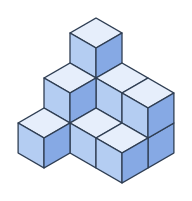
The diagram shows a solid made from cubes. Every stack of cubes goes all the way down to the table.
Count stack by stack, using the top of each stack to see how tall it is. Some cubes are hidden behind or under others, but every stack goes down to the table, so a stack 3 cubes high has 3 cubes even if you can only see the top one. Working row by row helps you not to miss any.
Mark scheme
1 mark
12
Seen from above, the back row has stacks of 3, 2 and 2 cubes, the middle row 2, 1 and 1, and the front row one stack of 1 cube on the left: \(7 + 4 + 1 = 12\). Do not accept 7 (the number of stacks) or answers that count only the cubes whose faces can be seen. A correct answer with no working scores full marks.
Question 2
2 marks
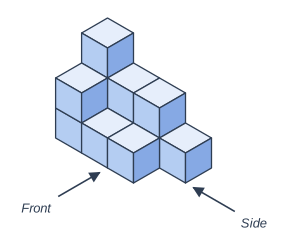
This solid is built from cubes. The arrows labelled Front and Side show the directions you look in for the front elevation and the side elevation.
How many squares does the front elevation have? How many squares does the side elevation have?
Model answer
Front elevation: the tallest stack in each column, from left to right, is 3, 2, 2 and 1. \(3 + 2 + 2 + 1 = 8\) squares Side elevation: the back row is 3 tall and the front row is 2 tall. \(3 + 2 = 5\) squares
Explanation
An elevation shows only what you can see from that direction. From the front, a short stack hidden behind a taller one adds nothing, so each column of the elevation is as tall as the tallest stack in that column. From the side, each row of the solid becomes one column. A common mistake is to count all the cubes instead of the squares you can see.
Mark scheme
1 mark
Front elevation: 8 (squares); or the correct answer 8 with no working
Columns of 3, 2, 2 and 1 squares: the tallest stack in each column. Do not accept 12 (the number of cubes). A correct answer with no working scores this mark.
1 mark
Side elevation: 5 (squares)
Columns of 2 and 3 squares (front row 2, back row 3): the tallest stack in each row. Award this mark even if the first answer is wrong. If two numbers are given without saying which is which, take them in the order asked (front, then side). A correct answer with no working scores full marks.
Question 3
3 marks
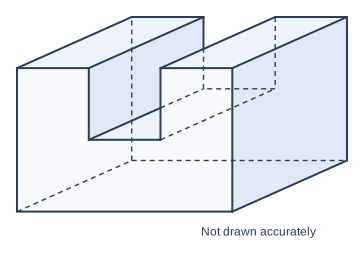
The diagram shows a prism. Its front face is a U shape with 8 sides. Hidden edges are shown as dashed lines.
How many faces does the prism have? How many edges does it have? How many vertices does it have?
Model answer
The front face has 8 sides and 8 corners. Faces: 2 ends + 8 rectangles = 10 Edges: 8 at the front + 8 at the back + 8 joining them = 24 Vertices: 8 at the front + 8 at the back = 16
Explanation
Use the shape of the cross-section. Each of its 8 sides becomes a rectangular face going back, and the two ends are extra faces. Each corner of the front face is a vertex, with a matching vertex at the back, and each pair is joined by an edge. You can check with Euler's rule: \(10 + 16 = 24 + 2\). A common mistake is to forget the 8 edges that run from the front to the back.
Mark scheme
1 mark
10 faces; or the correct answer 10 with no working
2 U-shaped ends and 8 rectangles. Do not accept 8 or 9.
1 mark
24 edges
8 round the front, 8 round the back and 8 going from front to back. Do not accept 16 or 20.
1 mark
16 vertices
8 at the front and 8 at the back. If the three numbers are given without saying which is which, take them in the order asked (faces, edges, vertices). A correct answer with no working scores full marks.
Question 4
4 marks
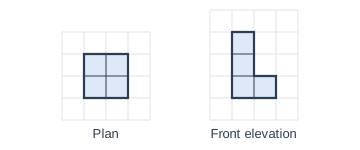
Owen makes a solid from 7 identical cubes. Every stack of cubes goes all the way down to the table.
The diagram shows the plan and the front elevation of the solid. The front is at the bottom of the plan.
Work out the number of squares in the side elevation of the solid.
Model answer
The plan has 4 squares, so there are 4 stacks. The right column of the front elevation is 1 tall, so both right-hand stacks have 1 cube: 2 cubes. The left-hand stacks have \(7 - 2 = 5\) cubes, and one of them is 3 tall, so they are 3 and 2. From the side you see the tallest stack in each row: 3 and 2. The side elevation has \(3 + 2 = 5\) squares.
Explanation
Use the number of cubes as an extra clue. The right-hand stacks can only be 1 cube each, so the left-hand stacks share the other 5 cubes, and one of them is 3. That forces 3 and 2. Whichever row the 3 is in, each row's tallest stack is on the left, so the side elevation is 3 and 2: 5 squares. A common mistake is to stop at the front elevation and give 4 squares (3 and 1), but the cubes must add up to 7.
Mark scheme
1 mark
The two stacks on the right each have 1 cube (the right column of the front elevation is 1 tall); or the correct answer 5 with no working
May be seen as 2 cubes in the right column.
1 mark
The two stacks on the left have \(7 - 2 = 5\) cubes altogether
1 mark
The left stacks are 3 and 2 (one must be 3 tall, from the front elevation)
Accept either order (back 3 and front 2, or back 2 and front 3).
1 mark
5 (squares)
The side elevation has columns of 3 and 2 squares (in either order). Do not accept 4 (columns of 3 and 1), 6 or 7. A correct answer with no working scores full marks.
Ready to try the rest? Every answer you write is marked against the mark scheme, so you can see exactly where the marks are.
Ctrl + Enter to check
Study HelperHints first, answers after you try
Stuck on this one? Ask for a hint and I’ll point you in the right direction, without giving the answer away. Once you’ve checked your answer, I’ll show you how the marks are awarded.