The big idea
In many problems you have to write the equation yourself before you can solve it. Choose a letter for one unknown, write everything else in terms of it, and use a fact from the problem to make an equation. Solve it, answer the question asked, with units, and check that the answer makes sense.
Reminder from Year 8: say what your letter stands for ("let \(w\) be the width in cm"), and use a bracket when something is added before it is multiplied: "add 3 to \(n\), then double" is \(2(n + 3)\).
Writing the facts in algebra
Consecutive numbers follow on from each other, like 14, 15, 16. These facts turn words into algebra:
| Situation | Write it as |
|---|
| three consecutive numbers | \(n\), \(n + 1\), \(n + 2\) |
| three consecutive even (or odd) numbers | \(n\), \(n + 2\), \(n + 4\) |
| everyone's age in 5 years' time | add 5 to every age |
| distance travelled | speed × time |
| total cost | fixed charge + price × number bought |
| angles inside a polygon | add up to (number of sides − 2) × 180° |
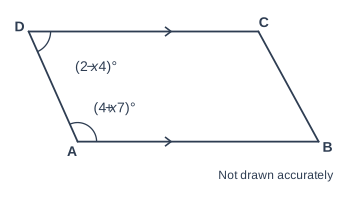
| alternate or corresponding angles on parallel lines | equal |
| co-interior angles on parallel lines | add up to 180° |
Shapes and angles
A rectangle is 3 times as long as it is wide. Its perimeter is 64 cm. Find its area.
Let the width be \(w\) cm. Then the length is \(3w\) cm.
Perimeter: \(w + 3w + w + 3w = 8w\), so \(8w = 64\) and \(w = 8\)
The rectangle is 8 cm wide and \(3 \times 8 = 24\) cm long.
Area: \(8 \times 24 = 192\) cm². Check: \(8 + 24 + 8 + 24 = 64\) ✓
The interior angles of a polygon add up to 900°. Five of its angles are \(x^\circ\) each, and all the others are \((x + 30)^\circ\) each. How many sides does the polygon have, and how big is its largest angle?
With \(n\) sides, the angles add up to \((n - 2) \times 180\). So \((n - 2) \times 180 = 900\), which gives \(n - 2 = 5\) and \(n = 7\).
There are 7 angles: five of \(x^\circ\) and two of \((x + 30)^\circ\). Add them: \(5x + 2(x + 30) = 900\)
Expand and collect like terms: \(7x + 60 = 900\), so \(7x = 840\) and \(x = 120\)
The largest angle is \(120 + 30 = 150^\circ\). Check: \(5 \times 120 + 2 \times 150 = 600 + 300 = 900\) ✓
Speed, money and ages
Turn each sentence into algebra, and keep the same units all the way through: change minutes to hours (half an hour is 0.5 hours, 20 minutes is \(\dfrac{1}{3}\) of an hour), or pounds to pence.
Ana cycles for some time at 18 km/h. She then walks for half an hour longer than that at 6 km/h. She travels 21 km altogether. How long does her whole journey take?
Let \(t\) be the cycling time in hours. The walk takes \(t + 0.5\) hours.
Distance = speed × time: \(18t + 6(t + 0.5) = 21\)
Expand: \(18t + 6t + 3 = 21\), so \(24t = 18\) and \(t = \dfrac{18}{24} = 0.75\)
She cycles for 0.75 hours (45 minutes) and walks for 1.25 hours: 2 hours in all.
Check: \(18 \times 0.75 = 13.5\) km and \(6 \times 1.25 = 7.5\) km, and \(13.5 + 7.5 = 21\) km ✓
Lena has £5 more than twice as much money as Sam. Lena gives Sam £15, and then they have the same amount. How much did each of them have at the start?
Let Sam have \(s\) pounds at the start. Then Lena has \(2s + 5\) pounds.
After the gift, Lena has \(2s + 5 - 15 = 2s - 10\) and Sam has \(s + 15\).
They are equal: \(2s - 10 = s + 15\), so \(s = 25\)
Sam had £25, and Lena had \(2 \times 25 + 5 = 55\), so £55. Check: after the gift, each has £40 ✓
Does the answer make sense?
- Answer the question asked, with units: if it asks for an area or an angle, the value of the letter is not the answer.
- A number of people or objects must be whole. If you get 12.5 people, the situation is impossible.
- A length must be positive. If \(x = 3\), a side of \((x - 5)\) cm would be \(-2\) cm, so no such shape exists.
- Fractions and negative numbers can be fine. \(3x = 20\) gives the exact answer \(x = \dfrac{20}{3}\). An age that is \(-4\) years from now means 4 years ago.
Common mistakes
- Using \(n + 1\) and \(n + 2\) for consecutive even numbers: even numbers go up in 2s, so use \(n + 2\) and \(n + 4\).
- Adding the years to only one age: in 4 years' time, every person is 4 years older.
- Leaving out a bracket: 3 hours at \((s + 5)\) km/h is \(3(s + 5)\) km, not \(3s + 5\).
- Mixing units: 15 minutes is 0.25 hours, not 0.15 hours.
Top tip
Write a "let" sentence first, then write every other quantity in terms of your letter before you form the equation. Finish with a sentence that answers the question, with units.