Practise 22 questions on Enlargement with fractional scale factors for Year 9 Maths. Write your answer and get it marked in seconds against the mark scheme, point by point, with the Study Helper on hand if you get stuck.
22 questions
1–5 marks each
Instant marking
No sign-up needed
20 questions, marked as you go
Sample questions with model answers
Here are 4 of the questions in this topic, each with a model answer, an explanation of why it earns the marks and the mark scheme.
Question 1
1 mark
The point \((8, 6)\) is enlarged by scale factor \(\dfrac{1}{2}\), with centre of enlargement the origin, \((0, 0)\).
Write down the coordinates of the image of the point.
Model answer
The point is 8 right and 6 up from the origin. Half of each move: 4 right and 3 up. The image is \((4, 3)\).
Explanation
With the centre at the origin, each move from the origin is multiplied by the scale factor. So multiply both coordinates by \(\dfrac{1}{2}\): \(8 \times \dfrac{1}{2} = 4\) and \(6 \times \dfrac{1}{2} = 3\). This quick rule only works when the centre is the origin. A common mistake is to multiply by 2 instead.
Mark scheme
1 mark
\((4, 3)\)
Accept 4, 3 without brackets. Do not accept (16, 12) (multiplying by 2) or (3, 4) (coordinates swapped).
Question 2
2 marks
The point \((14, 8)\) is enlarged with centre of enlargement \((-1, 3)\). Its image is the point \((5, 5)\).
Work out the scale factor of the enlargement.
Model answer
From the centre \((-1, 3)\) to \((14, 8)\): \(14 - (-1) = 15\) right and \(8 - 3 = 5\) up. From the centre to the image \((5, 5)\): \(5 - (-1) = 6\) right and \(5 - 3 = 2\) up. \(6 \div 15 = \dfrac{2}{5}\) and \(2 \div 5 = \dfrac{2}{5}\) The scale factor is \(\dfrac{2}{5}\).
Explanation
In an enlargement, the image is the scale factor times as far from the centre as the original point, in the same direction. So compare the moves from the centre, not the coordinates: the image is 6 right of the centre and the point is 15 right, and \(\dfrac{6}{15} = \dfrac{2}{5}\). The up moves give the same fraction, which checks the answer. A common mistake is to divide the coordinates of the image by the coordinates of the point, which only works when the centre is the origin.
Mark scheme
1 mark
Both moves from the centre found (to the point: 15 right and 5 up; to the image: 6 right and 2 up), or \(6 \div 15\) or \(2 \div 5\) seen; or the correct answer \(\dfrac{2}{5}\) with no working
Working from the centre of enlargement, not from the origin.
1 mark
\(\dfrac{2}{5}\)
Accept 0.4 or an equivalent fraction such as 6/15. Do not accept 5/2 or 2.5 (dividing the wrong way round), or 5/14 or 5/8 (dividing the coordinates of the image by those of the point, as if the centre were the origin). A correct answer with no working scores full marks.
Question 3
3 marks
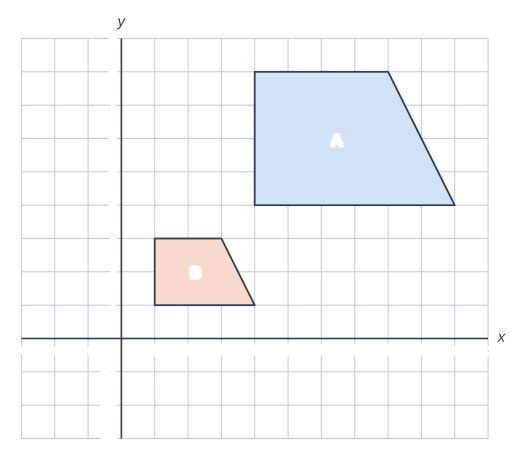
Here are shape A and shape B on a coordinate grid.
Describe fully the single transformation that maps A onto B.
Model answer
B is smaller than A. The bottom side of A is 6 units and the bottom side of B is 3 units, so the scale factor is \(\dfrac{1}{2}\). \((10, 4) \to (4, 1)\) is 6 left and 3 down. The same again from \((4, 1)\) reaches \((-2, -2)\). \((4, 4) \to (1, 1)\) is 3 left and 3 down. The same again also reaches \((-2, -2)\). Enlargement, scale factor \(\dfrac{1}{2}\), centre \((-2, -2)\).
Explanation
B is the same shape as A but smaller, so the transformation is an enlargement with a scale factor between 0 and 1. Divide a side of B by the matching side of A to get \(\dfrac{1}{2}\). For the centre, join matching corners and extend the lines until they meet: with scale factor \(\dfrac{1}{2}\), each corner of B is halfway between the centre and the matching corner of A. A common mistake is to leave out the centre, which a full description needs.
Mark scheme
1 mark
Enlargement
'Describe fully' needs three things: the word enlargement, the scale factor and the centre of enlargement. Naming more than one transformation (e.g. 'enlargement and translation') scores 0 in total.
1 mark
scale factor \(\dfrac{1}{2}\)
Accept 0.5 or 'a half'. Do not accept 2 or -1/2.
1 mark
centre \((-2, -2)\)
The centre must be given as coordinates. A correct description with no working scores full marks.
Question 4
4 marks
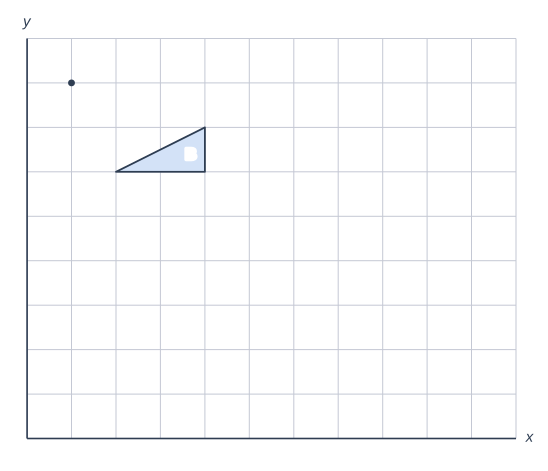
Triangle B and the point C are drawn on the grid. Triangle B is the image of triangle A after an enlargement with scale factor \(\dfrac{1}{3}\) and centre C. Triangle A is not shown.
Work out the coordinates of the vertices of triangle A. Describe fully the single transformation that maps triangle B back onto triangle A.
Model answer
C is \((1, 8)\). B is \(\dfrac{1}{3}\) of the way from C to A, so each vertex of A is 3 times as far from C. \((2, 6)\): 1 right, 2 down from C \(\to\) 3 right, 6 down: \((4, 2)\) \((4, 6)\): 3 right, 2 down \(\to\) 9 right, 6 down: \((10, 2)\) \((4, 7)\): 3 right, 1 down \(\to\) 9 right, 3 down: \((10, 5)\) B onto A: enlargement, scale factor 3, centre \((1, 8)\).
Explanation
Work backwards. An enlargement with scale factor \(\dfrac{1}{3}\) brings every point a third of the way towards C, so to undo it, go back out to 3 times the distance from C. That reverse move is itself an enlargement, with scale factor 3 and the same centre: scale factors \(\dfrac{1}{3}\) and 3 undo each other. A common mistake is to divide the moves by 3 again, which makes the triangle even smaller.
Mark scheme
1 mark
One vertex of A correct: \((4, 2)\), \((10, 2)\) or \((10, 5)\); or all the correct answers with no working
Each vertex of A is 3 times as far from C as the matching vertex of B, in the same direction.
1 mark
Two vertices of A correct
1 mark
All three vertices of A correct: \((4, 2)\), \((10, 2)\) and \((10, 5)\)
In any order. Coordinates in the form (x, y).
1 mark
Enlargement, scale factor 3, centre C \((1, 8)\)
'Describe fully' needs all three for this mark: the word enlargement, the scale factor 3 and the centre, (1, 8) or C. Do not accept scale factor 1/3. Naming two transformations scores 0 for this mark. A correct answer with no working scores full marks.
Ready to try the rest? Every answer you write is marked against the mark scheme, so you can see exactly where the marks are.
Ctrl + Enter to check
Study HelperHints first, answers after you try
Stuck on this one? Ask for a hint and I’ll point you in the right direction, without giving the answer away. Once you’ve checked your answer, I’ll show you how the marks are awarded.