Level:
Correct: 0
Incorrect: 0
Marks: 0/0
Practice
Course:
Topics:
Year 9 Maths Smart practice A mixed round aimed at your weak spots
Unit 1
Number: standard form, indices and accuracy
Unit 2
Percentages and money
Unit 3
Algebraic expressions and proof
Unit 4
Equations and inequalities
Unit 5
Graphs and sequences
Unit 6
Ratio, proportion and rates
Unit 7
Congruence, similarity and transformations
Unit 8
Pythagoras' theorem and trigonometry
Unit 9
3D shapes and measures
Unit 10
Probability
Unit 11
Statistics
Avg
score:
–
Topics
done:
0/46

Geometric proof and angle problems

Practise 21 questions on Geometric proof and angle problems for Year 9 Maths. Write your answer and get it marked in seconds against the mark scheme, point by point, with the Study Helper on hand if you get stuck.

  • 21 questions
  • 1–5 marks each
  • Instant marking
  • No sign-up needed
20 questions, marked as you go

Sample questions with model answers

Here are 4 of the questions in this topic, each with a model answer, an explanation of why it earns the marks and the mark scheme.

Question 1

1 mark

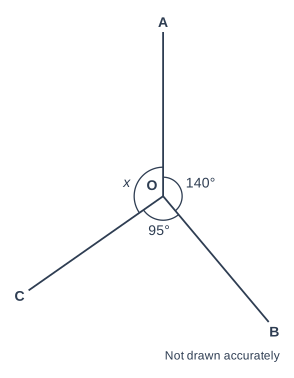
In the diagram, the three lines OA, OB and OC meet at O.

Lina writes, "\(x = 360 - 140 - 95 = 125^\circ\)"

Write down the reason Lina should give.

Geometry diagram, marked "Not drawn accurately". Line segments OA, OB and OC are drawn. Angle AOB is marked 140°. Angle BOC is marked 95°. Angle COA is marked x.

Model answer

Angles around a point add up to \(360^\circ\).

Explanation

The three angles fill the whole space around the point O, which is a full turn. So they add up to \(360^\circ\), and \(x\) is what is left after the other two. In a reason, name the fact in words: 'angles around a point add up to \(360^\circ\)'. A common mistake is to write 'angles on a straight line', which add up to \(180^\circ\).

Mark scheme
  1. 1 mark

    Angles around a point add up to \(360^\circ\)

    Accept 'angles at a point add up to 360' or 'a full turn is 360 degrees'. 'Angles in a circle' or 'angles on a straight line' scores 0.

Question 2

2 marks

In triangle ABC, angle C = angle A + angle B.

Prove that angle C is a right angle.

Model answer

The angles in a triangle add up to \(180^\circ\), so angle A + angle B + angle C \(= 180^\circ\).
Angle A + angle B = angle C, so angle C + angle C \(= 180^\circ\).
\(2 \times\) angle C \(= 180^\circ\)
Angle C \(= 90^\circ\), so angle C is a right angle.

Explanation

Start from a fact that is true for every triangle: its angles add up to \(180^\circ\). The question tells you that angle A + angle B is the same as angle C, so swap it in and solve. This works for every triangle with this property, which is what makes it a proof. A common mistake is to check one example, such as \(30^\circ\), \(60^\circ\) and \(90^\circ\): that shows only that one triangle works.

Mark scheme
  1. 1 mark

    A correct start: angle A + angle B + angle C \(= 180^\circ\) (the angles in a triangle add up to \(180^\circ\)), with angle A + angle B replaced by angle C, e.g. angle C + angle C \(= 180^\circ\)

    Accept letters, e.g. \(a + b + c = 180\) and \(c = a + b\), so \(2c = 180\). Checking one or more example triangles (such as \(30^\circ\), \(60^\circ\) and \(90^\circ\)) is not a proof and scores 0.

  2. 1 mark

    A complete proof: \(2 \times\) angle C \(= 180^\circ\), so angle C \(= 90^\circ\), which is a right angle

    The proof must use the angle sum of a triangle, not an example. A complete correct proof on its own scores both marks.

Question 3

3 marks

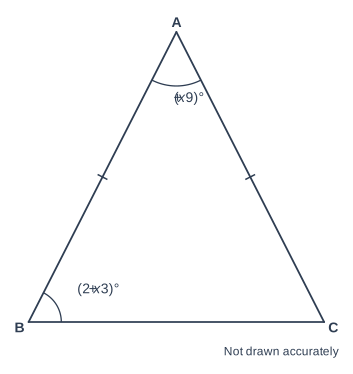
In the diagram, ABC is an isosceles triangle with AB = AC.

Work out the size of angle BAC.

Geometry diagram, marked "Not drawn accurately". Triangle ABC. Angle ABC is marked (2x + 3)°. Angle BAC is marked (x + 9)°. AB and AC are each marked with one short dash (equal lengths).

Model answer

AB = AC, so angle ACB = angle ABC \(= (2x + 3)^\circ\).
\((2x + 3) + (2x + 3) + (x + 9) = 180\)
\(5x + 15 = 180\)
\(5x = 165\), so \(x = 33\)
Angle BAC \(= 33 + 9 = 42^\circ\)

Explanation

The angle at C has no label, but it is equal to the angle at B because the triangle is isosceles. So the angle sum has two lots of \(2x + 3\). Solve, then substitute into \(x + 9\). Check: \(69 + 69 + 42 = 180\). A common mistake is to add only the two labelled angles: \((2x + 3) + (x + 9) = 180\) gives the wrong value of \(x\).

Mark scheme
  1. 1 mark

    Uses angle ACB \(= (2x + 3)^\circ\), e.g. \(2(2x + 3) + (x + 9) = 180\) or \(5x + 15 = 180\); or the correct answer \(42^\circ\) with no working

    The base angles of an isosceles triangle are equal.

  2. 1 mark

    \(x = 33\)

  3. 1 mark

    Angle BAC \(= 42^\circ\)

    Accept 42. Follow through their \(x + 9\). An answer of 33 or 69 scores 0 for this mark. A correct answer with no working scores full marks.

Question 4

4 marks

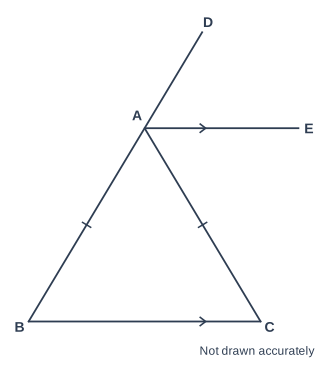
In the diagram, ABC is an isosceles triangle with AB = AC.
The side BA has been extended to D.
The line AE is parallel to BC.

Prove that angle DAE = angle EAC.
Give a reason for each step.

Geometry diagram, marked "Not drawn accurately". Triangle ABC. Line segments AD and AE are drawn. AB and AC are each marked with one short dash (equal lengths). AE and BC are each marked with an arrowhead (parallel lines).

Model answer

Angle DAE = angle ABC (corresponding angles are equal, because AE is parallel to BC)
Angle EAC = angle ACB (alternate angles are equal)
Angle ABC = angle ACB (base angles of an isosceles triangle are equal)
So angle DAE = angle EAC.

Explanation

Link each of the two angles at A to an angle inside the triangle using the parallel lines: angle DAE is corresponding to angle B, and angle EAC is alternate to angle C. The isosceles triangle then joins the two links together. This shows that AE cuts the exterior angle DAC exactly in half. A common mistake is to mix up corresponding and alternate angles.

Mark scheme
  1. 1 mark

    Angle DAE = angle ABC, because corresponding angles are equal (AE is parallel to BC)

    Points 1 to 3 may be awarded for correct facts, but a full proof gives a reason in words for each fact. Max 3 if a reason is missing or wrong (for example 'F angles' instead of 'corresponding angles'). Max 2 if no reasons are given. Accept 'corresponding angles' as the reason.

  2. 1 mark

    Angle EAC = angle ACB, because alternate angles are equal

    Accept 'alternate angles'. 'Z angles' is not an acceptable reason.

  3. 1 mark

    Angle ABC = angle ACB, because the base angles of an isosceles triangle are equal

    'Isosceles' on its own is not an acceptable reason: the reason must say which angles are equal.

  4. 1 mark

    Conclusion: so angle DAE = angle EAC

    Needs the mark before. Measuring the diagram or using example angles is not a proof and scores 0.

Ready to try the rest? Every answer you write is marked against the mark scheme, so you can see exactly where the marks are.

Topic notes

Geometric proof and angle problems

The big idea

Chain angle facts together, with a reason for every step, to find angles that look out of reach. Use algebra when angles are expressions, and prove facts: show that they are true for every shape, not just the ones you measured.

Reasons in words

A reason names the fact you used, in words. The facts you need most, from Years 7 and 8:

  • Angles on a straight line add up to 180°; angles around a point add up to 360°.
  • Vertically opposite angles are equal.
  • Angles in a triangle add up to 180°; in a quadrilateral, 360°.
  • The base angles of an isosceles triangle (the two angles opposite the equal sides) are equal.
  • Where a line crosses parallel lines, alternate angles (a Z shape) are equal, corresponding angles (an F shape) are equal and co-interior angles (a C shape) add up to 180°.
  • Opposite angles of a parallelogram are equal.

Problems with several steps

Mark each angle on the diagram as you find it, and write each step as "angle = value (reason)".

Flower bed ABCD is a trapezium with AB parallel to DC, crossed by a straight path AC. DA = DC, angle ADC = 112° and angle ABC = 75°. Find the angles marked x and y.

Trapezium ABCD with AB along the top and DC along the bottom, marked as parallel. A straight path joins A to C. DA and DC are each marked with one dash. Angle ADC is marked 112° and angle ABC is marked 75°. At A, the angle between AB and AC is marked x. At C, the angle between CA and CB is marked y.
The flower bed ABCD. AB is parallel to DC, DA = DC, and the path AC runs across the bed.

DA = DC, so angle DCA = angle DAC (base angles of an isosceles triangle are equal).

Angle DCA \(= (180 - 112) \div 2 = 34^\circ\) (angles in a triangle add up to 180°)

\(x = 34^\circ\) (alternate angles are equal: angle BAC = angle DCA, because AB is parallel to DC)

\(y = 180 - 75 - 34 = 71^\circ\) (angles in a triangle add up to 180°)

Angles with algebra

Use an angle fact to write an equation, solve it, then put the value back in to find each angle.

In a garden trellis, KLMN is a parallelogram with angle K = \((5x - 22)^\circ\) and angle L = \((3x + 10)^\circ\). Find all four angles.

KN is parallel to LM, so angles K and L are co-interior angles, which add up to 180°:

\((5x - 22) + (3x + 10) = 180\)

\(8x - 12 = 180\), so \(8x = 192\) and \(x = 24\)

Angle K \(= 5 \times 24 - 22 = 98^\circ\) and angle L \(= 3 \times 24 + 10 = 82^\circ\)

Angle M \(= 98^\circ\) and angle N \(= 82^\circ\) (opposite angles of a parallelogram are equal)

Check: \(98 + 82 + 98 + 82 = 360\)

Proof

Checking examples, however many, is not a proof: a proof uses facts that are true in every case, with a reason for each step.

The angles of a triangle add up to 180°. Take any triangle ABC, with angle \(a\) at B, \(b\) at C and \(c\) at A. Through A, add the line DE parallel to BC.

Triangle ABC with BC along the bottom and A at the top. A straight line through A, from D on the left to E on the right, is marked parallel to BC. BC is extended past C to F. Angle ABC is marked a, angle ACB is marked b and angle BAC is marked c. At A, angle DAB is marked a and angle EAC is marked b. At C, the exterior angle ACF is marked a + c.
Triangle ABC with the line DE through A parallel to BC, and BC extended to F. Alternate angles copy a and b up to A.
  • Angle DAB and \(a\) lie between DE and BC, on opposite sides of AB: they are alternate angles. Alternate angles are equal, so angle DAB \(= a\).
  • Angle EAC and \(b\) are alternate angles too, so angle EAC \(= b\).
  • At A, the angles \(a\), \(c\) and \(b\) are next to each other along DE, a straight line. Angles on a straight line add up to 180°, so \(a + b + c = 180^\circ\).

No sizes were used, so this works for every triangle.

The exterior angle of a triangle. Extending BC to F makes an exterior angle, ACF. Angle ACF and \(b\) lie on the straight line BF, so angle ACF \(= 180^\circ - b\), and the angle sum gives \(a + c = 180^\circ - b\). So angle ACF \(= a + c\): an exterior angle of a triangle equals the sum of the two interior opposite angles. (A line from C parallel to AB also works: by alternate and corresponding angles, it splits angle ACF into \(c\) and \(a\).)

Can a regular polygon have this angle?

A regular polygon with \(n\) sides has \(n\) equal exterior angles adding up to 360°, so \(n = 360 \div \text{exterior angle}\). The angle is possible only if \(n\) is a whole number.

Could a regular polygon have interior angles of 145°? What about 156°?

The interior and exterior angles lie on a straight line, so exterior = 180° − interior.

145°: the exterior angle is \(180 - 145 = 35^\circ\). \(35 \times 10 = 350\) and \(35 \times 11 = 385\), so \(360 \div 35\) is between 10 and 11: not a whole number, so no.

156°: the exterior angle is \(180 - 156 = 24^\circ\), and \(360 \div 24 = 15\). So yes: a regular polygon with 15 sides.

Common mistakes

  • Writing "Z angles" or "F angles" as a reason instead of "alternate angles are equal" or "corresponding angles are equal".
  • Writing just "isosceles": say "the base angles of an isosceles triangle are equal".
  • Taking away only one base angle: with base angles of 65°, the third angle is \(180 - 65 - 65\), which is 50°.
  • Stopping at \(x\): put it back into the expression to find the angle.
  • Checking a few examples and calling it a proof.

Top tip

Name each angle with three letters, the corner in the middle (angle ACB is at C), so everyone knows which angle you mean.

Study Helper Hints first, answers after you try

Stuck on this one? Ask for a hint and I’ll point you in the right direction, without giving the answer away. Once you’ve checked your answer, I’ll show you how the marks are awarded.