Level:
Correct: 0
Incorrect: 0
Marks: 0/0
Practice
Course:
Topics:
Year 9 Maths Smart practice A mixed round aimed at your weak spots
Unit 1
Number: standard form, indices and accuracy
Unit 2
Percentages and money
Unit 3
Algebraic expressions and proof
Unit 4
Equations and inequalities
Unit 5
Graphs and sequences
Unit 6
Ratio, proportion and rates
Unit 7
Congruence, similarity and transformations
Unit 8
Pythagoras' theorem and trigonometry
Unit 9
3D shapes and measures
Unit 10
Probability
Unit 11
Statistics
Avg
score:
–
Topics
done:
0/46

Pythagoras' theorem: finding the hypotenuse

Practise 27 questions on Pythagoras' theorem: finding the hypotenuse for Year 9 Maths. Write your answer and get it marked in seconds against the mark scheme, point by point, with the Study Helper on hand if you get stuck.

  • 27 questions
  • 1–5 marks each
  • Instant marking
  • No sign-up needed
20 questions, marked as you go

Sample questions with model answers

Here are 4 of the questions in this topic, each with a model answer, an explanation of why it earns the marks and the mark scheme.

Question 1

1 mark

A right-angled triangle has shorter sides of 30 cm and 40 cm.

Work out the length of the hypotenuse.

Model answer

\(c^2 = 30^2 + 40^2 = 900 + 1600 = 2500\)
\(c = \sqrt{2500} = 50\)
The hypotenuse is 50 cm.

Explanation

Square the two shorter sides, add the squares, then take the square root. You may spot that 30, 40, 50 is 10 times the Pythagorean triple 3, 4, 5, so the hypotenuse is \(10 \times 5 = 50\) cm. A common mistake is to add the two sides and get 70 cm.

Mark scheme
  1. 1 mark

    50 (cm)

    From \(30^2 + 40^2 = 900 + 1600 = 2500\) and \(\sqrt{2500} = 50\). Do not accept 70 (adding the sides) or 2500 (not square rooted). A correct answer with no working scores full marks.

Question 2

2 marks

You may use a calculator.

Megan walks 2.7 km due south. She then walks 3.6 km due west.

How far is Megan from her starting point, in a straight line?

Model answer

South and west are at right angles, so the straight-line distance \(d\) is the hypotenuse.
\(d^2 = 2.7^2 + 3.6^2 = 7.29 + 12.96 = 20.25\)
\(d = \sqrt{20.25} = 4.5\)
Megan is 4.5 km from her starting point.

Explanation

Due south and due west are at right angles, so Megan's walk makes the two shorter sides of a right-angled triangle. Her straight-line distance from the start is the hypotenuse. A quick sketch helps. A common mistake is to add 2.7 and 3.6: that is how far she walked, not how far she is from the start.

Mark scheme
  1. 1 mark

    \(2.7^2 + 3.6^2\) or \(7.29 + 12.96\) or 20.25; or the correct answer 4.5 km with no working

    Seeing that the straight-line distance is the hypotenuse of a right-angled triangle.

  2. 1 mark

    4.5 (km)

    Accept 4.5 km or 4500 m. Do not accept 6.3 km (adding the two distances). A correct answer with no working scores full marks.

Question 3

3 marks

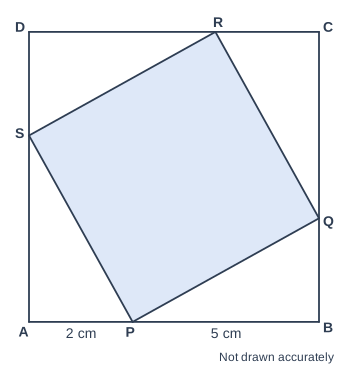
The diagram shows a large square ABCD with sides of 7 cm. Inside it is a shaded square PQRS.

The corners of the shaded square split each side of the large square into lengths of 2 cm and 5 cm. This makes four identical right-angled triangles around the shaded square, each with shorter sides of 2 cm and 5 cm.

Use the areas of the large square and the four triangles to work out the area of the shaded square. Then show that this area is equal to \(2^2 + 5^2\).

Geometry diagram, marked "Not drawn accurately". Square ABCD. Square PQRS (shaded). P lies on side AB. Q lies on side BC. R lies on side CD. S lies on side AD. Side AP is labelled 2 cm. Side PB is labelled 5 cm.

Model answer

Area of the large square: \(7 \times 7 = 49\) cm²
Area of one triangle: \(\dfrac{1}{2} \times 2 \times 5 = 5\) cm²
Area of the shaded square: \(49 - 4 \times 5 = 49 - 20 = 29\) cm²
\(2^2 + 5^2 = 4 + 25 = 29\), so the area of the shaded square is equal to \(2^2 + 5^2\).

Explanation

Each side of the shaded square is the hypotenuse of one of the triangles, so the area of the shaded square is the hypotenuse squared. Working it out from the diagram gives 29 cm², which is exactly \(2^2 + 5^2\). The same picture works for any right-angled triangle, and this is one way to see why Pythagoras' theorem is true. A common mistake is to take away the area of only one triangle instead of all four.

Mark scheme
  1. 1 mark

    Area of the large square \(7 \times 7 = 49\) (cm²), or area of one triangle \(\dfrac{1}{2} \times 2 \times 5 = 5\) (cm²)

    Working from the diagram.

  2. 1 mark

    Area of the shaded square \(49 - 4 \times 5 = 29\) (cm²)

    Accept \(49 - 20 = 29\). The first two marks need the area worked out from the large square and the four triangles: 29 cm² with no working, or found with Pythagoras' theorem, scores 0 for them.

  3. 1 mark

    \(2^2 + 5^2 = 4 + 25 = 29\), the same as the area of the shaded square

    Needs \(2^2 + 5^2 = 29\) seen and linked to the area. Working out the area only as \(2^2 + 5^2\) by Pythagoras' theorem scores this mark only, because it does not use the diagram to show the result.

Question 4

4 marks

You may use a calculator.

For safety, the foot of a ladder should be 1 m away from the wall for every 4 m that the top of the ladder reaches up the wall.

Kwame needs the top of a ladder to reach 6 m up a vertical wall. The ladder will stand on flat ground and be set up safely.

Ladders are sold in lengths of 5.5 m, 6 m, 6.5 m and 7 m. Which is the shortest of these ladders that Kwame can use? Show your working.

Model answer

Foot of the ladder: \(6 \div 4 = 1.5\) m from the wall
\(L^2 = 6^2 + 1.5^2 = 36 + 2.25 = 38.25\)
\(L = \sqrt{38.25} = 6.184...\) m
The ladder must be at least 6.18 m long, so the 6 m ladder is too short.
Kwame should use the 6.5 m ladder.

Explanation

First use the safety rule: 6 m up means 1.5 m out from the wall. The wall, the ground and the ladder make a right-angled triangle with the ladder as the hypotenuse, so the ladder must be about 6.18 m long. Of the lengths sold, 6.5 m is the shortest that is long enough. A common mistake is to choose the 6 m ladder, which would only reach 6 m up if it stood straight up against the wall.

Mark scheme
  1. 1 mark

    Distance of the foot of the ladder from the wall \(= 6 \div 4 = 1.5\) (m)

    Using the safety rule.

  2. 1 mark

    \(6^2 + 1.5^2\) or \(36 + 2.25\) or 38.25

    Follow through their distance from the wall.

  3. 1 mark

    Length of ladder needed \(= \sqrt{38.25} = 6.18...\) (m)

    Accept 6.2 or 6.18 or better.

  4. 1 mark

    The 6.5 m ladder

    Needs a correct length of about 6.18 m (or 6.2 m). Choosing 6.5 m with no working scores 0. The 6 m ladder is too short, because the ladder must be longer than the 6 m height it reaches.

Ready to try the rest? Every answer you write is marked against the mark scheme, so you can see exactly where the marks are.

Topic notes

Pythagoras' theorem: finding the hypotenuse

The big idea

Pythagoras' theorem is a rule that links the three sides of a right-angled triangle. If you know the two shorter sides, it gives you the longest side without measuring. It finds straight-line distances, such as the length of a ladder or how far you are from where you started.

Reminder from Years 7 and 8: squaring multiplies a number by itself, so \(7^2 = 49\). The square root undoes squaring: \(\sqrt{49} = 7\).

The hypotenuse

The hypotenuse is the side opposite the right angle. It is always the longest side. Find it first in every question: it is the side that does not touch the right-angle mark.

Pythagoras' theorem

Picture a square on each side of a right-angled triangle. The square on the hypotenuse has exactly the same area as the other two squares put together.

A right-angled triangle ABC with the right angle at C. Side CB is 3 cm, side CA is 4 cm and the hypotenuse AB is 5 cm. A square is built outwards on each side: the square on CB has an area of 9 cm², the square on CA has an area of 16 cm² and the square on the hypotenuse AB has an area of 25 cm². Drawn accurately.
A square on each side of a right-angled triangle: 9 cm² + 16 cm² = 25 cm².

Call the two shorter sides \(a\) and \(b\), and the hypotenuse \(c\). The area of a square is its side squared, so

\[ a^2 + b^2 = c^2 \]

In the figure, \(3^2 + 4^2 = 9 + 16 = 25 = 5^2\). This is true for every right-angled triangle: the two smaller squares could even be cut into pieces that fit exactly into the big square.

Finding the hypotenuse

  1. Square the two shorter sides.
  2. Add the squares. This gives \(c^2\).
  3. Find the square root. This gives \(c\).

Swimming across a river

Maya swims across a river 24 m wide. The current carries her along, so she lands 7 m downstream from the point straight opposite her start. Her path is a straight line. How far does she swim?

Across the river and along the bank are at right angles, so her path is the hypotenuse.

\(c^2 = 24^2 + 7^2 = 576 + 49 = 625\)

\(c = \sqrt{625} = 25\), so Maya swims 25 m.

Three whole numbers that fit the theorem, such as 3, 4, 5 or 5, 12, 13 or 7, 24, 25, make a Pythagorean triple. Multiplying a triple by any whole number gives another one: 6, 8, 10 is 3, 4, 5 doubled. Most pairs of sides do not give a whole-number hypotenuse, so you often need a calculator.

Using a calculator and rounding

Write down the full calculator value first, then round it to the accuracy the question asks for.

Geometry diagram, marked "Diagram NOT accurately drawn". Triangle FPT. Angle PFT is marked as a right angle (90°). Side FT is labelled 7.5 m. Side FP is labelled 3.2 m. Side TP is labelled w.
The flagpole FT, the ground FP and the wire TP make a right-angled triangle. The wire, w m, is the hypotenuse.

A wire holding up a flagpole

A flagpole stands on level ground. A straight wire runs from the top of the pole, 7.5 m up, to a peg 3.2 m from its foot. Find the length of the wire, \(w\) m, to 1 decimal place.

The right angle is at F, where the pole meets the ground, so the wire is the hypotenuse.

\(w^2 = 7.5^2 + 3.2^2 = 56.25 + 10.24 = 66.49\)

Key in 7.5 x² + 3.2 x² = then √ Ans = and the display shows 8.15414...

The second decimal digit is 5, so round up: the wire is 8.2 m long. Check: it is longer than 7.5 m.

A diagonal joins opposite corners. It cuts a rectangle into two right-angled triangles, and it is the hypotenuse of each.

A shortcut across a park

A rectangular park is 160 m long and 95 m wide. Zara walks from one corner to the opposite corner. How much shorter is the diagonal than the route along two edges? Give your answer to the nearest metre.

Along two edges: \(160 + 95 = 255\) m

Diagonal: \(d^2 = 160^2 + 95^2 = 25600 + 9025 = 34625\)

Key in √ 34625 = to get \(d = 186.077...\) m, then 255 − Ans = to get 68.922...

The first decimal digit is 9, so round up: the diagonal is 69 m shorter.

Ladders and journeys work the same way. A wall meets the ground at a right angle, so a leaning ladder is the hypotenuse. North and east are at right angles, so after walking north and then east, your straight-line distance from the start is the hypotenuse.

Remember

  • The hypotenuse is opposite the right angle and is the longest side.
  • Pythagoras' theorem: \(a^2 + b^2 = c^2\), where \(c\) is the hypotenuse.
  • To find the hypotenuse: square, add, then square root.

Common mistakes

  • Adding the sides instead of their squares: shorter sides of 6 cm and 8 cm give a hypotenuse of 10 cm, not 14 cm.
  • Stopping at \(c^2 = 100\) instead of taking the square root.
  • Square-rooting only the first number: \(\sqrt{6^2} + 8^2 = 70\). Add the squares first.
  • Mixing units: change 1.5 m and 80 cm into 1.5 m and 0.8 m before squaring.
  • Rounding too early, or to the wrong accuracy: 8.15 is not given to 1 decimal place.

Top tip

Check every answer. The hypotenuse must be longer than each of the other two sides, but less than the two of them added together: for 7.5 m and 3.2 m, between 7.5 m and 10.7 m.

Study Helper Hints first, answers after you try

Stuck on this one? Ask for a hint and I’ll point you in the right direction, without giving the answer away. Once you’ve checked your answer, I’ll show you how the marks are awarded.