Level:
Correct: 0
Incorrect: 0
Marks: 0/0
Practice
Course:
Topics:
Year 9 Maths Smart practice A mixed round aimed at your weak spots
Unit 1
Number: standard form, indices and accuracy
Unit 2
Percentages and money
Unit 3
Algebraic expressions and proof
Unit 4
Equations and inequalities
Unit 5
Graphs and sequences
Unit 6
Ratio, proportion and rates
Unit 7
Congruence, similarity and transformations
Unit 8
Pythagoras' theorem and trigonometry
Unit 9
3D shapes and measures
Unit 10
Probability
Unit 11
Statistics
Avg
score:
–
Topics
done:
0/46

Expanding binomials

Practise 26 questions on Expanding binomials for Year 9 Maths. Write your answer and get it marked in seconds against the mark scheme, point by point, with the Study Helper on hand if you get stuck.

  • 26 questions
  • 1–5 marks each
  • Instant marking
  • No sign-up needed
20 questions, marked as you go

Sample questions with model answers

Here are 4 of the questions in this topic, each with a model answer, an explanation of why it earns the marks and the mark scheme.

Question 1

1 mark

Which expression is equal to \((2x - 3)^2\)?

Choose your answer.

  • \(4x^2 + 9\)
  • \(4x^2 - 6x + 9\)
  • \(4x^2 - 12x + 9\)
  • \(2x^2 - 12x + 9\)

Model answer

\(4x^2 - 12x + 9\)
\((2x - 3)(2x - 3) = 4x^2 - 6x - 6x + 9 = 4x^2 - 12x + 9\)

Explanation

Write the square as two brackets, \((2x - 3)(2x - 3)\), and multiply every term. \(2x \times 2x = 4x^2\), the two middle terms are each \(-6x\), and \(-3 \times -3 = +9\). A common mistake is to square each term on its own and get \(4x^2 + 9\).

Mark scheme
  1. 1 mark

    \(4x^2 - 12x + 9\)

    \((2x - 3)(2x - 3) = 4x^2 - 6x - 6x + 9\). \(4x^2 + 9\) squares each term on its own and misses the middle terms; \(4x^2 - 6x + 9\) has only one of the two middle terms; \(2x^2 - 12x + 9\) does not square the 2 in \(2x\). More than one answer scores 0.

Question 2

2 marks

Expand and simplify \((2x - 5)(3x + 1)\)

Model answer

\((2x - 5)(3x + 1) = 6x^2 + 2x - 15x - 5\)
\(= 6x^2 - 13x - 5\)

Explanation

Multiply each term in the first bracket by each term in the second: \(2x \times 3x = 6x^2\), \(2x \times 1 = 2x\), \(-5 \times 3x = -15x\) and \(-5 \times 1 = -5\). Then collect the \(x\) terms: \(2x - 15x = -13x\). A common mistake is to write \(2x \times 3x\) as \(5x^2\); multiply the numbers and multiply the letters.

Mark scheme
  1. 1 mark

    Four terms with at least three correct, from \(6x^2\), \(+2x\), \(-15x\) and \(-5\); or the correct answer \(6x^2 - 13x - 5\) with no working

  2. 1 mark

    \(6x^2 - 13x - 5\)

    Accept the terms in any order. The \(x\) terms must be collected for this mark. Do not accept \(6x^2 + 13x - 5\), \(6x^2 - 5\) or \(5x^2 - 13x - 5\). A correct answer with no working scores full marks.

Question 3

3 marks

Expand and simplify \((2x + 5)(x - 1) + (x + 3)(x - 4)\)

Model answer

\((2x + 5)(x - 1) = 2x^2 - 2x + 5x - 5 = 2x^2 + 3x - 5\)
\((x + 3)(x - 4) = x^2 - 4x + 3x - 12 = x^2 - x - 12\)
Total: \(2x^2 + 3x - 5 + x^2 - x - 12 = 3x^2 + 2x - 17\)

Explanation

Expand each pair of brackets on its own, then add the results and collect like terms: \(2x^2 + x^2 = 3x^2\), \(3x - x = 2x\) and \(-5 - 12 = -17\). Take care with the signs: \(3 \times -4 = -12\). A common mistake is to lose a minus sign and finish with \(+7\) instead of \(-17\).

Mark scheme
  1. 1 mark

    \(2x^2 - 2x + 5x - 5\) or \(2x^2 + 3x - 5\) from the first pair of brackets; or the correct answer \(3x^2 + 2x - 17\) with no working

  2. 1 mark

    \(x^2 - 4x + 3x - 12\) or \(x^2 - x - 12\) from the second pair of brackets

  3. 1 mark

    \(3x^2 + 2x - 17\)

    Accept the terms in any order. The answer must be simplified, with like terms collected. Do not accept \(3x^2 + 2x + 7\) (from \(+12\) instead of \(-12\)) or \(3x^2 + 4x - 17\). A correct answer with no working scores full marks.

Question 4

4 marks

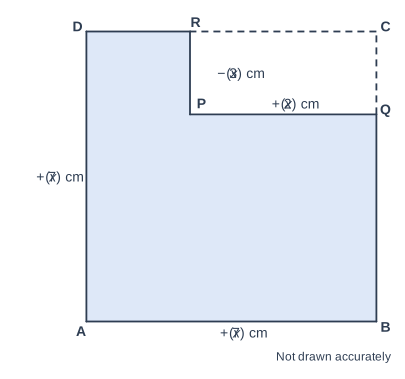
The diagram shows a square tile with sides of \((x + 7)\) cm.
A rectangular piece, \((x + 2)\) cm by \((x - 3)\) cm, has been removed from a corner of the tile.

Write an expression for the area of the shaded part. Give your answer in its simplest form.

Geometry diagram, marked "Not drawn accurately". Shaded L-shape ABQPRD (shaded). Dashed line segments QC and CR are drawn. Side AB is labelled (x + 7) cm. Side DA is labelled (x + 7) cm. Side PQ is labelled (x + 2) cm. Side RP is labelled (x − 3) cm.

Model answer

Square: \((x + 7)^2 = x^2 + 7x + 7x + 49 = x^2 + 14x + 49\)
Rectangle: \((x + 2)(x - 3) = x^2 - 3x + 2x - 6 = x^2 - x - 6\)
Shaded area \(= x^2 + 14x + 49 - (x^2 - x - 6)\)
\(= x^2 + 14x + 49 - x^2 + x + 6\)
\(= 15x + 55\) cm²

Explanation

The shaded area is the area of the square take away the area of the rectangle. Expand both, then put the rectangle's area in a bracket when you subtract it, so that every sign changes: \(-(x^2 - x - 6) = -x^2 + x + 6\). The \(x^2\) terms cancel, leaving \(15x + 55\). A common mistake is to change only the first sign and get \(13x + 43\).

Mark scheme
  1. 1 mark

    \((x + 7)^2\) expanded: \(x^2 + 14x + 49\); or the correct answer \(15x + 55\) with no working

    Accept \(x^2 + 7x + 7x + 49\).

  2. 1 mark

    \((x + 2)(x - 3)\) expanded: \(x^2 - x - 6\)

    Accept \(x^2 - 3x + 2x - 6\).

  3. 1 mark

    Their rectangle area subtracted from their square area with every sign handled correctly, for example \(x^2 + 14x + 49 - x^2 + x + 6\)

  4. 1 mark

    \(15x + 55\)

    Accept \(55 + 15x\) or \(5(3x + 11)\). Ignore units. Do not accept \(13x + 43\) (from \(-(x^2 - x - 6) = -x^2 - x - 6\)) or \(2x^2 + 13x + 43\) (from adding). A correct answer with no working scores full marks.

Ready to try the rest? Every answer you write is marked against the mark scheme, so you can see exactly where the marks are.

Topic notes

Expanding binomials

The big idea

A binomial is an expression with two terms, such as \(3x - 2\). Expanding a product of binomials means multiplying out the brackets. In Year 9 the brackets can have any number in front of \(x\), and you also square brackets and find missing numbers.

Reminder from Year 8: in \((x + 5)(x + 2)\), every term in the first bracket multiplies every term in the second: \(x^2 + 2x + 5x + 10 = x^2 + 7x + 10\).

Two methods for any two brackets

The grid method. Write one bracket along the top and the other down the side, each term with its sign. Each box is its row term times its column term.

FOIL. Multiply the First terms, the Outside terms, the Inside terms and the Last terms.

Both give the same four products. Then simplify by collecting the like terms. Each term keeps the sign in front of it.

Expand and simplify \((4x - 3)(2x + 7)\)

A multiplication grid for (4x − 3)(2x + 7), with 4x and −3 along the top and 2x and +7 down the side. The four boxes hold 8x², −6x, 28x and −21.
Each box is its row term times its column term: for example, 2x × 4x = 8x² and +7 × −3 = −21.

Add the four boxes: \(8x^2 - 6x + 28x - 21\)

Collect the \(x\) terms: \(-6x + 28x = 22x\)

Answer: \(8x^2 + 22x - 21\)

Squaring a bracket

\((x - 5)^2\) means \((x - 5)(x - 5)\), so write it as two brackets and expand:

\((x - 5)^2 = x^2 - 5x - 5x + 25 = x^2 - 10x + 25\)

There are always two equal middle terms, so \((a + b)^2 = a^2 + 2ab + b^2\).

Expand and simplify \((5k - 2)^2\)

Write it as \((5k - 2)(5k - 2)\) and use FOIL.

First: \(5k \times 5k = 25k^2\)

Outside: \(5k \times (-2) = -10k\)

Inside: \(-2 \times 5k = -10k\)

Last: \(-2 \times (-2) = +4\)

Answer: \(25k^2 - 10k - 10k + 4 = 25k^2 - 20k + 4\)

The difference of two squares

When two brackets are the same except that one has \(+\) and the other has \(-\), the middle terms cancel:

\((x + 4)(x - 4) = x^2 - 4x + 4x - 16 = x^2 - 16\)

The answer is one square take away another, so this pattern is called the difference of two squares:

\[ (a + b)(a - b) = a^2 - b^2 \]

For example, \((3y + 5)(3y - 5) = 9y^2 - 25\).

Two pairs of brackets

Expand each product on its own, then combine them. When a product is subtracted, keep its expansion in a bracket, because the minus sign changes every sign inside it.

A photo is \((3x + 2)\) cm by \((x + 4)\) cm. It is mounted on a card with a border 2 cm wide all round. Find the area of the border in its simplest form.

The card is 4 cm longer each way: \((3x + 6)\) cm by \((x + 8)\) cm.

Card: \((3x + 6)(x + 8) = 3x^2 + 24x + 6x + 48 = 3x^2 + 30x + 48\)

Photo: \((3x + 2)(x + 4) = 3x^2 + 12x + 2x + 8 = 3x^2 + 14x + 8\)

Border: \(3x^2 + 30x + 48 - (3x^2 + 14x + 8)\)

\(= 3x^2 + 30x + 48 - 3x^2 - 14x - 8 = 16x + 40\)

The area of the border is \((16x + 40)\) cm².

Check with \(x = 2\): the border is \(12 \times 10 - 8 \times 6 = 72\) cm², and \(16 \times 2 + 40 = 72\) ✓

Finding missing numbers

Two expressions are identical (written \(\equiv\)) when they are equal for every value of \(x\). Then their terms must match: the \(x^2\) terms, the \(x\) terms and the number terms. This is called comparing coefficients. A coefficient is the number in front of a letter.

\(a\) and \(b\) are whole numbers, and \((ax + 3)(2x + b) \equiv 6x^2 + 21x + 15\). Find \(a\) and \(b\).

Expand with the letters left in: \(2ax^2 + abx + 6x + 3b\)

Compare the \(x^2\) terms: \(2a = 6\), so \(a = 3\).

Compare the number terms: \(3b = 15\), so \(b = 5\).

Check the \(x\) terms: \(ab + 6 = 3 \times 5 + 6 = 21\) ✓

Stretch: three brackets

Expand two brackets first. Then multiply each term of that answer by each term of the third bracket, and collect like terms.

\((x + 1)(x + 2) = x^2 + 3x + 2\)

\((x^2 + 3x + 2)(x + 3) = x^3 + 3x^2 + 3x^2 + 9x + 2x + 6 = x^3 + 6x^2 + 11x + 6\)

Remember

  • Every term in one bracket multiplies every term in the other.
  • \((a + b)^2 = a^2 + 2ab + b^2\): do not forget the middle term.
  • \((a + b)(a - b) = a^2 - b^2\): the middle terms cancel.
  • Put a bracket round an expansion before you subtract it.

Common mistakes

  • Squaring each term on its own: \((x + 6)^2\) is \(x^2 + 12x + 36\), not \(x^2 + 36\).
  • Forgetting to square the number in front of \(x\): \((3x)^2 = 9x^2\), not \(3x^2\).
  • Adding instead of multiplying: \(4x \times 2x = 8x^2\), not \(6x^2\).
  • Losing a sign: \(-3 \times 2x = -6x\), not \(+6x\).
  • Changing only the first sign when you subtract: \(-(x^2 - 5x + 6) = -x^2 + 5x - 6\), not \(-x^2 - 5x + 6\).

Top tip

Check an expansion by putting a small number, such as \(x = 2\), into the question and into your answer. If the two values are different, there is a mistake somewhere.

Study Helper Hints first, answers after you try

Stuck on this one? Ask for a hint and I’ll point you in the right direction, without giving the answer away. Once you’ve checked your answer, I’ll show you how the marks are awarded.