Level:
Correct: 0
Incorrect: 0
Marks: 0/0
Practice
Course:
Topics:
Year 9 Maths Smart practice A mixed round aimed at your weak spots
Unit 1
Number: standard form, indices and accuracy
Unit 2
Percentages and money
Unit 3
Algebraic expressions and proof
Unit 4
Equations and inequalities
Unit 5
Graphs and sequences
Unit 6
Ratio, proportion and rates
Unit 7
Congruence, similarity and transformations
Unit 8
Pythagoras' theorem and trigonometry
Unit 9
3D shapes and measures
Unit 10
Probability
Unit 11
Statistics
Avg
score:
–
Topics
done:
0/46

Trigonometry: finding angles

Practise 23 questions on Trigonometry: finding angles for Year 9 Maths. Write your answer and get it marked in seconds against the mark scheme, point by point, with the Study Helper on hand if you get stuck.

  • 23 questions
  • 1–5 marks each
  • Instant marking
  • No sign-up needed
20 questions, marked as you go

Sample questions with model answers

Here are 4 of the questions in this topic, each with a model answer, an explanation of why it earns the marks and the mark scheme.

Question 1

1 mark

You may use a calculator.

Work out the value of \(\cos^{-1}\left(\dfrac{5}{8}\right)\).
Give your answer in degrees, correct to 1 decimal place.

Model answer

\(\dfrac{5}{8} = 0.625\)
\(\cos^{-1}(0.625) = 51.317...^\circ\)
\(51.3^\circ\) (1 d.p.)

Explanation

\(\cos^{-1}\left(\dfrac{5}{8}\right)\) means 'the angle whose cosine is \(\dfrac{5}{8}\)'. Press SHIFT and cos, then type the fraction (or 0.625) inside the bracket. The display shows 51.317..., which is \(51.3^\circ\) to 1 decimal place. \(\cos^{-1}\) does not mean \(\dfrac{1}{\cos}\): it is the inverse function that turns a cosine back into an angle.

Mark scheme
  1. 1 mark

    \(51.3^\circ\)

    Accept [51.25, 51.35] given to 1 decimal place, i.e. 51.3, with or without the degree sign. The unrounded value 51.317... scores 0, because the question asks for 1 decimal place. Do not accept 38.7 (from \(\sin^{-1}\)), 50.9 (from rounding \(\dfrac{5}{8}\) to 0.63 first) or 0.896 (radians). A correct answer with no working scores full marks.

Question 2

2 marks

You may use a calculator.

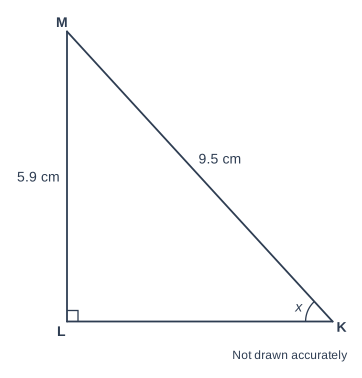
The diagram shows a right-angled triangle KLM. LM = 5.9 cm and KM = 9.5 cm.

Work out the size of angle \(x\).
Give your answer correct to 1 decimal place.

Geometry diagram, marked "Not drawn accurately". Triangle KLM. Angle KLM is marked as a right angle (90°). Angle MKL is marked x. Side LM is labelled 5.9 cm. Side KM is labelled 9.5 cm.

Model answer

\(\sin x = \dfrac{5.9}{9.5}\)
\(x = \sin^{-1}\left(\dfrac{5.9}{9.5}\right) = 38.393...^\circ\)
\(x = 38.4^\circ\) (1 d.p.)

Explanation

LM does not touch the angle \(x\), so it is opposite, and KM is the hypotenuse. Opposite and hypotenuse means SOH: \(\sin x = \dfrac{5.9}{9.5}\). Then \(x = \sin^{-1}\left(\dfrac{5.9}{9.5}\right)\). A common mistake is to round \(5.9 \div 9.5\) to 0.62 before using \(\sin^{-1}\), which gives 38.3 instead of 38.4.

Mark scheme
  1. 1 mark

    \(\sin x = \dfrac{5.9}{9.5}\) or \(\sin^{-1}\left(\dfrac{5.9}{9.5}\right)\); or the correct answer \(38.4^\circ\) with no working

    Choosing sin: 5.9 cm is opposite \(x\) and 9.5 cm is the hypotenuse. Max 1 if the answer is not given correct to 1 decimal place.

  2. 1 mark

    \(38.4^\circ\)

    Accept [38.35, 38.45] given to 1 decimal place, i.e. 38.4, with or without the degree sign. The unrounded value 38.393... scores the first mark only, and so does 38.3 (from rounding \(\dfrac{5.9}{9.5}\) to 0.62 first). Do not accept 51.6 (from \(\cos^{-1}\)) or 31.8 (from \(\tan^{-1}\)). A correct answer with no working scores full marks.

Question 3

2 marks

Imani says, "If I double the lengths of all three sides of a right-angled triangle, its two acute angles double as well."

Is Imani right? Explain how you know.

Model answer

No. Doubling every side is an enlargement with scale factor 2, so the new triangle is similar to the first one. Every ratio such as opposite \(\div\) adjacent stays the same, so the angles stay the same.

Explanation

Trigonometry works because the angles of a right-angled triangle depend only on the ratios of its sides, not on its size. Doubling all the sides keeps those ratios, so the angles do not change. There is a quick check too: the two acute angles add up to \(90^\circ\), so doubling both would give \(180^\circ\), with nothing left for the right angle.

Mark scheme
  1. 1 mark

    No, with a relevant but incomplete reason, e.g. 'the angles stay the same' with no reason, or 'the shape is just bigger'

    'No' on its own scores 0.

  2. 1 mark

    A complete correct reason: doubling every side is an enlargement with scale factor 2, so the new triangle is similar and its angles are the same / the ratios of the sides (such as opposite \(\div\) adjacent) do not change, so the angles do not change / the angles of a triangle add up to \(180^\circ\), so the acute angles cannot double (they would add up to \(180^\circ\) on their own)

    A complete correct reason on its own scores both marks. An example with numbers is enough only if it says why the angles do not change.

Question 4

4 marks

You may use a calculator.

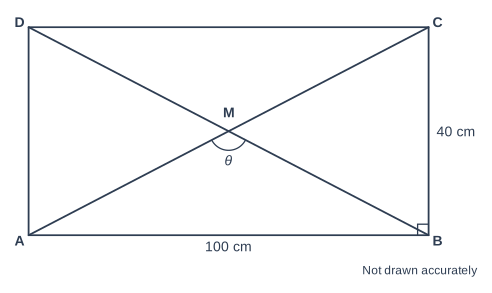
A rectangular flag, ABCD, is 100 cm long and 40 cm wide.
Two straight stripes run along its diagonals, AC and BD. They cross at M.

The diagram shows the flag. Work out the size of angle AMB, marked \(\theta\).
Give your answer correct to 1 decimal place.

Geometry diagram, marked "Not drawn accurately". Rectangle ABCD. Line segments AC and BD are drawn. M lies on AC and BD. Angle ABC is marked as a right angle (90°). Angle AMB is marked θ. Side AB is labelled 100 cm. Side BC is labelled 40 cm.

Model answer

In triangle ABC: \(\tan(\text{angle BAC}) = \dfrac{40}{100}\), so angle BAC \(= \tan^{-1}(0.4) = 21.801...^\circ\)
The diagonals of a rectangle are equal and cut each other in half, so MA = MB and triangle AMB is isosceles.
Angle MBA \(= 21.801...^\circ\)
\(\theta = 180 - 2 \times 21.801... = 136.397...^\circ\)
\(\theta = 136.4^\circ\) (1 d.p.)

Explanation

Angle AMB is not in a right-angled triangle, so start with one that is: triangle ABC has its right angle at B, and tan gives angle BAC. The diagonals of a rectangle are the same length and bisect each other, so triangle AMB is isosceles with two equal base angles. Then use the angle sum of a triangle. A common mistake is to give the acute angle between the diagonals, \(43.6^\circ\), but \(\theta\) is the obtuse one.

Mark scheme
  1. 1 mark

    \(\tan(\text{angle BAC}) = \dfrac{40}{100}\) or angle BAC \(= \tan^{-1}(0.4)\); or the correct answer \(136.4^\circ\) with no working

    Max 3 if the answer is not given correct to 1 decimal place. Another method: M is 50 cm along AB from A and 20 cm above it, so half of \(\theta\) is \(\tan^{-1}\left(\dfrac{50}{20}\right) = 68.19...^\circ\).

  2. 1 mark

    Angle BAC (= angle MAB) \(= 21.80...^\circ\) (or 21.8)

    Or half of \(\theta = 68.19...^\circ\) (or 68.2).

  3. 1 mark

    Triangle AMB is isosceles (MA = MB), so angle MBA is also \(21.80...^\circ\) and \(\theta = 180 - 2 \times 21.80...\)

    Or \(\theta = 2 \times 68.19...\). Follow through their angle.

  4. 1 mark

    \(136.4^\circ\)

    Accept [136.35, 136.45] given to 1 decimal place, i.e. 136.4, with or without the degree sign. Working with 21.8 or 68.2 also gives 136.4. The unrounded value 136.39... scores the first three marks only. Do not accept 43.6 (the acute angle between the diagonals) or 158.2. A correct answer with no working scores full marks.

Ready to try the rest? Every answer you write is marked against the mark scheme, so you can see exactly where the marks are.

Topic notes

Trigonometry: finding angles

The big idea

To find a side with trigonometry, you start from an angle. Now it is the other way round: you know two sides of a right-angled triangle and want an angle. Your calculator turns the ratio of the two sides back into an angle. This tells you how steep a ramp, a ladder or a hill is.

Reminder: SOH CAH TOA means \(\sin\theta = \dfrac{\text{opp}}{\text{hyp}}\), \(\cos\theta = \dfrac{\text{adj}}{\text{hyp}}\) and \(\tan\theta = \dfrac{\text{opp}}{\text{adj}}\).

Inverse functions

The inverse sine, written \(\sin^{-1}\), turns a sine back into an angle. Read \(\sin^{-1}(0.4)\) as "the angle whose sine is 0.4". If \(\sin x = 0.4\), then \(x = \sin^{-1}(0.4) = 23.6^\circ\) (to 1 d.p.). The inverse cosine, \(\cos^{-1}\), and the inverse tangent, \(\tan^{-1}\), work in the same way.

On most calculators you press SHIFT (or 2nd), then sin, cos or tan. Check first that the calculator is in degree mode (D or DEG on the screen). The small −1 means "inverse", not a power: \(\sin^{-1}\) does not mean \(1 \div \sin\).

Finding an angle

  1. Label the sides from the angle you want.
  2. The two sides you know choose the ratio: opposite and hypotenuse, sin; adjacent and hypotenuse, cos; opposite and adjacent, tan.
  3. Write the ratio as a fraction.
  4. Use the inverse function on the whole fraction. Do not round the fraction first.
  5. Round the angle as the question asks.

A wheelchair ramp

A wheelchair ramp up to a stage covers 8 m of floor, measured horizontally, and rises 0.6 m. Work out the angle between the ramp and the floor, correct to 1 decimal place.

The 0.6 m rise is opposite the angle and the 8 m is adjacent. Opposite and adjacent: tan.

\(\tan x = \dfrac{0.6}{8}\), so \(x = \tan^{-1}\left(\dfrac{0.6}{8}\right)\)

Key in SHIFT tan ( 0.6 ÷ 8 ) = and the display shows 4.289...

\(x = 4.3^\circ\) (1 d.p.). A small angle makes sense for a gentle ramp.

A cable car

A cable car travels 1.2 km along a straight cable and rises 380 m. Work out the angle between the cable and the horizontal, correct to 1 decimal place.

Use the same unit for both lengths: 1.2 km = 1200 m.

The cable is the hypotenuse and the rise is opposite the angle. Opposite and hypotenuse: sin.

\(\sin x = \dfrac{380}{1200}\), so \(x = \sin^{-1}\left(\dfrac{380}{1200}\right)\)

Key in SHIFT sin ( 380 ÷ 1200 ) = and the display shows 18.461...

\(x = 18.5^\circ\) (1 d.p.)

Geometry diagram, marked "Diagram NOT accurately drawn". Triangle GFT. Angle FGT is marked as a right angle (90°). Angle TFG is marked x. Side FT is labelled 5.4 m. Side GF is labelled 1.4 m. Side GT is labelled wall.
The ladder FT leans against the wall GT. The angle x is between the ladder and the ground.

Is the ladder safe?

Safety advice says a ladder should make an angle of about 75° with the ground. Jo puts a 5.4 m ladder on level ground with its foot 1.4 m from a wall. Find the angle \(x\) between the ladder and the ground, to the nearest degree. Is the ladder safe?

The ladder is the hypotenuse, and the 1.4 m along the ground is adjacent to \(x\). Adjacent and hypotenuse: cos.

\(\cos x = \dfrac{1.4}{5.4}\), so \(x = \cos^{-1}\left(\dfrac{1.4}{5.4}\right)\)

Key in SHIFT cos ( 1.4 ÷ 5.4 ) = and the display shows 74.973...

\(x = 75^\circ\) (to the nearest degree), so the ladder is safe.

Is your angle sensible?

Always ask whether your answer fits the picture.

  • The two angles that are not the right angle are both acute (less than 90°), and they add up to 90°.
  • The bigger of these two angles is opposite the longer of the two shorter sides.
  • A gentle slope (a small rise over a long distance) has a small angle. A steep slope has an angle close to 90°.
  • If \(\sin^{-1}\) or \(\cos^{-1}\) gives an error, your fraction is bigger than 1: the hypotenuse must go on the bottom.
  • If the ramp gives 0.0748..., the calculator is in radians (another unit for angles), not degrees.

Remember

  • \(\sin^{-1}\), \(\cos^{-1}\) and \(\tan^{-1}\) turn a ratio back into an angle.
  • The two sides you know decide the ratio.
  • Use degree mode, and round only the final angle.

Common mistakes

  • Pressing tan instead of \(\tan^{-1}\): tan 0.075 is not an angle.
  • Putting the fraction upside down: \(\tan^{-1}\left(\dfrac{8}{0.6}\right) = 85.7^\circ\) is the angle at the top of the ramp, not the angle with the ground.
  • Rounding the fraction first: \(\dfrac{380}{1200}\) rounded to 0.32 gives \(18.7^\circ\) instead of \(18.5^\circ\).
  • Finding the wrong angle: a ladder's angle with the wall is not its angle with the ground. Mark the angle you want first.
  • Choosing sin whenever the hypotenuse is given: sin needs the opposite side and the hypotenuse.

Top tip

Before you press =, picture the slope and make a guess: gentle or steep? If your answer does not match your guess, check which sides you used.

Study Helper Hints first, answers after you try

Stuck on this one? Ask for a hint and I’ll point you in the right direction, without giving the answer away. Once you’ve checked your answer, I’ll show you how the marks are awarded.