Level:
Correct: 0
Incorrect: 0
Marks: 0/0
Practice
Course:
Topics:
Year 9 Maths Smart practice A mixed round aimed at your weak spots
Unit 1
Number: standard form, indices and accuracy
Unit 2
Percentages and money
Unit 3
Algebraic expressions and proof
Unit 4
Equations and inequalities
Unit 5
Graphs and sequences
Unit 6
Ratio, proportion and rates
Unit 7
Congruence, similarity and transformations
Unit 8
Pythagoras' theorem and trigonometry
Unit 9
3D shapes and measures
Unit 10
Probability
Unit 11
Statistics
Avg
score:
–
Topics
done:
0/46

Quadratic graphs

Practise 26 questions on Quadratic graphs for Year 9 Maths. Write your answer and get it marked in seconds against the mark scheme, point by point, with the Study Helper on hand if you get stuck.

  • 26 questions
  • 1–5 marks each
  • Instant marking
  • No sign-up needed
20 questions, marked as you go

Sample questions with model answers

Here are 4 of the questions in this topic, each with a model answer, an explanation of why it earns the marks and the mark scheme.

Question 1

1 mark

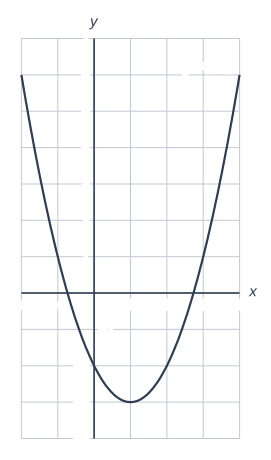
The diagram shows the graph of \(y = x^2 - 2x - 2\).

Write down the coordinates of the turning point of the graph.

A coordinate grid with x from −2 to 4 and y from −4 to 7; each grid square is 1 unit across, and the axes cross at the origin O. The curve labelled "y = x² − 2x − 2" is a U-shaped parabola: it crosses the x-axis at about (−0.7, 0) and about (2.7, 0); it crosses the y-axis at (0, −2); it has a minimum point, which can be read from the grid.

Model answer

The lowest point of the graph is at \(x = 1\), \(y = -3\).
The turning point is \((1, -3)\).

Explanation

The turning point of a U-shaped graph is its lowest point, where the curve stops going down and starts going up. Here it is at \((1, -3)\). A common mistake is to give the point where the graph crosses the \(y\)-axis, \((0, -2)\), which is not the lowest point.

Mark scheme
  1. 1 mark

    \((1, -3)\)

    The turning point is at a grid point, but each coordinate is still accepted within half a grid square: an \(x\)-coordinate any value in [0.5, 1.5] and a \(y\)-coordinate any value in [\(-3.5\), \(-2.5\)]. Accept \(x = 1\), \(y = -3\). Do not accept \((-3, 1)\) (coordinates reversed) or \((0, -2)\) (where the graph crosses the \(y\)-axis).

Question 2

2 marks

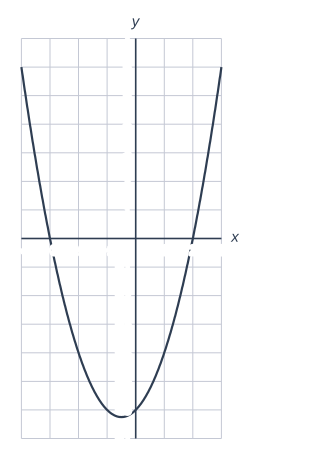
The diagram shows the graph of \(y = x^2 + x - 6\).

Use the graph to solve the equation \(x^2 + x - 6 = 0\).

A coordinate grid with x from −4 to 3 and y from −7 to 7; each grid square is 1 unit across, and the axes cross at the origin O. The curve labelled "y = x² + x − 6" is a U-shaped parabola: it meets the x-axis twice; these points can be read from the grid; it crosses the y-axis at (0, −6); it has a minimum point at (−0.5, −6.25).

Model answer

The solutions are where the graph crosses the \(x\)-axis (where \(y = 0\)).
\(x = -3\) and \(x = 2\)

Explanation

Solving \(x^2 + x - 6 = 0\) means finding the values of \(x\) that make \(y = 0\) on the graph. Those are the points where the curve crosses the \(x\)-axis. Read their \(x\)-coordinates: \(-3\) and 2. A common mistake is to read where the curve crosses the \(y\)-axis instead.

Mark scheme
  1. 1 mark

    \(x = -3\)

    Accept the point \((-3, 0)\). The crossings are at grid points, but each reading is still accepted within half a grid square: any value in [\(-3.5\), \(-2.5\)] for this solution and any value in [1.5, 2.5] for the other.

  2. 1 mark

    \(x = 2\)

    Accept any value in [1.5, 2.5]. Accept the point \((2, 0)\). Do not accept \(-6\) (where the graph crosses the \(y\)-axis). If more than two solutions are given, award 1 mark at most. A correct answer with no working scores full marks.

Question 3

2 marks

Ella says that the graph of \(y = x^2 - 3x - 10\) crosses the \(x\)-axis at the point \((-2, 0)\).

Is Ella right? Show how you decide.

Model answer

When \(x = -2\):
\(y = (-2)^2 - 3 \times (-2) - 10\)
\(y = 4 + 6 - 10 = 0\)
\(y = 0\), so \((-2, 0)\) is on the graph and on the \(x\)-axis. Ella is right.

Explanation

A graph crosses the \(x\)-axis where \(y = 0\). So substitute \(x = -2\) and see whether you get 0. Take care with the signs: \((-2)^2 = 4\) and \(-3 \times (-2) = +6\). A common mistake is to work out \(-3 \times (-2)\) as \(-6\), which gives \(-12\).

Mark scheme
  1. 1 mark

    Substitutes \(x = -2\): \((-2)^2 - 3 \times (-2) - 10\) or \(4 + 6 - 10\)

    Also award for a correct factorisation, \((x + 2)(x - 5)\). 'Yes' with no working scores 0.

  2. 1 mark

    Yes, because \(y = 0\) when \(x = -2\)

    Depends on the first mark. Also accept 'Yes, because \(x + 2 = 0\) when \(x = -2\)' after a correct factorisation.

Question 4

4 marks

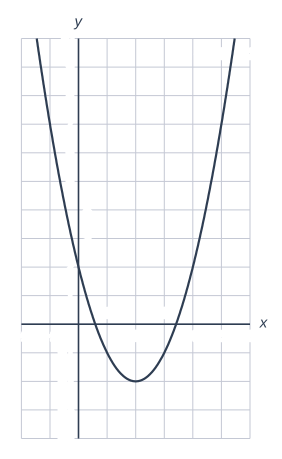
The diagram shows the graph of \(y = x^2 - 4x + 2\).

Use the graph to solve \(x^2 - 4x + 2 = 7\).

Then explain why the equation \(x^2 - 4x + 2 = -3\) has no solutions.

A coordinate grid with x from −2 to 6 and y from −4 to 10; each grid square is 1 unit across, and the axes cross at the origin O. The curve labelled "y = x² − 4x + 2" is a U-shaped parabola; its key points can be read from the grid.

Model answer

\(x^2 - 4x + 2 = 7\) where the graph is at height 7: \(x = -1\) and \(x = 5\).
The turning point of the graph is \((2, -2)\), so the lowest value of \(y\) is \(-2\).
\(-3\) is below \(-2\), so the graph never reaches \(y = -3\). The line \(y = -3\) does not meet the graph, so \(x^2 - 4x + 2 = -3\) has no solutions.

Explanation

Each equation asks where the graph of \(y = x^2 - 4x + 2\) is at a certain height. At \(y = 7\) a horizontal line meets the curve twice, giving two solutions. The lowest point of the curve is at \(y = -2\), so a horizontal line at \(y = -3\) is completely below the curve and never meets it. A common mistake is to solve \(x^2 - 4x + 2 = 0\) instead, by reading where the curve crosses the \(x\)-axis.

Mark scheme
  1. 1 mark

    \(x = -1\)

    Read where the graph is at height \(y = 7\). Both readings are at grid crossings, \((-1, 7)\) and \((5, 7)\), but each is still accepted within half a grid square: any value in [\(-1.5\), \(-0.5\)] for this value and any value in [4.5, 5.5] for the other. The answers may be given in either order.

  2. 1 mark

    \(x = 5\)

    Accept any value in [4.5, 5.5]. Do not accept the values where the graph crosses the \(x\)-axis (about 0.6 and 3.4), or 7 (the height, not a value of \(x\)).

  3. 1 mark

    A relevant but incomplete reason, e.g. 'the line \(y = -3\) does not meet the graph' or 'the graph does not go down to \(-3\)', with no mention of the lowest value

    'It has no solutions' on its own scores 0.

  4. 1 mark

    A complete correct reason: the lowest value of \(y\) on the graph is \(-2\) (the turning point is \((2, -2)\)), and \(-3\) is lower than \(-2\), so the line \(y = -3\) never meets the graph

    The lowest value of \(y\) read from the graph is accepted as any value in [\(-2.5\), \(-1.5\)], and the \(x\)-coordinate of the turning point as any value in [1.5, 2.5] (half a grid square either side). A complete correct reason on its own scores both of the last two marks.

Ready to try the rest? Every answer you write is marked against the mark scheme, so you can see exactly where the marks are.

Topic notes

Quadratic graphs

The big idea

In a quadratic, the highest power of \(x\) is \(x^2\): for example \(y = x^2 - 3\) or \(y = x^2 + 2x - 1\). Its graph is a smooth, symmetrical curve called a parabola. From the graph you can read its key points and solve equations.

Tables of values

Start with a table of values. Work out each term separately, then add. A negative number squared is positive: \((-4)^2 = 16\). On a calculator, put brackets round a negative number.

Work out \(y = x^2 + 6x + 8\) for each whole number \(x\) from \(-6\) to 0, and set out the results in a table.

For example, when \(x = -6\): \(y = (-6)^2 + 6 \times (-6) + 8 = 36 - 36 + 8 = 8\)

The other values work in the same way:

\(x\)−6−5−4−3−2−10
\(y\)830−1038

Check: the \(y\)-values go down, then back up in the same pattern either side of \(x = -3\).

On the graph, the points are joined with a smooth curve, not with straight lines.

Reading a quadratic graph

A coordinate grid with x from −7 to 1 and y from −3 to 9, with 5 small squares to each unit. It shows the U-shaped graph of y = x² + 6x + 8. Dots mark (−4, 0) and (−2, 0), where the curve crosses the x-axis, (0, 8), where it crosses the y-axis, and its lowest point, (−3, −1). A dashed vertical line, x = −3, goes through the lowest point. A horizontal line, y = 2, crosses the curve once on each side of x = −3.
The graph of y = x² + 6x + 8, with its turning point, roots, y-intercept and line of symmetry marked. Each small square is 0.2 units. The line y = 2 is used in the next example.
  • The turning point is where the curve turns round. For a U-shaped graph it is the lowest point, a minimum: here \((-3, -1)\).
  • The line of symmetry is the vertical line through the turning point. Its equation is \(x = -3\), because every point on it has \(x\)-coordinate \(-3\).
  • The roots are where the curve crosses the \(x\)-axis: here \(x = -4\) and \(x = -2\). The line of symmetry is halfway between them.
  • The curve crosses the \(y\)-axis at \((0, 8)\). This is not the turning point.

When the \(x^2\) term is negative, as in \(y = 6 - x^2\), the graph is upside down (∩). Its turning point is then the highest point, a maximum. Adding a number moves a graph up: \(y = x^2 + 2\) is \(y = x^2\) moved up 2.

Solving equations with a graph

The roots solve the equation \(x^2 + 6x + 8 = 0\), because \(y = 0\) on the \(x\)-axis. To solve \(x^2 + 6x + 8 = 2\) instead, read where the curve meets the horizontal line \(y = 2\). A horizontal line below the minimum point never meets the curve, so \(x^2 + 6x + 8 = -2\) has no solutions.

To estimate \(y\) for a given \(x\), go from \(x\) to the curve, then across to the \(y\)-axis. To find \(x\) for a given \(y\), go the other way: there are usually two answers.

Use the graph to estimate \(y\) when \(x = -0.5\). Then solve \(x^2 + 6x + 8 = 2\).

Go up from \(-0.5\) to the curve and across: \(y \approx 5.2\)

Check: \((-0.5)^2 + 6 \times (-0.5) + 8 = 0.25 - 3 + 8 = 5.25\) ✓

The line \(y = 2\) meets the curve at \(x \approx -4.7\) and \(x \approx -1.3\).

Check with symmetry: both answers are 1.7 from the line \(x = -3\) ✓

Stretch: quadratic graphs in real life

The path of a thrown ball, a jet of water and the curve of an arch are all ∩-shaped parabolas. The turning point gives the greatest height.

A graph of height in metres, from 0 to 5, against distance across in metres, from 0 to 8, with 2 small squares to each metre. The arch is an upside-down U-shaped curve that starts at (0, 0), rises to its highest point in the middle of the canal and comes back down to (8, 0). A shaded rectangle, the boat, has corners at (2, 0), (6, 0), (6, 2.5) and (2, 2.5).
The arch of a footbridge over a canal 8 m wide. The shaded rectangle is a boat 4 m wide and 2.5 m tall, in the middle of the canal.

The height of the arch, \(h\) m, at \(x\) m across the canal is \(h = 2x - 0.25x^2\). How high is the arch at its highest point? Can the boat pass under it?

From the graph, the turning point is \((4, 4)\), so the arch is 4 m high in the middle of the canal.

The boat is 4 m wide and centred on the line of symmetry \(x = 4\), so its sides are at \(x = 2\) and \(x = 6\).

At \(x = 2\): \(h = 2 \times 2 - 0.25 \times 2^2 = 4 - 1 = 3\) m. By symmetry, \(h = 3\) m at \(x = 6\) too.

The boat is 2.5 m tall and the arch is 3 m high at its sides, so it fits, with 0.5 m to spare.

Remember

  • A quadratic graph is a parabola: a U with a minimum when the \(x^2\) term is positive, a ∩ with a maximum when it is negative.
  • The line of symmetry is \(x = \) the \(x\)-coordinate of the turning point.
  • The roots are where the graph crosses the \(x\)-axis.
  • To solve "quadratic \(= k\)", read where the curve meets the line \(y = k\).

Common mistakes

  • Squaring a negative wrongly: \((-4)^2 = 16\), not \(-16\).
  • Doubling instead of squaring: when \(x = 3\), \(x^2 = 9\), not 6.
  • Giving where the curve crosses the \(y\)-axis as a root or as the turning point.
  • Writing the line of symmetry as \(y = -3\) or \((-3, -1)\). It is a vertical line: \(x = -3\).
  • Solving \(x^2 + 6x + 8 = 2\) by reading the \(x\)-axis instead of the line \(y = 2\), or giving only one answer.

Top tip

Use symmetry to check a table. Equal \(y\)-values come in pairs the same distance either side of the line of symmetry. A value that breaks the pattern is probably wrong.

Study Helper Hints first, answers after you try

Stuck on this one? Ask for a hint and I’ll point you in the right direction, without giving the answer away. Once you’ve checked your answer, I’ll show you how the marks are awarded.