
Level:
Correct: 0
Incorrect: 0
Marks: 0/0
Exam Practice
Course:
Topics:
Edexcel GCSE Geography B (Paper 2) Smart practice A mixed round aimed at your weak spots
Unit 4
Topic 4: The UK's evolving physical landscape
Unit 5
Topic 5: The UK's evolving human landscape
Unit 6
Topic 6: Geographical investigations
Avg
score:
–
Topics
done:
0/28

Urban core and rural periphery in the UK

Practise 26 exam-style questions on Urban core and rural periphery in the UK for Edexcel GCSE Geography B (Paper 2). Write your answer as you would in the exam and get it marked in seconds against the mark scheme, point by point, with the Study Helper on hand if you get stuck.

  • 26 questions
  • 1–12 marks each
  • Instant marking
  • No sign-up needed
20 questions, marked as you go

Sample questions with model answers

Here are 4 of the questions in this topic, each with a model answer, an explanation of why it earns the marks and the mark scheme an examiner would use.

Question 1

1 mark

State one way in which settlements in the UK's rural periphery are different from settlements in the urban core.

Model answer

Settlements in the rural periphery are mostly small villages, hamlets and isolated farms spread far apart, whereas the urban core has large cities joined into continuous built-up areas.

Explanation

One clear difference in the size, spacing or function of settlements earns the mark. Answers about how many people live there per km² describe population density, not settlement, so they do not answer this question.

Mark scheme
  1. 1 mark

    A valid difference, e.g. settlements in the rural periphery are small (villages, hamlets, isolated farms) rather than large towns and cities / they are scattered (dispersed) rather than forming continuous built-up areas (conurbations) / they have far fewer services and functions / buildings are lower density

    The answer must say something about settlements, and the difference must be clear (a statement about one area that implies the contrast is enough, e.g. 'in the rural periphery settlements are mostly small villages and isolated farms'). Do not credit population density or age structure on their own (the question is about settlements). Accept any other appropriate response.
Question 2

2 marks

Explain one way in which investment in transport infrastructure can reduce differences between the urban core and the rural periphery of the UK.

Model answer

Upgrading roads and railways cuts journey times between peripheral areas and the big cities. This lowers costs for businesses, so firms are more willing to set up in the periphery, creating jobs and reducing the gap in incomes.

Explanation

The first mark is for a clear improvement (faster or better links) and the second for explaining how it helps the periphery catch up, for example through investment, jobs or access to services. Naming a project such as HS2 earns nothing on its own.

Mark scheme
  1. 1 mark

    Identifies a valid way, e.g. faster / better road or rail links to the periphery / shorter journey times / better access to markets, jobs or services

    Examples: New or upgraded roads and railways cut journey times to the periphery (1) so firms can reach customers and suppliers more cheaply and are more likely to invest and create jobs there (1). Better rail links let people commute to jobs in cities (1) so they can earn higher wages without moving away, which slows out-migration of young people (1). Improved transport makes remote areas easier to visit (1) which brings tourist spending and jobs (1). Accept any other appropriate response.

  2. 1 mark

    Develops the way, e.g. explains how it brings jobs, investment, income or services to the periphery

    The development must explain how the same improvement reduces the gap between the core and the periphery. Do not credit naming a scheme (e.g. HS2) without explanation.

Question 3

4 marks

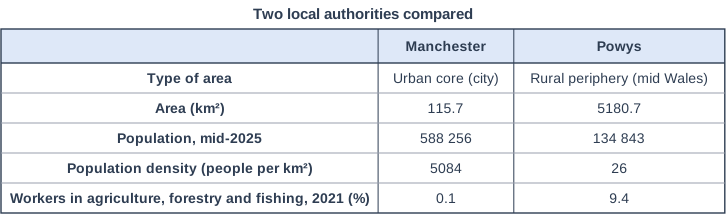
Study Figure 1, which shows information about Manchester and Powys (sources: ONS mid-year population estimates and Census 2021).

Using Figure 1, suggest two reasons why a much higher percentage of workers are employed in agriculture, forestry and fishing in Powys than in Manchester.

Two local authorities compared. Table with columns (row headings), "Manchester", "Powys". Type of area; Manchester: Urban core (city); Powys: Rural periphery (mid Wales) | Area (km²); Manchester: 115.7; Powys: 5180.7 | Population, mid-2025; Manchester: 588 256; Powys: 134 843 | Population density (people per km²); Manchester: 5084; Powys: 26 | Workers in agriculture, forestry and fishing, 2021 (%); Manchester: 0.1; Powys: 9.4.

Model answer

1. Powys covers a very large area (5180.7 km²) but has only 26 people per km², so most of the land is used for farms, moorland and forestry. This provides many jobs in agriculture and forestry, 9.4% of workers compared with 0.1% in Manchester.
2. Manchester is a densely populated city (5084 people per km²), so almost all its land is built on. Instead it has a wide range of jobs in services such as offices, shops and universities, so very few people work in farming.

Explanation

Each reason earns 1 mark and its development 1 more. At least one reason must use evidence from Figure 1, such as the area or density figures, or the answer is limited to 3 marks. The two reasons must be genuinely different, for example the amount of land in Powys and the built-up, service-based economy of Manchester.

Mark scheme
  1. 1 mark

    First reason, e.g. Powys has a very large area of land (5180.7 km²) with few people, so much of it is farmland and forest

    Max 3 if no data or evidence from Figure 1 is used. Examples: Powys covers 5180.7 km² with only 26 people per km² (1) so most land is farmland, moorland and forest that provide work in farming and forestry (1). Manchester is a densely populated city (5084 people per km²) (1) so almost all land is built on and there is no space for farming (1). The upland relief and wet climate of mid Wales suit sheep farming and forestry (1) which are major employers in a rural area with few other industries (1). Powys has few factories or offices (1) because it is far from large markets and has poor transport links, so farming remains a bigger share of jobs (1). Manchester has a wide range of service jobs in the city (1) so farming is a tiny share of employment (0.1%) (1). Accept any other appropriate response. The two reasons must be different.

  2. 1 mark

    Development of the first reason

    Evidence from Figure 1 (e.g. area, density, population or the 9.4% and 0.1% figures) may be used in either reason; it is needed in at least one reason for 4 marks.

  3. 1 mark

    Second, different reason, e.g. the physical environment of mid Wales suits livestock farming and forestry / there are few other industries / Manchester is almost completely built up

    Do not credit the same reason expressed in different words.

  4. 1 mark

    Development of the second reason

Question 4

4 marks

Explain one social consequence and one economic consequence of the older age structure of many areas in the UK's rural periphery.

Model answer

Social: Older people need more health and social care, but hospitals and GP surgeries in the rural periphery are often a long way away. This means long journeys for patients and pressure on local care services.
Economic: There are fewer people of working age, so local businesses find it hard to recruit staff. This can stop firms expanding and makes the area less attractive to new investment.

Explanation

Each consequence earns 1 mark and its development 1 more. The social and economic points must be clearly different; positive economic effects, such as spending by retired people, are also valid.

Mark scheme
  1. 1 mark

    A social consequence, e.g. greater demand for health and social care / schools close as there are fewer children / isolation of older people with poor public transport / fewer young people to support community activities

    Examples (social): More older people need health and social care (1) but hospitals and GP surgeries are often far away in the periphery, so journeys are long and services are stretched (1). There are fewer children (1) so village schools may close and families have to travel further, making the area less attractive to young families (1). Many older people do not drive (1) so they can become isolated if rural bus services are cut (1). Accept any other appropriate response.

  2. 1 mark

    Development of the social consequence

  3. 1 mark

    An economic consequence, e.g. smaller working-age labour force / firms struggle to recruit workers / higher costs of care for councils / spending by retired people supports local shops and care jobs

    Examples (economic): There are fewer people of working age (1) so local businesses struggle to recruit staff and may not expand or invest (1). Councils have to spend more on adult social care (1) leaving less money for other services such as roads (1). Retired people bring pensions and savings into the area (1) which supports local shops and creates jobs in care and leisure (1). Accept positive or negative consequences. Accept any other appropriate response.

  4. 1 mark

    Development of the economic consequence

    Do not credit the same point given as both social and economic (e.g. 'care costs' under both headings).

Ready to try the rest? Every answer you write is marked against the mark scheme, so you can see exactly where the marks are.

Study Helper Hints first, answers after you try

Stuck on this one? Ask for a hint and I’ll point you in the right direction, without giving the answer away. Once you’ve checked your answer, I’ll show you how the marks are awarded.