Level:
Correct: 0
Incorrect: 0
Marks: 0/0
Exam Practice
Course:
Topics:
Edexcel GCSE Geography B (Paper 2) Smart practice A mixed round aimed at your weak spots
Unit 4
Topic 4: The UK's evolving physical landscape
Unit 5
Topic 5: The UK's evolving human landscape
Unit 6
Topic 6: Geographical investigations
Avg
score:
–
Topics
done:
0/28

The UK's changing economy, globalisation and FDI

Practise 26 exam-style questions on The UK's changing economy, globalisation and FDI for Edexcel GCSE Geography B (Paper 2). Write your answer as you would in the exam and get it marked in seconds against the mark scheme, point by point, with the Study Helper on hand if you get stuck.

  • 26 questions
  • 1–12 marks each
  • Instant marking
  • No sign-up needed
20 questions, marked as you go

Sample questions with model answers

Here are 4 of the questions in this topic, each with a model answer, an explanation of why it earns the marks and the mark scheme an examiner would use.

Question 1

1 mark

Study Figure 1, which shows the value (stock) of foreign direct investment (FDI) in the UK, 2015 to 2024 (source: ONS, Foreign direct investment involving UK companies, 2024).

Calculate the increase in the value of FDI in the UK between 2015 and 2024.
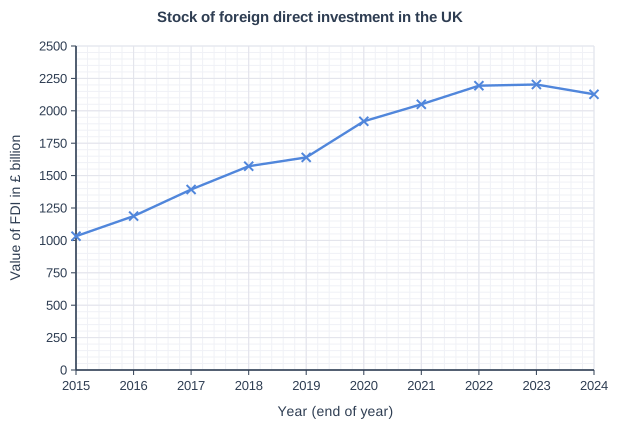
Stock of foreign direct investment in the UK. Line graph of Value of FDI in £ billion (y-axis, 0 to 2500) against year (end of year) (x-axis, 2015 to 2024). The line joins the points (2015, 1032.5), (2016, 1187.3), (2017, 1392.5), (2018, 1572.8), (2019, 1640.6), (2020, 1919.2), (2021, 2049.8), (2022, 2193.5), (2023, 2203), (2024, 2127.6).

Model answer

2128 - 1033 = about £1095 billion

Explanation

Read the values for 2015 (about £1030 billion) and 2024 (about £2125 billion) from the graph and subtract: an increase of about £1095 billion, so the stock of FDI roughly doubled. Because the values are read from the graph, answers from £1040 billion to £1150 billion are accepted. A common error is to give the 2024 value instead of the increase.

Mark scheme
  1. 1 mark

    About £1095 billion (2127.6 - 1032.5 = 1095.1; accept 1040 to 1150)

    Accept readings from 1005 to 1060 (£ billion) for 2015 and from 2100 to 2155 for 2024 (half a gridline either side of the plotted values). Award this mark for the answer worked correctly from the student's own readings within these ranges: answers from 1040 to 1150 (£ billion), e.g. 1095 from readings of 1030 and 2125; units are not required. Correct answer with no working scores full marks. Do not credit the 2024 value on its own or a percentage.
Question 2

2 marks

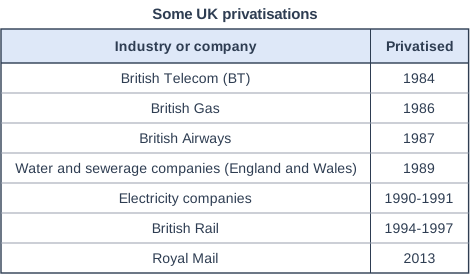
Study Figure 1, which shows some UK industries that were sold by the government to private owners (privatised; facts compiled for this course from published sources, 2026).

Explain one way in which privatisation has increased foreign direct investment (FDI) in the UK.

Some UK privatisations. Table with columns "Industry or company", "Privatised". Industry or company: British Telecom (BT); Privatised: 1984 | Industry or company: British Gas; Privatised: 1986 | Industry or company: British Airways; Privatised: 1987 | Industry or company: Water and sewerage companies (England and Wales); Privatised: 1989 | Industry or company: Electricity companies; Privatised: 1990-1991 | Industry or company: British Rail; Privatised: 1994-1997 | Industry or company: Royal Mail; Privatised: 2013.

Model answer

When industries such as electricity and water were privatised, their shares could be bought by anyone, including foreign companies. Many were later taken over by foreign firms; for example, EDF Energy is owned by the French company EDF, and this counts as foreign direct investment in the UK.

Explanation

One mark is for the way (foreign companies could buy privatised firms, or enter newly opened markets) and one for developing it, ideally with an example. Listing privatised companies from the figure without explaining the link to FDI earns no marks.

Mark scheme
  1. 1 mark

    Identifies a valid way, e.g. foreign companies and investors could buy shares in, or take over, privatised companies / privatised utilities were opened to competition, so foreign firms entered the UK market / foreign owners invest to upgrade networks

    Examples: Once industries such as electricity and water were sold, foreign companies were able to buy them (1) so many are now owned by foreign firms or investors, for example EDF Energy, owned by the French company EDF (1). Privatisation opened markets such as energy and telecommunications to competition (1) so foreign companies set up or bought UK businesses to compete for customers (1). Foreign owners of privatised companies invest money to modernise networks and power stations (1) which counts as FDI flowing into the UK (1). Accept any other appropriate response.

  2. 1 mark

    Develops the way

    The development must explain the same way. Do not credit simply naming a privatised company.

Question 3

3 marks

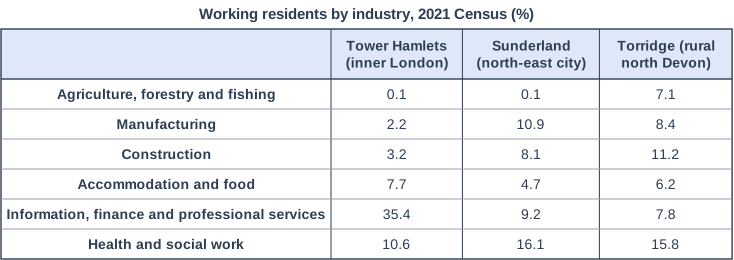
Study Figure 1, which shows the percentage of working residents employed in different industries in three local authorities, from the 2021 Census (source: ONS, Census 2021 industry table TS060).

Compare the employment structure of Tower Hamlets with the employment structure of Torridge.

Working residents by industry, 2021 Census (%). Table with columns (row headings), "Tower Hamlets (inner London)", "Sunderland (north-east city)", "Torridge (rural north Devon)". Agriculture, forestry and fishing; Tower Hamlets (inner London): 0.1; Sunderland (north-east city): 0.1; Torridge (rural north Devon): 7.1 | Manufacturing; Tower Hamlets (inner London): 2.2; Sunderland (north-east city): 10.9; Torridge (rural north Devon): 8.4 | Construction; Tower Hamlets (inner London): 3.2; Sunderland (north-east city): 8.1; Torridge (rural north Devon): 11.2 | Accommodation and food; Tower Hamlets (inner London): 7.7; Sunderland (north-east city): 4.7; Torridge (rural north Devon): 6.2 | Information, finance and professional services; Tower Hamlets (inner London): 35.4; Sunderland (north-east city): 9.2; Torridge (rural north Devon): 7.8 | Health and social work; Tower Hamlets (inner London): 10.6; Sunderland (north-east city): 16.1; Torridge (rural north Devon): 15.8.

Model answer

A much higher percentage of working residents in Tower Hamlets work in information, finance and professional services (35.4%) than in Torridge (7.8%), over four times as many. In contrast, Torridge has far more people in agriculture, forestry and fishing (7.1% compared with 0.1%). Torridge also has higher percentages in manufacturing (8.4% compared with 2.2%) and construction (11.2% compared with 3.2%).

Explanation

Each mark needs a statement comparing both places, ideally with data from both. Reasons for the differences are not asked for, and writing about one place then the other without comparing does not score.

Mark scheme
  1. 1 mark

    A valid comparative point, e.g. a much higher percentage work in information, finance and professional services in Tower Hamlets (35.4%) than in Torridge (7.8%)

    Award 1 mark for each valid comparative point, up to 3 marks (any three of these points or other valid comparisons). Comparisons may use manipulated data, e.g. 'over four times as many in information, finance and professional services'. Do not credit data lifts directly from the figure without a comparison. Do not credit explanation.

  2. 1 mark

    A second comparative point, e.g. agriculture, forestry and fishing employs 7.1% in Torridge but only 0.1% in Tower Hamlets

  3. 1 mark

    A third comparative point, e.g. Torridge has a higher percentage in manufacturing (8.4% compared with 2.2%) / construction (11.2% compared with 3.2%) / health and social work (15.8% compared with 10.6%) / Tower Hamlets has slightly more in accommodation and food (7.7% compared with 6.2%)

    Accept any other valid comparison, including an overall comparison, e.g. 'Tower Hamlets is dominated by quaternary and business services whereas Torridge has a more mixed structure with more primary and secondary jobs'.

Question 4

4 marks

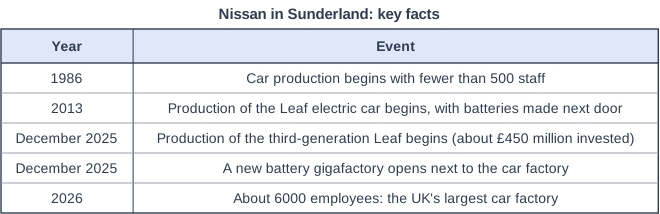
Study Figure 1, which shows information about the Nissan car factory in Sunderland, in north-east England (facts compiled for this course from GOV.UK and news reports, 2026).

Using Figure 1, explain two ways in which investment by Nissan has benefited the North East.

Nissan in Sunderland: key facts. Table with columns "Year", "Event". Year: 1986; Event: Car production begins with fewer than 500 staff | Year: 2013; Event: Production of the Leaf electric car begins, with batteries made next door | Year: December 2025; Event: Production of the third-generation Leaf begins (about £450 million invested) | Year: December 2025; Event: A new battery gigafactory opens next to the car factory | Year: 2026; Event: About 6000 employees: the UK's largest car factory.

Model answer

1. Nissan has grown from fewer than 500 workers in 1986 to about 6000 in 2026. This has given well-paid jobs to people in an area that had lost many jobs when coal mines and shipyards closed.
2. Nissan has invested in new technology, making the Leaf electric car since 2013 and investing about £450 million in the third-generation Leaf, with a battery plant and a gigafactory next door. This gives local workers skills in low-carbon industries and attracts further investment, making jobs more secure for the future.

Explanation

Each way earns 1 mark and its development 1 more; at least one way must use evidence from Figure 1 for full marks. Good answers link the benefits to the North East's history of deindustrialisation and to the multiplier effect.

Mark scheme
  1. 1 mark

    First way, e.g. created thousands of direct jobs / supported jobs in supplier firms and local services (positive multiplier) / brought new technology and skills such as electric car and battery production / attracted further investment such as the battery gigafactory

    Max 3 if no data or evidence from Figure 1 is used. Examples: Nissan employs about 6000 people (1) which replaced some of the jobs lost when coal mining and shipbuilding declined in the North East (1). Workers spend their wages in local shops and services, and suppliers make parts for the factory (1) creating more jobs through the positive multiplier effect (1). The factory has made electric cars since 2013, with batteries made next door (1) so local workers gain new skills in modern, low-carbon technology (1). Continued investment, such as about £450 million for the third-generation Leaf (1), makes the jobs more secure for the future (1). The battery gigafactory next to the plant (1) brings further investment and jobs to the area (1). Accept any other appropriate response. The two ways must be different.

  2. 1 mark

    Development of the first way

  3. 1 mark

    Second, different way

    Evidence from Figure 1 is needed in at least one way for 4 marks.

  4. 1 mark

    Development of the second way

Ready to try the rest? Every answer you write is marked against the mark scheme, so you can see exactly where the marks are.

Study Helper Hints first, answers after you try

Stuck on this one? Ask for a hint and I’ll point you in the right direction, without giving the answer away. Once you’ve checked your answer, I’ll show you how the marks are awarded.