
Level:
Correct: 0
Incorrect: 0
Marks: 0/0
Exam Practice
Course:
Topics:
Edexcel GCSE Geography B (Paper 2) Smart practice A mixed round aimed at your weak spots
Unit 4
Topic 4: The UK's evolving physical landscape
Unit 5
Topic 5: The UK's evolving human landscape
Unit 6
Topic 6: Geographical investigations
Avg
score:
–
Topics
done:
0/28

Rural challenges and diversification

Practise 26 exam-style questions on Rural challenges and diversification for Edexcel GCSE Geography B (Paper 2). Write your answer as you would in the exam and get it marked in seconds against the mark scheme, point by point, with the Study Helper on hand if you get stuck.

  • 26 questions
  • 1–12 marks each
  • Instant marking
  • No sign-up needed
20 questions, marked as you go

Sample questions with model answers

Here are 4 of the questions in this topic, each with a model answer, an explanation of why it earns the marks and the mark scheme an examiner would use.

Question 1

1 mark

State one leisure activity that a farm could offer to visitors as a way of diversifying.

Model answer

Pony trekking on the farm's land and nearby bridleways.

Explanation

Farm diversification can take the form of farm shops, accommodation or leisure activities. This question asks for a leisure activity, so the answer must be something visitors do for fun or recreation, such as riding, fishing or a petting farm; holiday cottages and farm shops are other kinds of diversification.

Mark scheme
  1. 1 mark

    Any valid leisure activity, e.g. horse riding or pony trekking / fishing lakes / mountain-bike or walking trails / clay pigeon shooting / paintball / a petting farm or farm visits / pick-your-own fruit / a maze

    One mark for one valid leisure activity. Do not credit accommodation (e.g. holiday cottages, glamping) or a farm shop on their own: these are other types of diversification, not leisure activities. Accept any other appropriate response.
Question 2

2 marks

Explain one reason why it is difficult to provide healthcare for people in sparsely populated rural areas.

Model answer

People in sparsely populated areas are spread over a large area, so a local surgery has few patients and each patient costs more to treat, which makes it expensive for the NHS to keep small surgeries open.

Explanation

One mark is for the reason (low population density, distance, recruitment, cost) and one for explaining why it makes healthcare harder or more expensive to provide. Saying only that there are no hospitals in the countryside does not explain the difficulty.

Mark scheme
  1. 1 mark

    Identifies a valid reason, e.g. few patients spread over a large area / high cost per patient / difficult to recruit doctors and nurses / long distances for ambulances and home visits / ageing population with more health needs

    Examples: People are spread thinly over a large area (1), so a surgery or hospital serves few patients and costs more per patient to run (1). Ambulances and community nurses must travel long distances on narrow roads (1), so response times are slower and fewer visits can be made each day (1). It is hard to attract doctors to work in remote areas (1) because there are fewer opportunities and facilities for them and their families (1). Accept any other appropriate response.

  2. 1 mark

    Develops the reason

    Do not credit 'there are no hospitals' with no explanation.

Question 3

3 marks

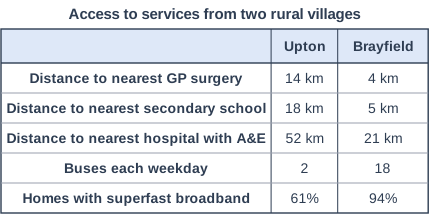
Study Figure 1, which shows access to services from two villages in a rural area (data written for this course).

Compare access to services in Upton and Brayfield.

Use data from Figure 1 in your answer.

Access to services from two rural villages. Table with columns (row headings), "Upton", "Brayfield". Distance to nearest GP surgery; Upton: 14 km; Brayfield: 4 km | Distance to nearest secondary school; Upton: 18 km; Brayfield: 5 km | Distance to nearest hospital with A&E; Upton: 52 km; Brayfield: 21 km | Buses each weekday; Upton: 2; Brayfield: 18 | Homes with superfast broadband; Upton: 61%; Brayfield: 94%.

Model answer

Upton has much poorer access to services than Brayfield. It is 14 km from the nearest GP surgery compared with 4 km, so 3.5 times as far, and 52 km from a hospital with A&E compared with 21 km. Brayfield has 18 buses each weekday, nine times as many as Upton's 2, and 94% of its homes have superfast broadband compared with only 61% in Upton.

Explanation

Each mark needs a statement comparing the two villages, ideally using the data or a difference or ratio worked out from it. Explaining why Upton has poorer access does not earn marks in a Compare question.

Mark scheme
  1. 1 mark

    One comparative point, e.g. Upton is much further from a GP surgery than Brayfield (14 km v 4 km, 10 km further / 3.5 times as far)

    Max 2 if no data from Figure 1 is used. Award 1 mark for each comparative point, up to 3 marks. Points must compare the two villages; separate descriptions with no comparison score 1 mark at most. Data manipulation (differences, ratios) counts as use of data. Do not credit explanation.

  2. 1 mark

    A second comparative point, e.g. Brayfield has nine times as many buses each weekday (18 v 2) / Upton is 13 km further from a secondary school (18 km v 5 km)

  3. 1 mark

    A third comparative point, e.g. Upton is 31 km further from a hospital with A&E (52 km v 21 km) / a smaller share of homes in Upton have superfast broadband (61% v 94%, 33 percentage points lower) / Upton has worse access to every service shown

    An overall comparison (e.g. 'Brayfield has better access to all five services') is a valid point.

Question 4

4 marks

Explain two reasons why employment in primary industries has declined in many rural areas of the UK.

Model answer

First, farming has become highly mechanised. Machines such as large tractors, combine harvesters and milking robots do work that once needed many labourers, so far fewer people are employed on each farm.

Second, cheaper food and raw materials are imported from other countries, so many UK farms, mines and quarries cannot compete on price. Some have closed or cut their workforce, reducing primary jobs in rural areas.

Explanation

Each reason needs a cause of the decline (mechanisation, farm amalgamation, imports, closure of mines) and a development explaining why it reduced jobs. Effects of the decline do not answer the question.

Mark scheme
  1. 1 mark

    First reason, e.g. mechanisation of farming / farms joining into larger units / cheaper imports of food, coal or timber / mines and quarries closing as resources run out or become uneconomic / falling farm incomes / environmental rules

    Examples: Farms now use large machines such as combine harvesters and milking robots (1), so far fewer workers are needed to produce the same amount of food (1). Small farms have been bought up and joined into larger farms (1), which are run by fewer people (1). Cheaper food and raw materials are imported from abroad (1), so UK farms, mines and quarries cannot compete and employ fewer people (1). Coal mines closed in the 1980s and 1990s (1) as coal became more expensive to mine than to import, and demand fell (1). Accept any other appropriate response.

  2. 1 mark

    Develops the first reason

  3. 1 mark

    Second, different reason

    The two reasons must be different.

  4. 1 mark

    Develops the second reason

    Do not credit effects of the decline (e.g. young people leaving); the question asks for causes.

Ready to try the rest? Every answer you write is marked against the mark scheme, so you can see exactly where the marks are.

Study Helper Hints first, answers after you try

Stuck on this one? Ask for a hint and I’ll point you in the right direction, without giving the answer away. Once you’ve checked your answer, I’ll show you how the marks are awarded.