
Level:
Correct: 0
Incorrect: 0
Marks: 0/0
Exam Practice
Subject:
Topics:
AQA GCSE Geography (Paper 1) Smart practice A mixed round aimed at your weak spots
Unit 1
The challenge of natural hazards
Unit 2
The living world
Unit 3
Physical landscapes in the UK
Unit 4
Geographical skills: OS maps
Avg
score:
–
Topics
done:
0/32

Tropical rainforest ecosystems

Practise 30 exam-style questions on Tropical rainforest ecosystems for AQA GCSE Geography (Paper 1). Write your answer as you would in the exam and get it marked in seconds against the mark scheme, point by point, with an AI tutor on hand if you get stuck.

  • 30 questions
  • 1–12 marks each
  • Instant marking
  • No sign-up needed
20 questions, marked as you go

Sample questions with model answers

Here are 4 of the questions in this topic, each with a model answer, an explanation of why it earns the marks and the mark scheme an examiner would use.

Question 1

1 mark

Which one of the following layers of a tropical rainforest contains the tallest trees, reaching up to about 50 m?

A Canopy
B Under-canopy
C Emergents
D Shrub layer

Give the letter of the correct answer.

Model answer

C

Explanation

Emergent trees grow above the continuous canopy (at about 30 m) to reach up to about 50 m, where they get the most sunlight but are exposed to strong winds. The canopy is the thick, continuous layer of tree crowns below them.

Mark scheme
  1. 1 mark

    C (emergents)

    accept the letter or the option written out; do not accept more than one answer
Question 2

2 marks

Give two ways in which people benefit from the biodiversity of tropical rainforests.

Model answer

Many medicines come from rainforest plants, such as quinine for treating malaria, and many foods such as cocoa, coffee and bananas originally came from rainforests.

Explanation

Rainforest biodiversity is a resource for people all over the world, not just those who live there. Many species have never been studied, so losing them could mean losing future medicines or foods.

Mark scheme
  1. 1 mark

    Medicines from rainforest plants, e.g. quinine (malaria) or drugs from the rosy periwinkle (leukaemia)

    max 2; 1 mark per benefit

  2. 1 mark

    Foods, e.g. cocoa, bananas, coffee, Brazil nuts, spices

  3. 1 mark

    Raw materials, e.g. rubber, timber, fibres, oils

  4. 1 mark

    Genetic resources for breeding new crop varieties

  5. 1 mark

    Ecotourism, which brings income and jobs

  6. 1 mark

    Food, shelter and medicine for indigenous people who live there

  7. 1 mark

    Forests store carbon and regulate climate and the water cycle

Question 3

4 marks

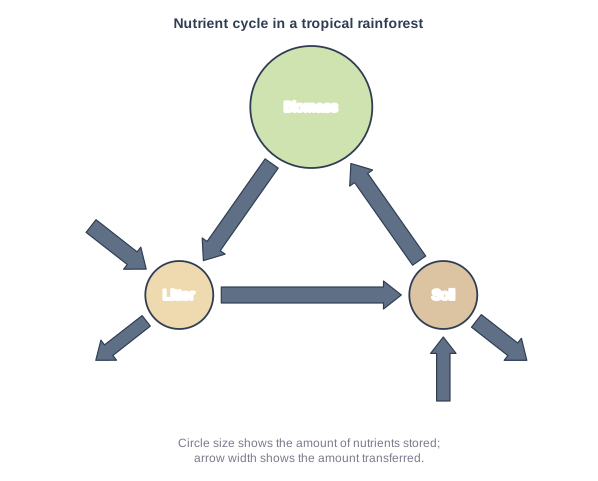
Figure 1 shows the nutrient cycle in a tropical rainforest.

Using Figure 1, explain why most of the nutrients in a tropical rainforest are stored in the biomass.

Gersmehl nutrient cycle diagram for a tropical rainforest. Its heading is "Nutrient cycle in a tropical rainforest". Three circles show the nutrient stores, each sized by the amount of nutrients it holds: biomass at the top (very large), litter at the bottom left (small) and soil at the bottom right (small); biomass is the largest store. Arrows show the transfers, their width showing the size of each flow: fall-out from biomass to litter (very thick), decomposition from litter to soil (very thick) and uptake from soil to biomass (very thick). Inputs: precipitation (nutrients dissolved in rain) into the litter (very thick) and weathering of rock into the soil (thick). Outputs: run-off from the litter (thick) and leaching from the soil (very thick). A note under the diagram reads "Circle size shows the amount of nutrients stored; arrow width shows the amount transferred." The label "Biomass" points to the circle at the top; the label "Litter" points to the circle at the bottom left; the label "Soil" points to the circle at the bottom right; the label "Decomposition" points to the arrow from the bottom-left circle to the bottom-right circle; the label "Fall-out" points to the arrow from the top circle to the bottom-left circle; the label "Uptake" points to the arrow from the bottom-right circle to the top circle; the label "Precipitation" points to the arrow coming in from the top left to the bottom-left circle; the label "Run-off" points to the arrow leaving the bottom-left circle towards the bottom left; the label "Weathering" points to the arrow coming up from below into the bottom-right circle; the label "Leaching" points to the arrow leaving the bottom-right circle towards the bottom right.

Model answer

Figure 1 shows that the biomass is by far the largest store, while the litter and soil stores are small and all the flows are very thick. The hot, wet climate allows plants to grow all year, so there is an enormous amount of vegetation holding nutrients. Leaves fall all year round, but in the hot, humid conditions decomposers break the litter down very quickly, so little builds up on the ground. The nutrients released are taken up almost immediately by the shallow roots of the dense vegetation, and the heavy rain leaches away any that remain in the soil. As a result, nutrients pass through the litter and soil quickly and are stored mainly in the plants.

Explanation

Top answers use the figure (store sizes and arrow widths) and explain the rapid cycle: fast decomposition, fast uptake and heavy leaching. This is why clearing the forest removes most of the nutrients and leaves the soil infertile.

Mark scheme
  1. 4 marks

    Levels of response (4 marks).
    Level 2 (3-4 marks): clear explanation of why nutrients are held in the biomass, linking the store sizes and flow widths in Figure 1 to the rainforest climate and vegetation; accurate terminology.
    Level 1 (1-2 marks): basic explanation with simple statements; may describe Figure 1 without explaining it.
    0 marks: nothing worthy of credit.

    Indicative content (not a checklist; credit other valid points): Figure 1: the biomass store is very large while the litter and soil stores are small; all the flows are very thick, showing rapid transfer; the hot, wet climate allows plants to grow all year, building up a huge amount of vegetation; leaves fall all year round (very thick fall-out flow); the hot, humid conditions mean decomposers (fungi, bacteria, insects) break down the litter very quickly, so the litter store stays small; nutrients released into the soil are taken up almost immediately by the shallow roots of the dense vegetation (very thick uptake flow); heavy rain leaches any nutrients left in the soil (very thick leaching), so the soil store is small; nutrients are therefore held in the plants themselves; if the trees are removed, most of the nutrients are lost.

Question 4

6 marks

Explain how animals are adapted to the physical conditions of the tropical rainforest.

Model answer

Most of the food in the rainforest, such as fruit, leaves and insects, is found high in the canopy, so many animals are adapted to living in the trees. Spider monkeys have long limbs and a prehensile tail that grips branches, so they can swing through the canopy and hang while feeding. Orangutans in Borneo have very long arms for the same reason. Some animals, such as flying frogs, can glide from tree to tree.

The sloth is adapted to a diet of leaves, which give little energy. It moves very slowly and has a slow metabolism to save energy, and long, curved claws let it hang from branches without effort. Green algae grow in its fur, camouflaging it from predators such as harpy eagles.

Camouflage and warning colours help animals in the dense, dappled light. The jaguar's spotted coat hides it as it hunts on the forest floor, while poison dart frogs have bright colours that warn predators they are poisonous. Toucans have long, light beaks that let them reach fruit at the ends of thin branches and help them lose heat in the hot climate. Because the vegetation is so dense, howler monkeys use very loud calls to communicate over long distances.

Explanation

Level 3 needs a range of adaptations, each explained in terms of the condition it helps with (life in the canopy, low-energy food, predators, dense vegetation), using named animals accurately. Naming animals without explaining their adaptations stays in Level 1.

Mark scheme
  1. 6 marks

    Levels of response (6 marks).
    Level 3 (5-6 marks): detailed, well-developed explanation of a range of animal adaptations, each clearly linked to the physical conditions (dense vegetation and layers, competition for food, heat and humidity, predators); uses named animal examples accurately.
    Level 2 (3-4 marks): clear explanation of some adaptations with some links to the conditions; some named examples.
    Level 1 (1-2 marks): basic description of adaptations, with little explanation or few examples.
    0 marks: nothing worthy of credit.

    Indicative content (not a checklist; credit other valid points): most food is in the canopy, so many animals are adapted to climbing and moving through trees: spider monkeys have long limbs and prehensile tails; orangutans (Borneo and Sumatra) have very long arms; flying frogs and flying squirrels glide between trees; sloths have long claws to hang from branches, a slow metabolism to save energy on a low-energy leaf diet, and algae in their fur for camouflage; camouflage in the dappled light, e.g. jaguar spots, stick insects, chameleons; bright warning colours, e.g. poison dart frogs; toucans have large beaks to reach fruit at the end of thin branches and to help them lose heat; howler monkeys use loud calls to communicate through dense vegetation; many animals are nocturnal to avoid predators or the heat; some specialise in particular foods to reduce competition (e.g. leaf-cutter ants farming fungus); jaguars are strong swimmers in the flooded forest.

Ready to try the rest? Every answer you write is marked against the mark scheme, so you can see exactly where the marks are.

AI Tutor Hints first, answers after you try

Hi! Stuck? Ask me for a hint and I’ll help you work it out. Once you’ve checked your answer I can explain exactly where the marks are.