Practise 35 exam-style questions on Plate tectonics and plate margins for AQA GCSE Geography (Paper 1). Write your answer as you would in the exam and get it marked in seconds against the mark scheme, point by point, with an AI tutor on hand if you get stuck.
35 questions
1–12 marks each
Instant marking
No sign-up needed
20 questions, marked as you go
Sample questions with model answers
Here are 4 of the questions in this topic, each with a model answer, an explanation of why it earns the marks and the mark scheme an examiner would use.
Question 1
1 mark
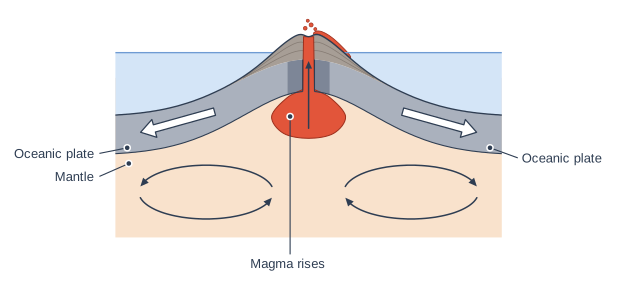
Figure 1 is a cross-section through a plate margin.
Name the type of plate margin shown in Figure 1.
Model answer
A constructive plate margin.
Explanation
The arrows show two oceanic plates moving apart, with magma rising into the gap and a gently sloping volcano above it - the features of a constructive margin. At destructive margins the plates move towards each other, and at conservative margins they slide past each other.
Mark scheme
1 mark
Constructive (plate margin)
accept 'divergent'; do not accept 'destructive', 'conservative' or 'mid-ocean ridge' alone
Question 2
2 marks
State two processes that cause tectonic plates to move.
Model answer
Convection currents in the mantle, and slab pull.
Explanation
Heat from the core creates convection currents in the mantle that drag the plates. Scientists now think that slab pull - the weight of the cold, dense plate sinking at a subduction zone - is also very important, helped by ridge push at mid-ocean ridges.
Mark scheme
1 mark
Convection currents in the mantle
max 2; 1 mark per process; accept 'heat from the core creates currents in the mantle'
1 mark
Slab pull (the weight of a sinking plate pulls the rest of the plate)
1 mark
Ridge push (new crust at a mid-ocean ridge pushes the plates apart / plates slide down from the raised ridge)
Question 3
4 marks
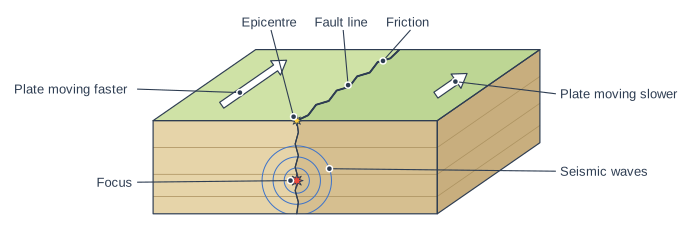
Figure 1 shows a conservative plate margin, where two plates are moving in the same direction at different speeds.
Using Figure 1, explain how earthquakes happen at this type of plate margin.
Model answer
In Figure 1 the two plates are moving in the same direction along the fault line, but one is moving faster than the other. The edges of the plates are rough, so friction makes them stick together while the plates continue to move, and pressure builds up over many years. When the pressure becomes too great, the plates suddenly slip past each other. This releases energy as seismic waves, which spread out from the focus deep underground. The shaking is usually strongest at the epicentre, the point on the surface directly above the focus. The San Andreas Fault in California is an example.
Explanation
Earthquakes at conservative margins are caused by stick-slip movement: friction → pressure builds → sudden release → seismic waves. Level 2 answers link these steps and use the diagram's terms: fault, focus, epicentre and seismic waves.
Mark scheme
4 marks
Levels of response (4 marks). Level 2 (3-4 marks): clear explanation of how friction, the build-up of pressure and its sudden release cause an earthquake, with linked points; makes use of features in Figure 1 (e.g. fault, focus, epicentre, seismic waves). Level 1 (1-2 marks): basic explanation with simple statements (e.g. 'the plates rub together'); little use of Figure 1. 0 marks: nothing worthy of credit.
Indicative content (not a checklist; credit other valid points): the two plates move past each other along a fault line, one faster than the other; the edges of the plates are rough, so friction makes them stick (lock together); the plates keep moving, so stress (pressure) builds up over many years; when the pressure becomes too great the plates suddenly slip or jerk past each other; energy is released as seismic waves that spread out from the focus underground; the epicentre is the point on the surface directly above the focus, where shaking is usually strongest; earthquakes can be shallow and very damaging; no volcanoes because no magma is formed; e.g. the San Andreas Fault in California (Pacific and North American plates).
Question 4
6 marks
Explain why some earthquakes and volcanoes occur away from plate margins.
Model answer
Although most earthquakes and volcanoes occur at plate margins, there are important exceptions. Volcanoes can form over hotspots, where a plume of very hot magma rises from deep in the mantle beneath the middle of a plate. The magma melts its way through the crust and erupts at the surface. Hawaii, in the middle of the Pacific plate, is the best-known example. The hotspot stays in the same place while the plate moves over it, so a chain of volcanic islands has formed, with the oldest islands to the north-west and active volcanoes such as Kilauea over the hotspot today. The rising magma also causes small earthquakes.
Earthquakes can also happen in the middle of plates. The stress caused by plate movement is passed through the rigid plate and can build up along old faults or weaknesses in the crust, far from any margin. When it is released, an earthquake occurs. Examples include the New Madrid area in the central USA and the small earthquakes that sometimes happen in the UK.
Finally, human activities such as mining, fracking and filling large reservoirs can change the stress on rocks and trigger small earthquakes away from plate margins.
Explanation
The two main causes are hotspots (for volcanoes) and stress released along old faults within plates (for earthquakes). A Level 3 answer explains the process for each and supports it with named examples such as Hawaii.
Mark scheme
6 marks
Levels of response (6 marks). Level 3 (5-6 marks): detailed, well-developed explanation of more than one cause of earthquakes and/or volcanoes away from plate margins (e.g. hotspots and intraplate faults), with clear links between process and hazard; accurate terminology; relevant examples. Level 2 (3-4 marks): clear explanation of at least one cause, with some linked points; examples may be limited. Level 1 (1-2 marks): basic statements with little explanation; may simply name examples. 0 marks: nothing worthy of credit.
Indicative content (not a checklist; credit other valid points): hotspots - a plume of very hot magma rises from deep in the mantle beneath the middle of a plate; the magma melts through the crust and erupts, e.g. Hawaii in the middle of the Pacific plate, Yellowstone in the USA; the hotspot stays still while the plate moves over it, forming a chain of volcanoes (the Hawaiian islands get older to the north-west); rising magma at hotspots also causes small earthquakes; intraplate earthquakes - stress from plate movement is transmitted through the plate and released along old faults or zones of weakness far from margins, e.g. the New Madrid area in the central USA, small earthquakes in the UK; human activities can trigger small earthquakes, e.g. mining, fracking, filling large reservoirs; most earthquakes and volcanoes are still at plate margins - these are exceptions.
Ready to try the rest? Every answer you write is marked against the mark scheme, so you can see exactly where the marks are.
Ctrl + Enter to check
AI TutorHints first, answers after you try
Hi! Stuck? Ask me for a hint and I’ll help you work it out. Once you’ve checked your answer I can explain exactly where the marks are.