Practise 32 exam-style questions on Effects of and responses to tectonic hazards for AQA GCSE Geography (Paper 1). Write your answer as you would in the exam and get it marked in seconds against the mark scheme, point by point, with an AI tutor on hand if you get stuck.
32 questions
1–12 marks each
Instant marking
No sign-up needed
20 questions, marked as you go
Sample questions with model answers
Here are 4 of the questions in this topic, each with a model answer, an explanation of why it earns the marks and the mark scheme an examiner would use.
Question 1
1 mark
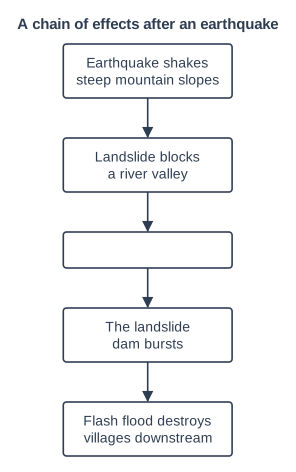
Figure 1 shows a chain of effects that can follow an earthquake in a mountainous area. One box has been left blank.
State what should go in the blank box.
Model answer
River water builds up behind the landslide, forming a lake.
Explanation
When a landslide blocks a valley it acts as a dam, so the river water backs up into a lake. If the loose material later gives way, the sudden release of water causes a flash flood downstream - one primary effect leading to a chain of secondary effects.
Mark scheme
1 mark
Water builds up behind the landslide, forming a lake (a landslide dam blocks the river)
accept 'a lake forms', 'the river is dammed and water collects'; do not accept 'flooding' alone
Question 2
2 marks
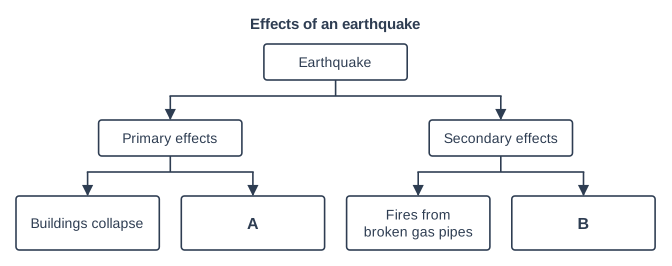
Figure 1 classifies some effects of an earthquake.
Suggest one effect that could go in box A and one effect that could go in box B.
Model answer
A: roads and bridges are damaged. B: disease spreads because water supplies are contaminated.
Explanation
Primary effects are caused directly by the shaking; secondary effects follow on from them. Putting a tsunami or landslide in box A is the most common error.
Mark scheme
1 mark
A: a primary effect, e.g. people killed or injured / roads, bridges or railways damaged / water or gas pipes broken / power lines brought down
do not accept 'buildings collapse' (already shown); accept 'people made homeless' in either box, as textbooks classify it differently
1 mark
B: a secondary effect, e.g. tsunami / landslides / disease from contaminated water / food shortages / loss of jobs or income / damage to the economy / aid delayed by blocked roads
do not accept fires (already shown) or any primary effect
Question 3
4 marks
Explain why the immediate responses to a tectonic hazard are often slower in a low-income country than in a high-income country.
Model answer
Low-income countries often have few trained rescue teams and little specialist equipment, such as heavy lifting gear, so it takes longer to find and free survivors. Roads, bridges and airports are often poorly built and may be destroyed, so rescuers and supplies cannot reach the affected areas; in Nepal in 2015, landslides blocked mountain roads and cut off remote villages. Governments may have little money and no emergency plan, so they rely on international aid, which can take days to arrive and may be held up at a single congested airport. In high-income countries, well-equipped emergency services and good infrastructure allow a much faster response.
Explanation
The key ideas are lack of equipment and trained staff, damaged or poor infrastructure, difficult terrain and reliance on outside help. Level 2 answers explain how each factor slows the response, ideally with an example.
Mark scheme
4 marks
Levels of response (4 marks). Level 2 (3-4 marks): clear explanation of several reasons why responses are slower, with linked (developed) points; may use examples. Level 1 (1-2 marks): basic, simple statements (e.g. 'they are poor') with little explanation of how this slows the response. 0 marks: nothing worthy of credit.
Indicative content (not a checklist; credit other valid points): fewer trained rescue teams and little specialist equipment (heavy lifting gear, sniffer dogs); poorly built roads, bridges and airports are damaged, so rescuers and supplies cannot get through; remote, mountainous areas are hard to reach, especially when landslides block roads (e.g. Nepal 2015); communications networks fail; hospitals are few, poorly equipped or damaged; governments have little money and may be poorly organised, with no emergency plan; reliance on international aid, which takes days to arrive and may be held up at a congested airport (e.g. Kathmandu, Port-au-Prince); in high-income countries trained emergency services, equipment, planning and good infrastructure allow a rapid response (e.g. Chile restored power and water to most homes within about 10 days).
Question 4
6 marks
Explain how the secondary effects of a volcanic eruption can affect people living far away from the volcano.
Model answer
Although lava and pyroclastic flows only affect areas close to a volcano, secondary effects can reach people hundreds or even thousands of kilometres away.
Ash clouds can be carried long distances by the wind. When Eyjafjallajökull in Iceland erupted in 2010, the ash drifted over Europe, and because ash can damage jet engines, much of European airspace was closed for several days. Around 100 000 flights were cancelled, millions of passengers were stranded, and businesses as far away as Kenya, which flies fresh flowers and vegetables to Europe, lost produce and income.
Lahars can also travel far from the volcano. When ash and rock mix with meltwater or heavy rain, they form mudflows that rush down river valleys. In 1985 the eruption of Nevado del Ruiz in Colombia melted part of its ice cap, and lahars travelled tens of kilometres to bury the town of Armero, killing about 23 000 people.
Very large eruptions can even affect the global climate. Mount Pinatubo in the Philippines erupted in 1991 and sent gases high into the atmosphere, which reflected sunlight and lowered global temperatures by about 0.5 °C for a year or two. Cooling like this can damage harvests and raise food prices around the world.
Explanation
The question is about distance, so focus on secondary effects that travel: ash clouds, lahars, tsunamis and climate change. Level 3 answers explain the process that carries each effect away from the volcano and use named examples such as Eyjafjallajökull or Nevado del Ruiz.
Mark scheme
6 marks
Levels of response (6 marks). Level 3 (5-6 marks): detailed, well-developed explanation of several secondary effects that reach people far from the volcano, clearly linking the process to the effect on people; accurate, relevant examples. Level 2 (3-4 marks): clear explanation of some far-reaching secondary effects, with some linked points and some use of examples. Level 1 (1-2 marks): basic statements about effects with little explanation of how they reach distant people; may describe primary effects near the volcano. 0 marks: nothing worthy of credit.
Indicative content (not a checklist; credit other valid points): ash clouds carried by the wind disrupt air travel far away - e.g. Eyjafjallajökull, Iceland, 2010: much of European airspace closed for several days, around 100 000 flights cancelled, millions of passengers stranded, and exporters such as Kenyan flower and vegetable growers lost produce; lahars (mudflows) travel tens of kilometres down river valleys - e.g. Nevado del Ruiz, Colombia, 1985: lahars buried the town of Armero, about 23 000 deaths; eruptions can trigger tsunamis that reach distant coasts - e.g. Krakatoa 1883; gases and ash in the stratosphere can cool global climate - e.g. Mount Pinatubo 1991 lowered global temperatures by about 0.5 °C for a year or two, and Tambora 1815 led to crop failures in Europe and North America in 1816; acid rain damages crops and buildings; food shortages and higher prices; economic effects on tourism, trade and insurance.
Ready to try the rest? Every answer you write is marked against the mark scheme, so you can see exactly where the marks are.
Ctrl + Enter to check
AI TutorHints first, answers after you try
Hi! Stuck? Ask me for a hint and I’ll help you work it out. Once you’ve checked your answer I can explain exactly where the marks are.