Practise 26 exam-style questions on Sustainable management of tropical rainforests for AQA GCSE Geography (Paper 1). Write your answer as you would in the exam and get it marked in seconds against the mark scheme, point by point, with an AI tutor on hand if you get stuck.
26 questions
1–12 marks each
Instant marking
No sign-up needed
20 questions, marked as you go
Sample questions with model answers
Here are 4 of the questions in this topic, each with a model answer, an explanation of why it earns the marks and the mark scheme an examiner would use.
Question 1
1 mark
Name the organisation whose logo on timber and paper products shows that the wood comes from responsibly managed forests.
Model answer
The Forest Stewardship Council (FSC).
Explanation
The FSC certifies forests that are managed sustainably and lets companies use its tree logo on their products. This allows consumers around the world to choose timber and paper that have not come from illegal logging or destructive clearance.
Mark scheme
1 mark
The Forest Stewardship Council (FSC)
accept 'FSC'; also accept the Programme for the Endorsement of Forest Certification (PEFC)
Question 2
2 marks
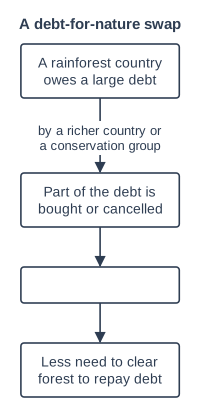
Figure 1 shows the stages of a debt-for-nature swap.
Describe what happens at the stage shown by the blank box.
Model answer
In return for part of its debt being cancelled, the rainforest country agrees to protect an area of forest. The money it would have used to repay the debt is spent on conservation, such as running national parks and paying rangers.
Explanation
A debt-for-nature swap exchanges debt for conservation: the country's debt is reduced, and in return it protects its forest. This also reduces the pressure to clear forest to earn the money needed for repayments.
Mark scheme
1 mark
In return for the debt being cancelled / reduced, the country agrees to protect an area of rainforest
max 2
1 mark
The money that would have been used to repay the debt is spent on conservation, e.g. national parks, rangers or local projects
Question 3
4 marks
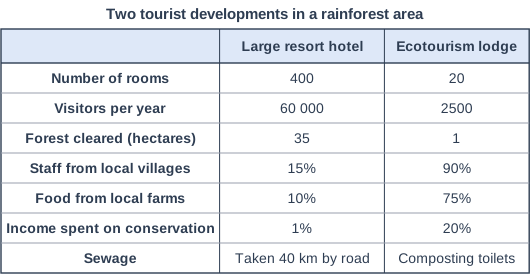
Figure 1 compares two tourist developments in a tropical rainforest area.
Using Figure 1, explain why the ecotourism lodge is more sustainable than the large resort hotel.
Model answer
The ecotourism lodge is more sustainable because it does much less damage to the forest. Only 1 hectare was cleared for its buildings, compared with 35 hectares for the hotel, and it has only 2500 visitors a year instead of 60 000, so there is far less disturbance to wildlife. It also benefits local people: 90% of its staff come from local villages, compared with 15% at the hotel, and 75% of its food comes from local farms, so local people earn money from the standing forest and have a reason to protect it. Finally, it spends 20% of its income on conservation, compared with only 1% at the hotel, which pays for the forest to be protected for the future.
Explanation
Use data from the figure, but explain what each figure means for sustainability; quoting numbers alone stays in Level 1. Sustainable tourism protects the environment, benefits local people and can continue in the long term, so try to cover more than one of these.
Mark scheme
4 marks
Levels of response (4 marks). Level 2 (3-4 marks): clear explanation of why the lodge is more sustainable, with developed points covering environmental and economic or social aspects; makes effective use of evidence from Figure 1. Level 1 (1-2 marks): basic explanation with simple points; little or no use of Figure 1, or data quoted without explanation. 0 marks: nothing worthy of credit.
Indicative content (not a checklist; credit other valid points): the lodge cleared only 1 hectare of forest compared with 35, so habitats and the carbon store are kept; far fewer visitors (2500 compared with 60 000 a year), so less disturbance to wildlife and less pressure on water, energy and waste disposal; 90% of staff are from local villages (compared with 15%), so local people earn an income from the standing forest and have a reason to protect it; 75% of food from local farms (compared with 10%) supports the local economy and means fewer imports and less transport; 20% of income is spent on conservation (compared with 1%), paying for protection of the forest; composting toilets mean waste is dealt with on site rather than being taken 40 km by road; the lodge can continue for a long time without damaging the forest it depends on.
Question 4
6 marks
Using a named example, explain how ecotourism can help a tropical rainforest to be managed sustainably.
Model answer
Ecotourism is small-scale tourism that aims to protect the environment and benefit local people. Costa Rica is a well-known example. About a quarter of the country is protected in national parks and reserves, and visitors come to see its rainforests and wildlife, making tourism one of the country's most important sources of income.
Ecotourism helps sustainable management in several ways. Because the attraction is the forest itself, there is a strong economic reason to keep it standing rather than clear it for farming. Lodges are small and use local materials, so little forest is cleared, and visitor numbers are limited to reduce disturbance to wildlife. Local people are employed as guides, cooks and drivers, so they earn an income from protecting the forest instead of cutting it down. Entry fees to national parks pay for rangers and conservation work, and visitors learn about the value of the rainforest.
Together with payments to landowners for keeping their land forested, this approach has helped forest cover in Costa Rica rise from about a fifth of the country in the 1980s to over half today, while bringing money into the economy.
Explanation
Explain how ecotourism makes the forest worth more standing than cleared: it provides income and jobs, funds conservation and educates visitors. Level 3 needs accurate details of a named example, such as Costa Rica or a named lodge or reserve.
Mark scheme
6 marks
Levels of response (6 marks). Level 3 (5-6 marks): detailed, well-developed explanation of how ecotourism helps sustainable management (environmental, economic and social benefits), with clear links; detailed, accurate place-specific knowledge of a named example. Level 2 (3-4 marks): clear explanation of some ways ecotourism helps; some place-specific detail. Level 1 (1-2 marks): basic explanation with simple statements; generic, with little or no place-specific detail. 0 marks: nothing worthy of credit.
Indicative content (not a checklist; credit other valid points): ecotourism is small-scale tourism that aims to have little impact on the environment and to benefit local people and conservation; small numbers of visitors and small lodges built with local materials, so little forest is cleared; local people are employed as guides, cooks and boat drivers, earning money from the standing forest instead of clearing it; entry fees and profits pay for conservation and rangers; visitors are educated about the value of the forest; gives governments an economic reason to protect forests; examples: Costa Rica - about a quarter of the country is protected in parks and reserves, ecotourism is a major source of income, and forest cover has risen from about a fifth in the 1980s to over half today, helped by payments to landowners to keep forest; the Danum Valley, Sabah, Malaysia - a protected conservation area with a research centre and a small rainforest lodge; the Mamirauá Reserve in the Brazilian Amazon, where a floating lodge is run with local communities, who work as guides and share the profits; limitations (e.g. visitor numbers must be controlled, flights add carbon emissions) credited as development; credit any appropriate named example.
Ready to try the rest? Every answer you write is marked against the mark scheme, so you can see exactly where the marks are.
Ctrl + Enter to check
AI TutorHints first, answers after you try
Hi! Stuck? Ask me for a hint and I’ll help you work it out. Once you’ve checked your answer I can explain exactly where the marks are.