Practise 25 exam-style questions on Natural hazards and hazard risk for AQA GCSE Geography (Paper 1). Write your answer as you would in the exam and get it marked in seconds against the mark scheme, point by point, with an AI tutor on hand if you get stuck.
25 questions
1–12 marks each
Instant marking
No sign-up needed
20 questions, marked as you go
Sample questions with model answers
Here are 4 of the questions in this topic, each with a model answer, an explanation of why it earns the marks and the mark scheme an examiner would use.
Question 1
1 mark
Give the term used to describe how likely people are to suffer harm from a natural hazard because of their circumstances, such as poverty, poor housing or a lack of education.
Model answer
Vulnerability
Explanation
Vulnerability describes how easily people are harmed because of human factors such as poverty, poor housing, age, health or education. Hazard risk is broader: it combines the hazard itself with people's vulnerability and their capacity to cope.
Mark scheme
1 mark
Vulnerability
accept 'vulnerable'; do not accept 'hazard risk', 'exposure' or 'capacity to cope'
Question 2
2 marks
Some geographers use this equation to show hazard risk:
Risk = (Hazard × Vulnerability) ÷ Capacity to cope
Explain why increasing a community's capacity to cope reduces hazard risk.
Model answer
Capacity to cope is how well a community can prepare for, respond to and recover from a hazard, for example by having trained emergency services and an evacuation plan. If capacity increases, people can be warned and evacuated and the injured treated quickly, so fewer people are harmed and the risk is lower.
Explanation
In the equation risk is divided by capacity to cope, so a bigger capacity gives a smaller risk. The second mark is for explaining the mechanism - better preparation and response mean fewer deaths and less damage.
Mark scheme
1 mark
Capacity to cope is the ability of a community to prepare for, respond to and recover from a hazard, e.g. trained emergency services, warning systems, evacuation plans, money or insurance, education
max 2: 1 mark for a valid point about what a greater capacity to cope means or provides, 1 for linking it to reduced risk
1 mark
so fewer people are harmed / damage is reduced / recovery is quicker, so the risk is lower (risk is divided by capacity, so higher capacity gives lower risk)
development of the previous point
Question 3
4 marks
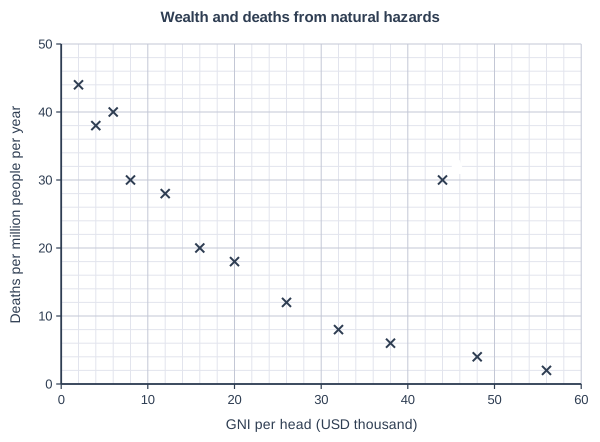
Figure 1 shows GNI per head and the average number of deaths from natural hazards per million people each year for 13 countries.
Suggest why countries with a higher GNI per head tend to have fewer deaths from natural hazards.
Model answer
Wealthier countries can afford to build homes, schools and offices to strict building codes, so buildings are less likely to collapse during an earthquake or tropical storm, which is the main cause of deaths. They can also pay for monitoring equipment and early warning systems, so people can be evacuated before a tropical storm or volcanic eruption arrives. Their emergency services are well trained and equipped, and hospitals are better, so injured people are rescued and treated quickly and outbreaks of disease are prevented. In poorer countries many people live in poorly built informal settlements on steep slopes or flood plains, so they are more vulnerable and have less capacity to cope.
Explanation
The key idea is that wealth lowers vulnerability and raises a country's capacity to cope. Level 2 answers explain how each factor saves lives (e.g. resistant buildings → fewer collapses → fewer deaths) rather than just listing things richer countries have.
Mark scheme
4 marks
Levels of response (4 marks). Level 2 (3-4 marks): clear, developed suggestions that link greater wealth to lower vulnerability and/or a greater capacity to cope, explaining how each factor reduces deaths; may refer to the pattern in Figure 1. Level 1 (1-2 marks): basic suggestions with simple, undeveloped points (e.g. 'richer countries have better buildings'); little explanation of how deaths are reduced. 0 marks: nothing worthy of credit.
Indicative content (not a checklist; credit other valid points): richer countries can afford hazard-resistant buildings and can enforce building codes, so fewer buildings collapse; they can pay for monitoring and early warning systems, giving time to evacuate; well-trained and equipped emergency services rescue people quickly; better healthcare treats the injured and prevents disease; good roads, airports and communications make evacuation and aid delivery easier; education and drills mean people know what to do; fewer people live in informal settlements on unsafe land (steep slopes, flood plains); insurance and savings help people recover; governments can afford emergency shelter, food and water; in poorer countries the opposite applies, so vulnerability is higher.
Question 4
6 marks
Explain why some types of natural hazard are more difficult to prepare for than others.
Model answer
How easy a hazard is to prepare for depends largely on whether it can be predicted and how much warning it gives. Earthquakes are the hardest because they happen suddenly and scientists cannot predict exactly when they will occur. Even the best early warning systems, such as Japan's, give only a few seconds of warning, so people cannot be evacuated and preparation has to rely on resistant buildings and drills.
Tropical storms are much easier to prepare for. They form over warm oceans and are tracked by satellites, so forecasters can predict their path several days in advance. This gives time to issue warnings, board up buildings and evacuate people from coasts at risk of storm surges.
Volcanoes are in between. Before an eruption there are often warning signs, such as small earthquakes, swelling of the ground and increased gas emissions, which can be monitored. However, it is hard to know exactly when an eruption will happen or how large it will be, so authorities may evacuate too early or too late.
Droughts are difficult for a different reason: they develop slowly, so it is hard to tell when a dry spell has become a drought, and they can last for years. Rare hazards are also hard to prepare for because people become complacent and governments are less willing to spend money on events that may not happen for decades.
Explanation
The key concepts are speed of onset, predictability and warning time. A Level 3 answer compares several hazard types and explains why each characteristic makes preparation easier or harder, using examples such as satellite tracking of tropical storms versus the unpredictability of earthquakes.
Mark scheme
6 marks
Levels of response (6 marks). Level 3 (5-6 marks): detailed, well-developed explanation that compares several types of hazard, clearly linking their characteristics (speed of onset, predictability, warning time, frequency, area affected) to how easy they are to prepare for; accurate terminology and relevant examples. Level 2 (3-4 marks): clear explanation of some differences between hazards, with some developed points; may focus mainly on one or two hazards or lack examples. Level 1 (1-2 marks): basic statements about hazards with little explanation of why preparation is harder; simple, unlinked points. 0 marks: nothing worthy of credit.
Indicative content (not a checklist; credit other valid points): earthquakes happen suddenly and cannot be predicted reliably, so there is no time to evacuate, at most seconds of warning from early warning systems; tropical storms form over the oceans and are tracked by satellites, so warnings can be given days ahead and people evacuated; volcanoes often give warning signs (small earthquakes, ground swelling, gas emissions) but the exact timing and size of an eruption are uncertain; tsunami warning time depends on distance from the epicentre - minutes near the coast, hours across an ocean; droughts are slow-onset and it is hard to know when one has begun or how long it will last; flash floods and landslides are local and can be triggered quickly by heavy rain; rare, high-magnitude hazards make people complacent and governments less willing to spend on preparation; hazards affecting large areas (storms, droughts) need preparation over a wide area; secondary hazards (tsunamis, landslides, fires) add further uncertainty.
Ready to try the rest? Every answer you write is marked against the mark scheme, so you can see exactly where the marks are.
Ctrl + Enter to check
AI TutorHints first, answers after you try
Hi! Stuck? Ask me for a hint and I’ll help you work it out. Once you’ve checked your answer I can explain exactly where the marks are.