
Level:
Correct: 0
Incorrect: 0
Marks: 0/0
Exam Practice
Subject:
Topics:
AQA GCSE Geography (Paper 1) Smart practice A mixed round aimed at your weak spots
Unit 1
The challenge of natural hazards
Unit 2
The living world
Unit 3
Physical landscapes in the UK
Unit 4
Geographical skills: OS maps
Avg
score:
–
Topics
done:
0/32

Coastal processes

Practise 32 exam-style questions on Coastal processes for AQA GCSE Geography (Paper 1). Write your answer as you would in the exam and get it marked in seconds against the mark scheme, point by point, with an AI tutor on hand if you get stuck.

  • 32 questions
  • 1–12 marks each
  • Instant marking
  • No sign-up needed
20 questions, marked as you go

Sample questions with model answers

Here are 4 of the questions in this topic, each with a model answer, an explanation of why it earns the marks and the mark scheme an examiner would use.

Question 1

1 mark

Which one of the following describes the process of attrition?

A Waves force air into cracks in a cliff, putting pressure on the rock
B Rocks carried by the sea are thrown at a cliff, wearing it away
C Rocks carried by waves knock against each other, becoming smaller and rounder
D Rainwater containing carbon dioxide slowly dissolves limestone

Give the letter of the correct answer.

Model answer

C - rocks carried by waves knock against each other, becoming smaller and rounder.

Explanation

Attrition wears down the load itself, not the cliff: pebbles collide, chip and become smaller and more rounded. Option A is hydraulic power, B is abrasion and D is chemical weathering (carbonation). Students often confuse attrition with abrasion - remember that abrasion attacks the cliff or sea bed.

Mark scheme
  1. 1 mark

    C (rocks carried by waves knock against each other, becoming smaller and rounder)

    accept the letter or the option written out; do not accept more than one answer
Question 2

2 marks

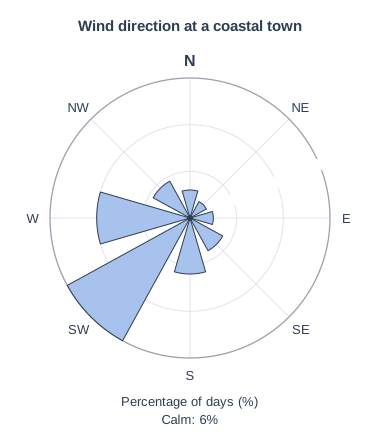
Figure 1 shows wind direction at a coastal town in southern England. The coastline runs from west to east, with the sea to the south.

Using Figure 1, identify the prevailing wind direction and state the direction in which longshore drift will move sediment along this coast.

Wind direction at a coastal town. Rose diagram with 8 compass directions (N at the top, then clockwise NE, E, SE ...). A wedge from the centre points towards each direction, its length in proportion to the value; circular scale rings are drawn every 10 out to 30 and labelled, and the scale is "Percentage of days (%)". Values: N 6%, NE 4%, E 5%, SE 8%, S 12%, SW 30%, W 20%, NW 9%. Printed underneath: Calm 6%.

Model answer

The prevailing wind is from the south-west (30% of days). Longshore drift will therefore move sediment from west to east along the coast.

Explanation

On a wind rose the longest bar shows the direction the wind blows from most often - here the south-west. The prevailing wind makes waves approach the beach at an angle, so the swash pushes sediment up the beach towards the north-east and the backwash brings it straight back down; the net movement along this west-east coast is eastwards. This is why many spits on the south coast of England, such as Hurst Castle spit, grow towards the east.

Mark scheme
  1. 1 mark

    Prevailing wind: south-west / south-westerly

    accept 'SW' or 'from the south-west'; do not accept 'west' or 'south' alone

  2. 1 mark

    Longshore drift: from west to east / eastwards

    accept 'towards the east'; allow a direction that follows correctly from a wrongly identified onshore wind

Question 3

4 marks

Explain how chemical weathering can weaken cliffs made of chalk or limestone.

Model answer

Chalk and limestone are made of calcium carbonate. Rainwater absorbs carbon dioxide from the atmosphere, which makes it a weak carbonic acid. When this rain falls on the cliff it reacts with the calcium carbonate and slowly dissolves the rock, carrying it away in solution. This process is called carbonation.

The acid works its way into joints and cracks and widens them. This weakens the cliff, so blocks of rock become loose and are more likely to fall, and the waves can erode the weakened rock more easily.

Explanation

Carbonation is the main chemical weathering process on chalk and limestone coasts: weak carbonic acid in rain reacts with calcium carbonate and dissolves it. To reach Level 2 the answer must explain why this weakens the cliff - widened joints, loosened blocks and easier erosion - not just that the rock 'dissolves'.

Mark scheme
  1. 4 marks

    Levels of response (4 marks).
    Level 2 (3-4 marks): clear explanation of carbonation, linking the formation of weak acid to the reaction with the rock and to the weakening of the cliff; accurate terminology (carbonic acid, calcium carbonate, solution).
    Level 1 (1-2 marks): basic explanation with simple, unlinked points, e.g. 'acid rain dissolves the rock'; little explanation of how the cliff is weakened.
    0 marks: nothing worthy of credit.

    Indicative content (not a checklist; credit other valid points): chemical weathering changes the chemical composition of the rock; rainwater absorbs carbon dioxide from the air, forming a weak carbonic acid; chalk and limestone are made of calcium carbonate; the acid reacts with the calcium carbonate (carbonation) and the rock dissolves; the dissolved rock is carried away in solution; the acid widens joints, cracks and bedding planes; this weakens the cliff and loosens blocks of rock; weakened rock is more easily eroded by waves (e.g. hydraulic power works on the wider cracks); blocks are more likely to collapse as rock falls; the cliff retreats over time.

Question 4

6 marks

Explain why sediment is deposited in some coastal areas.

Model answer

Sediment is deposited when the sea loses energy and can no longer carry its load. This happens in several types of coastal area.

Bays are sheltered from the full force of the waves. As waves enter a bay they spread out and lose energy, so they drop the sand and shingle they are carrying and form a beach. Shallow water has a similar effect, because friction with the sea bed slows the waves down.

Deposition is also common where constructive waves are dominant. Their swash is stronger than their backwash, so more material is carried up the beach than is taken back down, and the beach builds up.

Where the coastline changes direction, for example at a river mouth, the longshore drift carrying sediment along the coast loses energy and deposits material in the sheltered water. Over time this can build a spit, such as Spurn Head at the end of the Holderness coast.

Finally, deposition is more likely where there is a large supply of sediment, for example from rapidly eroding cliffs or from rivers. If more sediment arrives than the waves can carry away, it builds up. Groynes and vegetation can also trap sediment and encourage deposition.

Explanation

Every reason for deposition comes back to one idea: the waves lose energy, or there is more sediment than they can carry. Level 3 answers explain several different situations (bays, shallow water, constructive waves, changes in coastline direction, high sediment supply) and link each to energy. A list of places without the energy link is Level 1.

Mark scheme
  1. 6 marks

    Levels of response (6 marks).
    Level 3 (5-6 marks): detailed, well-developed explanation of several reasons for coastal deposition, each linked to the loss of energy by waves (or a large supply of sediment); may refer to named landforms or places; accurate use of a wide range of terminology.
    Level 2 (3-4 marks): clear explanation of some reasons with some linked points; links to loss of energy may be implied rather than explained.
    Level 1 (1-2 marks): basic explanation, simple statements, e.g. 'the sea is calm'; few links to energy.
    0 marks: nothing worthy of credit.

    Indicative content (not a checklist; credit other valid points): deposition happens when the sea loses energy and can no longer carry its load; constructive waves have a stronger swash than backwash, so they leave material on the beach; bays are sheltered and waves spread out (refract) and lose energy, so beaches form there; shallow water increases friction with the sea bed, slowing waves; where the coastline changes direction (e.g. at a river mouth or estuary), longshore drift slows and sediment is deposited, forming spits; little wind or calm weather means low-energy waves; large amounts of sediment are supplied by eroding cliffs, rivers or longshore drift, more than the waves can carry; obstacles such as groynes trap sediment carried by longshore drift; vegetation (e.g. in salt marshes or on dunes) traps sediment; examples: Spurn Head, Chesil Beach, Studland Bay.

Ready to try the rest? Every answer you write is marked against the mark scheme, so you can see exactly where the marks are.

AI Tutor Hints first, answers after you try

Hi! Stuck? Ask me for a hint and I’ll help you work it out. Once you’ve checked your answer I can explain exactly where the marks are.