
Level:
Correct: 0
Incorrect: 0
Marks: 0/0
Exam Practice
Course:
Topics:
AQA GCSE Maths (Foundation calculator) Smart practice A mixed round aimed at your weak spots
Unit 1
Number
Unit 2
Algebra
Unit 3
Ratio, proportion and rates of change
Unit 4
Geometry and measures
Unit 5
Probability
Unit 6
Statistics
Avg
score:
–
Topics
done:
0/86

Venn diagrams and sets

Practise 28 exam-style questions on Venn diagrams and sets for AQA GCSE Maths (Foundation calculator). Write your answer as you would in the exam and get it marked in seconds against the mark scheme, point by point, with the Study Helper on hand if you get stuck.

  • 28 questions
  • 1–5 marks each
  • Instant marking
  • No sign-up needed
20 questions, marked as you go

Sample questions with model answers

Here are 4 of the questions in this topic, each with a model answer, an explanation of why it earns the marks and the mark scheme an examiner would use.

Question 1

1 mark

ξ = {integers from 1 to 20}
A = {multiples of 4}
B = {factors of 24}

Ryan says,
"A ∩ B = {4, 8, 12, 24}"

Is Ryan correct?
Give a reason for your answer.

Model answer

No.
A = {4, 8, 12, 16, 20}
B = {1, 2, 3, 4, 6, 8, 12}
24 is not in ξ, because ξ only contains the integers from 1 to 20.
A ∩ B = {4, 8, 12}

Explanation

Every set can only contain members of the universal set ξ, which here stops at 20. 24 is a multiple of 4 and a factor of 24, but it is not in ξ, so it cannot be in A or B. Always list each set using only the numbers in ξ.

Mark scheme
  1. 1 mark

    B1 for No, with a reason, e.g. 24 is not in ξ (ξ only goes up to 20)

    accept 'A ∩ B = {4, 8, 12}' as the reason
Question 2

2 marks

A café sells three types of sandwich: cheese, ham and egg.
It sells two types of drink: tea and juice.

Tom buys one sandwich and one drink.

List all the possible combinations Tom could choose.

Model answer

Cheese, tea
Cheese, juice
Ham, tea
Ham, juice
Egg, tea
Egg, juice
There are 6 combinations.

Explanation

Work systematically: take each sandwich in turn and pair it with every drink. This makes sure you do not miss any or write any twice. There are 3 sandwiches and 2 drinks, so there should be 3 × 2 = 6 combinations.

Mark scheme
  1. 1 mark

    B1 for at least 4 correct combinations

    ignore repeats for this mark

  2. 1 mark

    B1 for all 6 correct with no repeats or extras: cheese and tea, cheese and juice, ham and tea, ham and juice, egg and tea, egg and juice

    B2 for a complete list; accept initials, e.g. CT, CJ, HT, HJ, ET, EJ

Question 3

2 marks

ξ = {1, 2, 3, 4, 5, 6, 7, 8, 9, 10, 11, 12}
A = {factors of 12}
B = {even numbers}

List the numbers that are in A or in B, but not in both.

Model answer

A = {1, 2, 3, 4, 6, 12}
B = {2, 4, 6, 8, 10, 12}
In both: 2, 4, 6, 12
In A only: 1, 3
In B only: 8, 10
Numbers in A or B but not both: 1, 3, 8, 10

Explanation

List both sets, then find the numbers they share (2, 4, 6 and 12). Take these out and keep the numbers that are in just one of the sets. In a Venn diagram these are the two parts of the circles that do not overlap.

Mark scheme
  1. 1 mark

    B1 for A = {1, 2, 3, 4, 6, 12} and B = {2, 4, 6, 8, 10, 12}, or at least 3 correct numbers with no more than one wrong

  2. 1 mark

    B1 for 1, 3, 8, 10 only

    B2 for all four correct with no extras, in any order

Question 4

4 marks

There are 49 members in a games club.
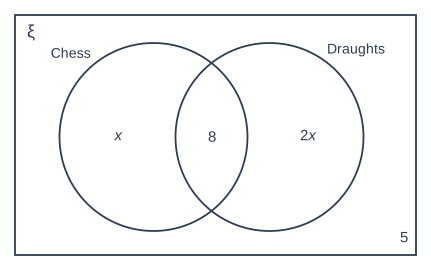
The Venn diagram shows information about the members who play chess and the members who play draughts.

One of the members is chosen at random.

Work out the probability that this member plays draughts but not chess.

A Venn diagram: a rectangle labelled ξ (the universal set) containing two overlapping circles labelled "Chess" and "Draughts". The numbers written in each region are: in "Chess" only: x; in both "Chess" and "Draughts": 8; in "Draughts" only: 2x; outside both circles: 5.

Model answer

x + 8 + 2x + 5 = 49
3x + 13 = 49
3x = 36
x = 12
Draughts but not chess = 2x = 24
P(draughts but not chess) = \(\frac{24}{49}\)

Explanation

All the regions of the Venn diagram add up to the total number of members, 49, so form an equation and solve it. Draughts but not chess is the part of the Draughts circle outside the overlap, which is 2x. Remember to work out 2x, not just x, before writing the probability.

Mark scheme
  1. 1 mark

    M1 for x + 8 + 2x + 5 = 49 oe

    e.g. 3x + 13 = 49

  2. 1 mark

    M1dep for 3x = 36 or \(x = (49 - 13) \div 3\)

  3. 1 mark

    A1 for x = 12

  4. 1 mark

    A1 for \(\frac{24}{49}\)

    oe; ft \(\frac{2 \times \text{their } x}{49}\) only if their x is a positive whole number; correct answer with no working scores full marks

Ready to try the rest? Every answer you write is marked against the mark scheme, so you can see exactly where the marks are.

Study Helper Hints first, answers after you try

Stuck on this one? Ask for a hint and I’ll point you in the right direction, without giving the answer away. Once you’ve checked your answer, I’ll show you how the marks are awarded.