Level:
Correct: 0
Incorrect: 0
Marks: 0/0
Exam Practice
Course:
Topics:
AQA GCSE Maths (Foundation calculator) Smart practice A mixed round aimed at your weak spots
Unit 1
Number
Unit 2
Algebra
Unit 3
Ratio, proportion and rates of change
Unit 4
Geometry and measures
Unit 5
Probability
Unit 6
Statistics
Avg
score:
–
Topics
done:
0/86

Exact trigonometric values

Practise 18 exam-style questions on Exact trigonometric values for AQA GCSE Maths (Foundation calculator). Write your answer as you would in the exam and get it marked in seconds against the mark scheme, point by point, with the Study Helper on hand if you get stuck.

  • 18 questions
  • 1–5 marks each
  • Instant marking
  • No sign-up needed
18 questions, marked as you go

Sample questions with model answers

Here are 4 of the questions in this topic, each with a model answer, an explanation of why it earns the marks and the mark scheme an examiner would use.

Question 1

1 mark

Which of these is the exact value of cos 30°?

Choose your answer.

  • \(\dfrac{1}{2}\)
  • \(\dfrac{\sqrt{2}}{2}\)
  • \(\dfrac{\sqrt{3}}{2}\)
  • \(\sqrt{3}\)

Model answer

\(\cos 30^\circ = \dfrac{\sqrt{3}}{2}\) (= 0.866...)

Explanation

cos 30° has the same value as sin 60°, which is \(\frac{\sqrt{3}}{2}\). The value \(\frac{1}{2}\) is cos 60° (or sin 30°), \(\frac{\sqrt{2}}{2}\) is cos 45° and \(\sqrt{3}\) is tan 60°. You can check on a calculator: cos 30° = 0.866... and \(\sqrt{3} \div 2\) = 0.866...

Mark scheme
  1. 1 mark

    B1 for \(\dfrac{\sqrt{3}}{2}\)

Question 2

2 marks

Use exact values to show that

\(\tan 60^\circ \times \tan 30^\circ = 1\)

Model answer

\(\tan 60^\circ = \sqrt{3}\)
\(\tan 30^\circ = \dfrac{1}{\sqrt{3}}\)
\(\sqrt{3} \times \dfrac{1}{\sqrt{3}} = \dfrac{\sqrt{3}}{\sqrt{3}} = 1\)

Explanation

Write each value exactly, not as a rounded decimal. tan 60° = \(\sqrt{3}\) and tan 30° = \(\frac{1}{\sqrt{3}}\), so multiplying gives \(\sqrt{3}\) divided by \(\sqrt{3}\), which is 1. Rounded decimals such as 1.732 × 0.577 = 0.999... do not show the answer is exactly 1.

Mark scheme
  1. 1 mark

    M1 for tan 60° = \(\sqrt{3}\) and tan 30° = \(\dfrac{1}{\sqrt{3}}\)

    accept tan 30° = \(\dfrac{\sqrt{3}}{3}\)

  2. 1 mark

    A1 for \(\sqrt{3} \times \dfrac{1}{\sqrt{3}} = 1\) shown

    or \(\sqrt{3} \times \dfrac{\sqrt{3}}{3} = \dfrac{3}{3} = 1\); decimals from a calculator (e.g. 1.732 × 0.577) score 0; answer only scores 0 (show that)

Question 3

3 marks

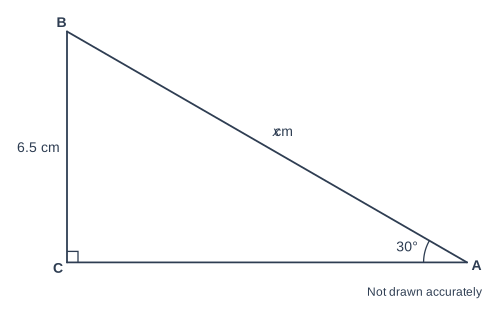
The diagram shows a right-angled triangle ABC.
BC = 6.5 cm and angle CAB = 30°.

Use the exact value of sin 30° to work out the value of x.

Geometry diagram, marked "Not drawn accurately". Triangle ABC. Angle ACB is marked as a right angle (90°). Angle CAB is marked 30°. Side BC is labelled 6.5 cm. Side AB is labelled x cm.

Model answer

From the 30° angle: BC = 6.5 cm is opposite and AB = x is the hypotenuse.
\(\sin 30^\circ = \dfrac{6.5}{x}\)
\(\dfrac{1}{2} = \dfrac{6.5}{x}\)
\(x = 6.5 \times 2 = 13\)

Explanation

Opposite and hypotenuse go with sin. Since sin 30° = \(\frac{1}{2}\), the opposite side is half of the hypotenuse, so the hypotenuse is double the opposite side. Dividing by \(\frac{1}{2}\) is the same as multiplying by 2.

Mark scheme
  1. 1 mark

    M1 for \(\sin 30^\circ = \dfrac{6.5}{x}\)

    oe

  2. 1 mark

    M1dep for \(x = 6.5 \div \dfrac{1}{2}\) or \(x = 6.5 \div \sin 30^\circ\)

    oe, e.g. \(x = 6.5 \times 2\)

  3. 1 mark

    A1 for 13

    correct answer with no working scores full marks; 3.25 (from \(6.5 \times \sin 30^\circ\)) scores 0, or M1 only if \(\sin 30^\circ = \frac{6.5}{x}\) is seen first

Question 4

4 marks

A ladder is 7 m long.
It leans against a vertical wall, with its foot on horizontal ground.
At first, the angle between the ladder and the ground is 60°.
The foot of the ladder then slides away from the wall until the angle between the ladder and the ground is 30°.

How far down the wall does the top of the ladder slide?
Give your answer to 3 significant figures.

Model answer

At first: height = \(7 \times \sin 60^\circ = 6.0621...\) m
After sliding: height = \(7 \times \sin 30^\circ = 7 \times \frac{1}{2} = 3.5\) m
6.0621... − 3.5 = 2.5621...
The top slides 2.56 m down the wall (3 s.f.).

Explanation

In both positions the ladder is the hypotenuse and the height up the wall is opposite the angle with the ground, so height = 7 × sin(angle). Work out both heights and subtract. Since sin 30° = \(\frac{1}{2}\), the second height is exactly half the ladder.

Mark scheme
  1. 1 mark

    M1 for \(7 \times \sin 60^\circ\) (= 6.06...)

    oe, e.g. \(7 \times \dfrac{\sqrt{3}}{2}\)

  2. 1 mark

    M1 for \(7 \times \sin 30^\circ\) (= 3.5)

    oe, e.g. \(7 \times \dfrac{1}{2}\)

  3. 1 mark

    M1dep for their 6.06... − their 3.5

    dependent on both previous M marks

  4. 1 mark

    A1 for 2.56 m

    accept a value in [2.56, 2.563] (2.5621...); correct answer with no working scores full marks

Ready to try the rest? Every answer you write is marked against the mark scheme, so you can see exactly where the marks are.

Study Helper Hints first, answers after you try

Stuck on this one? Ask for a hint and I’ll point you in the right direction, without giving the answer away. Once you’ve checked your answer, I’ll show you how the marks are awarded.