Level:
Correct: 0
Incorrect: 0
Marks: 0/0
Exam Practice
Course:
Topics:
AQA GCSE Maths (Foundation calculator) Smart practice A mixed round aimed at your weak spots
Unit 1
Number
Unit 2
Algebra
Unit 3
Ratio, proportion and rates of change
Unit 4
Geometry and measures
Unit 5
Probability
Unit 6
Statistics
Avg
score:
–
Topics
done:
0/86

Translations as vectors

Practise 19 exam-style questions on Translations as vectors for AQA GCSE Maths (Foundation calculator). Write your answer as you would in the exam and get it marked in seconds against the mark scheme, point by point, with the Study Helper on hand if you get stuck.

  • 19 questions
  • 1–5 marks each
  • Instant marking
  • No sign-up needed
19 questions, marked as you go

Sample questions with model answers

Here are 4 of the questions in this topic, each with a model answer, an explanation of why it earns the marks and the mark scheme an examiner would use.

Question 1

1 mark

The grid shows the point P.

P is translated by the vector \(\begin{pmatrix}3\\-1\end{pmatrix}\)

Write down the coordinates of the image of P.
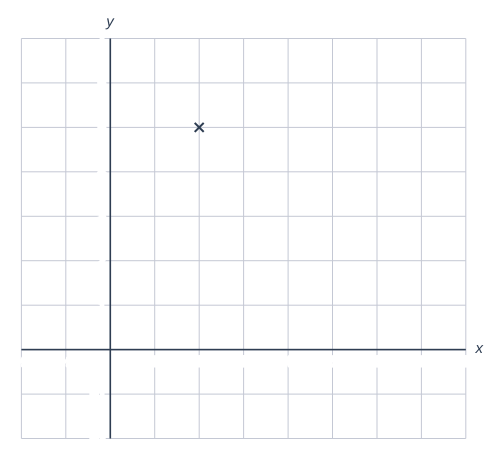
A coordinate grid with x from −2 to 8 and y from −2 to 7; each grid square is 1 unit across, and the axes cross at the origin O. Point P is marked with a cross at (2, 5).

Model answer

P is at (2, 5).
Move 3 to the right: 2 + 3 = 5
Move 1 down: 5 − 1 = 4
The image of P is (5, 4).

Explanation

Read the coordinates of P from the grid: (2, 5). Add the top number of the vector to the x-coordinate and the bottom number to the y-coordinate. A common mistake is to add the numbers the wrong way round, which gives (1, 8).

Mark scheme
  1. 1 mark

    B1 for (5, 4)

Question 2

2 marks

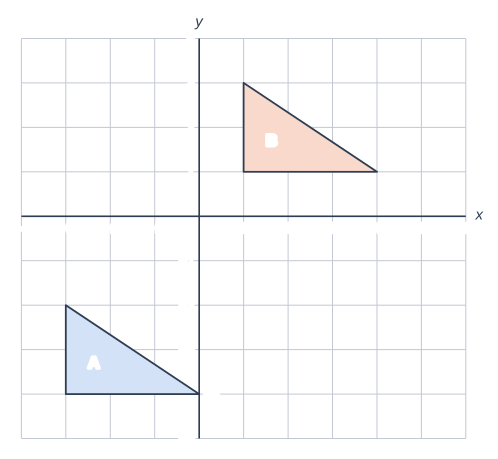
The grid shows triangle A and triangle B.

Describe fully the single transformation that maps triangle B onto triangle A.

A coordinate grid with x from −4 to 6 and y from −5 to 4; each grid square is 1 unit across, and the axes cross at the origin O. Shape A is a shaded triangle with vertices (−3, −4), (0, −4) and (−3, −2). Shape B is a shaded triangle with vertices (1, 1), (4, 1) and (1, 3).

Model answer

The question asks for B onto A, so start at B.
The corner (1, 1) of B moves to the corner (−3, −4) of A.
That is 4 left and 5 down.
Translation by the vector \(\begin{pmatrix}-4\\-5\end{pmatrix}\)

Explanation

Read the question carefully: it asks for the transformation that takes B to A, so count from B to A. Moving left and moving down both give negative numbers. Giving \(\begin{pmatrix}4\\5\end{pmatrix}\) describes the opposite journey, from A to B.

Mark scheme
  1. 1 mark

    B1 for translation

    accept translate or translated; do not accept 'move', 'slide' or 'transformation'

  2. 1 mark

    B1 for \(\begin{pmatrix}-4\\-5\end{pmatrix}\)

    accept the vector typed as (−4, −5), or 4 left and 5 down; \(\begin{pmatrix}4\\5\end{pmatrix}\) (A onto B) scores B1 B0

Question 3

2 marks

A point is translated by the vector \(\begin{pmatrix}-6\\2\end{pmatrix}\)
The image of the point is (1, −3).

Work out the coordinates of the original point.

Model answer

To go back, reverse the translation: 6 right and 2 down.
x: 1 + 6 = 7
y: −3 − 2 = −5
The original point is (7, −5).

Explanation

The vector takes the original point to (1, −3), so to find the original point you go backwards: add 6 instead of subtracting it and subtract 2 instead of adding it. Check by translating (7, −5) by the vector: (7 − 6, −5 + 2) = (1, −3).

Mark scheme
  1. 1 mark

    M1 for 1 + 6 or −3 − 2

    or either coordinate correct, or the reverse vector \(\begin{pmatrix}6\\-2\end{pmatrix}\) used

  2. 1 mark

    A1 for (7, −5)

    correct answer with no working scores full marks; SC1 for (−5, −1) (vector applied to the image instead of reversed), only if no other marks are awarded

Question 4

4 marks

A pattern is made by translating a tile again and again by the vector \(\begin{pmatrix}3\\2\end{pmatrix}\)
One corner of the first tile is at the point (−4, 1).
After each translation, this corner moves to a new point.

After how many translations is this corner at the point (11, 11)?
Will this corner ever be at the point (20, 15)? Give a reason for your answer.

Model answer

Across: 11 − (−4) = 15 and 15 ÷ 3 = 5. Up: 11 − 1 = 10 and 10 ÷ 2 = 5.
Both give 5, so the corner is at (11, 11) after 5 translations.
For (20, 15): across 20 − (−4) = 24 and 24 ÷ 3 = 8; up 15 − 1 = 14 and 14 ÷ 2 = 7.
8 and 7 are different, so no, the corner is never at (20, 15). (After 8 translations it is at (20, 17).)

Explanation

Each translation moves the corner 3 across and 2 up. To reach a point, the number of moves needed across must be the same as the number needed up. For (11, 11) both are 5, but for (20, 15) they are 8 and 7, so that point is never reached.

Mark scheme
  1. 1 mark

    M1 for (11 − (−4)) ÷ 3 or (11 − 1) ÷ 2

    or a list of positions (−1, 3), (2, 5), ... reaching (11, 11)

  2. 1 mark

    A1 for 5

  3. 1 mark

    M1 for (20 − (−4)) ÷ 3 (= 8) and (15 − 1) ÷ 2 (= 7)

    or a list showing (17, 15) and (20, 17) are positions but (20, 15) is not

  4. 1 mark

    A1 for No, with a correct reason, e.g. it needs 8 translations to get across to 20 but 7 translations to get up to 15

    accept when x = 20 the corner is at (20, 17), not (20, 15)

Ready to try the rest? Every answer you write is marked against the mark scheme, so you can see exactly where the marks are.

Study Helper Hints first, answers after you try

Stuck on this one? Ask for a hint and I’ll point you in the right direction, without giving the answer away. Once you’ve checked your answer, I’ll show you how the marks are awarded.