Practise 29 exam-style questions on Ordering numbers and inequality symbols for AQA GCSE Maths (Foundation calculator). Write your answer as you would in the exam and get it marked in seconds against the mark scheme, point by point, with the Study Helper on hand if you get stuck.
29 questions
1–5 marks each
Instant marking
No sign-up needed
20 questions, marked as you go
Sample questions with model answers
Here are 4 of the questions in this topic, each with a model answer, an explanation of why it earns the marks and the mark scheme an examiner would use.
Question 1
1 mark
Maya says, "−8 is greater than −3 because 8 is greater than 3."
Is Maya correct? Give a reason for your answer.
Model answer
No. −8 is further below zero than −3, so −8 is less than −3.
Explanation
With negative numbers, the further a number is from zero, the smaller it is. On a number line −8 is to the left of −3, so −8 < −3. Thinking of temperatures helps: −8 °C is colder than −3 °C.
Mark scheme
1 mark
B1 for No, with a correct reason, e.g. −8 is less than −3 because −8 is further below zero (further to the left on a number line)
accept −3 is greater than −8; accept a temperature argument, e.g. −8 °C is colder than −3 °C; do not accept "No" with no reason or an incorrect reason
Question 2
2 marks
Here is a number line.
Write down the number shown by arrow A and the number shown by arrow B.
Model answer
There are 5 small divisions between each whole number, so each division is 0.2 A is 2 divisions to the left of −1: −1 − 0.4 = −1.4 B is 3 divisions to the right of 0: 0.6
Explanation
Work out what one small division is worth: 1 ÷ 5 = 0.2. To the left of zero the numbers get more negative, so 2 divisions past −1 is −1.4, not −0.6. A common mistake is to count each small division as 0.1.
Mark scheme
1 mark
B1 for A = −1.4
do not accept −1.2 or −0.6
1 mark
B1 for B = 0.6
Question 3
2 marks
Priya says, "\(\frac{7}{11}\) is smaller than \(\frac{5}{8}\) because 11 is bigger than 8."
Is Priya correct? You must show your working.
Model answer
\(\frac{7}{11} = 7 \div 11 = 0.6363...\) \(\frac{5}{8} = 5 \div 8 = 0.625\) 0.6363... is bigger than 0.625 No, Priya is not correct: \(\frac{7}{11}\) is bigger than \(\frac{5}{8}\).
Explanation
You cannot compare fractions just by looking at their denominators, because the numerators are different too. Change each fraction to a decimal by dividing the numerator by the denominator, then compare. You could also use a common denominator: \(\frac{56}{88}\) is bigger than \(\frac{55}{88}\).
Mark scheme
1 mark
M1 for converting both fractions to decimals (0.636... and 0.625) or to fractions with a common denominator (\(\frac{56}{88}\) and \(\frac{55}{88}\))
accept percentages 63.6...% and 62.5%
1 mark
A1 for No, with correct values for both, e.g. 0.636... is bigger than 0.625
answer only scores 0 (working required)
Question 4
4 marks
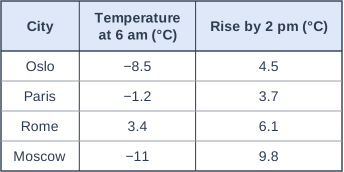
The table shows the temperature in four cities at 6 am one day. It also shows how much the temperature rose by 2 pm.
Write the four cities in order of their temperature at 2 pm, starting with the coldest.
Model answer
Oslo: −8.5 + 4.5 = −4 °C Paris: −1.2 + 3.7 = 2.5 °C Rome: 3.4 + 6.1 = 9.5 °C Moscow: −11 + 9.8 = −1.2 °C In order: −4, −1.2, 2.5, 9.5 Oslo, Moscow, Paris, Rome
Explanation
Add each rise to the 6 am temperature; for a negative start, count up towards zero and past it. Then order the new temperatures, remembering that the negative one furthest from zero is the coldest. Moscow was the coldest at 6 am but it warmed up the most, so it is not the coldest at 2 pm.
Mark scheme
1 mark
M1 for a correct method for the 2 pm temperature of a city that starts below zero, e.g. −8.5 + 4.5 or −11 + 9.8
1 mark
A1 for all four 2 pm temperatures correct: Oslo −4 °C, Paris 2.5 °C, Rome 9.5 °C, Moscow −1.2 °C
1 mark
M1 for their four 2 pm temperatures in order, coldest first
ft their temperatures if at least two are correct
1 mark
A1 for Oslo, Moscow, Paris, Rome
correct answer with no working scores full marks
Ready to try the rest? Every answer you write is marked against the mark scheme, so you can see exactly where the marks are.
Ctrl + Enter to check
Study HelperHints first, answers after you try
Stuck on this one? Ask for a hint and I’ll point you in the right direction, without giving the answer away. Once you’ve checked your answer, I’ll show you how the marks are awarded.