Practise 36 exam-style questions on Compound units: speed, density and pressure for AQA GCSE Maths (Foundation calculator). Write your answer as you would in the exam and get it marked in seconds against the mark scheme, point by point, with the Study Helper on hand if you get stuck.
36 questions
1–5 marks each
Instant marking
No sign-up needed
20 questions, marked as you go
Sample questions with model answers
Here are 4 of the questions in this topic, each with a model answer, an explanation of why it earns the marks and the mark scheme an examiner would use.
Question 1
1 mark
A tap fills a 24-litre bucket with water in 3 minutes.
Work out the rate of flow of water from the tap in litres per minute.
Model answer
24 ÷ 3 = 8 8 litres per minute
Explanation
"Litres per minute" means the number of litres in each minute, so divide the litres by the minutes: 24 ÷ 3 = 8. The unit tells you which way round to divide: litres ÷ minutes.
Mark scheme
1 mark
B1 for 8 (litres per minute)
Question 2
2 marks
Gold has a density of 19.3 g/cm³. A gold coin has a mass of 50 g.
Work out the volume of the coin. Give your answer to 1 decimal place.
Model answer
Volume = mass ÷ density 50 ÷ 19.3 = 2.5906... Volume = 2.6 cm³ (1 d.p.)
Explanation
Density = mass ÷ volume, so volume = mass ÷ density: 50 ÷ 19.3 = 2.5906..., which is 2.6 cm³ to 1 decimal place. Gold is very dense, so a small volume has a large mass - a volume of 965 cm³ (from multiplying) would be a huge coin.
Mark scheme
1 mark
M1 for 50 ÷ 19.3
1 mark
A1 for 2.6 cm³
accept 2.6 or a more accurate value in [2.59, 2.6] (2.5906...); correct answer with no working scores full marks; do not accept 965 (from 50 × 19.3)
Question 3
3 marks
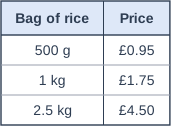
The table shows the prices of three bags of the same rice.
Which bag is the best value for money? You must show your working.
Model answer
Cost per kg: 500 g bag: £0.95 × 2 = £1.90 per kg 1 kg bag: £1.75 per kg 2.5 kg bag: £4.50 ÷ 2.5 = £1.80 per kg The 1 kg bag is the best value.
Explanation
Change every bag to the same amount - here the cost of 1 kg - so they can be compared. 500 g is half a kilogram, so double its price; divide the 2.5 kg price by 2.5. The biggest bag is not always the best value: the 1 kg bag has the lowest cost per kilogram.
Mark scheme
1 mark
M1 for a correct method to find a comparable value for at least two bags, e.g. cost per kg: 0.95 × 2 (= 1.90), 4.50 ÷ 2.5 (= 1.80)
or cost per 100 g (19p, 17.5p, 18p), or cost of 5 kg (£9.50, £8.75, £9.00), or grams per £1 (526..., 571..., 555...)
1 mark
A1 for all three comparable values correct, e.g. £1.90, £1.75 and £1.80 per kg
1 mark
A1 for the 1 kg bag, with correct values for all three bags
answer only scores 0
Question 4
4 marks
Metal X has a density of 8.4 g/cm³. Metal Y has a density of 7.2 g/cm³.
504 g of metal X and 216 g of metal Y are melted and mixed together to make an alloy.
Work out the density of the alloy.
Model answer
Volume of X = 504 ÷ 8.4 = 60 cm³ Volume of Y = 216 ÷ 7.2 = 30 cm³ Total mass = 504 + 216 = 720 g Total volume = 60 + 30 = 90 cm³ Density of alloy = 720 ÷ 90 = 8 g/cm³
Explanation
The density of the alloy is its total mass divided by its total volume. Find the volume of each metal with volume = mass ÷ density, then add the volumes and add the masses. Do not just find the mean of the two densities (7.8) - there is more of metal X, so the alloy's density is closer to 8.4.
Mark scheme
1 mark
M1 for 504 ÷ 8.4 (= 60) or 216 ÷ 7.2 (= 30)
1 mark
M1 for 504 + 216 (= 720) or their 60 + their 30 (= 90)
1 mark
M1dep for 720 ÷ (their 60 + their 30)
dependent on the first M1
1 mark
A1 for 8 (g/cm³)
correct answer with no working scores full marks; 7.8 from (8.4 + 7.2) ÷ 2 scores 0
Ready to try the rest? Every answer you write is marked against the mark scheme, so you can see exactly where the marks are.
Ctrl + Enter to check
Study HelperHints first, answers after you try
Stuck on this one? Ask for a hint and I’ll point you in the right direction, without giving the answer away. Once you’ve checked your answer, I’ll show you how the marks are awarded.