Practise 28 exam-style questions on Generating sequences for AQA GCSE Maths (Foundation calculator). Write your answer as you would in the exam and get it marked in seconds against the mark scheme, point by point, with the Study Helper on hand if you get stuck.
28 questions
1–5 marks each
Instant marking
No sign-up needed
20 questions, marked as you go
Sample questions with model answers
Here are 4 of the questions in this topic, each with a model answer, an explanation of why it earns the marks and the mark scheme an examiner would use.
The term-to-term rule tells you how to get from one term to the next. Subtract each term from the one after it: the difference is always 7, so the rule is add 7. Do not write an nth term such as 7n − 5; that is a position-to-term rule.
Mark scheme
1 mark
B1 for add 7
oe, e.g. +7 or 'goes up in 7s'; do not accept 7n or n + 7
Question 2
2 marks
The nth term of a sequence is \(n^2 + 5\)
Work out the difference between the 6th term and the 3rd term.
Put n = 6 and n = 3 into the rule. \(n^2\) means n × n, so \(6^2 = 36\), not 12. Then subtract the smaller term from the larger one. The terms of this sequence do not go up by the same amount each time, so you cannot just multiply a difference by 3.
Mark scheme
1 mark
M1 for 41 (6th term) or 14 (3rd term)
or \(6^2 + 5\) or \(3^2 + 5\)
1 mark
A1 for 27
correct answer with no working scores full marks
Question 3
3 marks
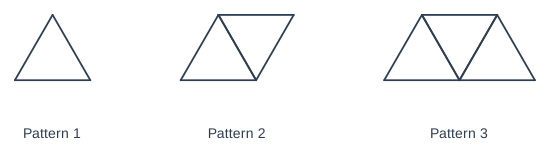
The diagram shows the first three patterns in a sequence. The patterns are made from sticks. Each pattern is a row of triangles.
Count the sticks: 3, 5, 7, so each new triangle adds 2 sticks because it shares a side with the one before. From Pattern 1 to Pattern 20 there are 19 steps, so add 19 lots of 2 to the 3 sticks in Pattern 1. A common mistake is to add 20 lots of 2.
Mark scheme
1 mark
M1 for the number of sticks going up by 2 each time (3, 5, 7), e.g. 9 for Pattern 4
1 mark
M1 for \(2 \times 20 + 1\) or 3 + 19 × 2 or continuing the sequence correctly to Pattern 20
1 mark
A1 for 41
correct answer with no working scores full marks; 43 (from 3 + 20 × 2) scores M1 M0 A0
Question 4
4 marks
The first term of a sequence is 3. The term-to-term rule is
multiply by 2 then add k
The 3rd term of the sequence is 30.
Work out the value of k.
Model answer
2nd term = 3 × 2 + k = 6 + k 3rd term = 2(6 + k) + k = 12 + 2k + k = 12 + 3k 12 + 3k = 30 3k = 18 k = 6 Check: 3, 12, 30
Explanation
Use the rule with the letter k in it, just as you would with a number. The 2nd term is 6 + k, so the 3rd term is 2 lots of (6 + k) plus another k, which is 12 + 3k. Set this equal to 30 and solve. Trying values of k and checking also works if you show each trial.
Mark scheme
1 mark
M1 for the 2nd term as \(6 + k\) oe
or a correct trial, e.g. k = 5 gives 3, 11, 27
1 mark
M1 for the 3rd term as \(2(6 + k) + k\) oe
or two correct trials that give 3rd terms either side of 30
1 mark
M1dep for \(12 + 3k = 30\) oe
1 mark
A1 for k = 6
correct answer with no working scores full marks; k = 6 found by trials and checked scores full marks
Ready to try the rest? Every answer you write is marked against the mark scheme, so you can see exactly where the marks are.
Ctrl + Enter to check
Study HelperHints first, answers after you try
Stuck on this one? Ask for a hint and I’ll point you in the right direction, without giving the answer away. Once you’ve checked your answer, I’ll show you how the marks are awarded.