Practise 39 exam-style questions on Circles, surface area and volume of solids for AQA GCSE Maths (Foundation calculator). Write your answer as you would in the exam and get it marked in seconds against the mark scheme, point by point, with the Study Helper on hand if you get stuck.
39 questions
1–5 marks each
Instant marking
No sign-up needed
20 questions, marked as you go
Sample questions with model answers
Here are 4 of the questions in this topic, each with a model answer, an explanation of why it earns the marks and the mark scheme an examiner would use.
Question 1
1 mark
The circumference of a circle is 30π cm.
Write down the diameter of the circle.
Model answer
Circumference = \(\pi d\) \(\pi d = 30\pi\), so d = 30 cm
Explanation
The circumference of a circle is π × diameter. If the circumference is 30π, the diameter must be 30. A common mistake is to give 15, which is the radius.
Mark scheme
1 mark
B1 for 30 cm
Question 2
2 marks
The circumference of a circle is 60 cm.
Work out the radius of the circle. Give your answer to 3 significant figures.
Model answer
\(2\pi r = 60\) \(r = 60 \div (2\pi)\) = 9.5492... = 9.55 cm (3 s.f.)
Explanation
Start from circumference = \(2\pi r\) and work backwards: divide 60 by 2π. On your calculator, use brackets: 60 ÷ (2 × π). If you only divide by π you get the diameter, which is twice the radius.
Mark scheme
1 mark
M1 for \(60 \div (2 \times \pi)\)
oe, e.g. \(2\pi r = 60\), or 60 ÷ π (= 19.09..., the diameter)
1 mark
A1 for 9.55 cm
accept 9.55 or a more accurate value in [9.549, 9.55] (9.5492...); correct answer with no working scores full marks; 19.1 (diameter) scores M1 A0
Question 3
3 marks
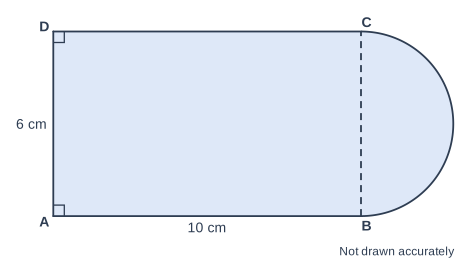
The diagram shows a shape made from a rectangle ABCD and a semicircle. BC is the diameter of the semicircle.
Work out the perimeter of the shape. Give your answer to 1 decimal place.
The perimeter is the outside edge only: AB, AD, DC and the curved arc. BC is inside the shape, so it is not part of the perimeter. The arc is half the circumference of a circle with diameter 6 cm.
Mark scheme
1 mark
M1 for \(\pi \times 6 \div 2\) (= 9.42...)
oe, e.g. 3π
1 mark
M1dep for 10 + 6 + 10 + their 9.42...
oe, e.g. 26 + 3π
1 mark
A1 for 35.4 cm
accept 35.4 or a more accurate value in [35.42, 35.43] (35.424...); correct answer with no working scores full marks; 41.4 (BC included) scores M1 M0 A0
Question 4
4 marks
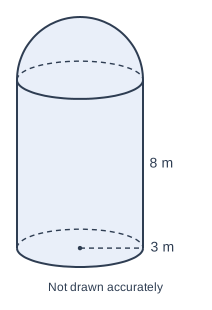
The diagram shows a grain silo. The silo is a cylinder with a hemisphere on top.
Volume of a sphere = \(\frac{4}{3}\pi r^3\)
Work out the volume of the silo. Give your answer to 3 significant figures.
Split the silo into a cylinder and a hemisphere with the same radius. The hemisphere is half a sphere, so halve the sphere formula. Add the two volumes and round only at the end.
Mark scheme
1 mark
M1 for \(\pi \times 3^2 \times 8\) (= 226.1... or 72π)
oe
1 mark
M1 for \(\frac{1}{2} \times \frac{4}{3} \times \pi \times 3^3\) (= 56.5... or 18π)
oe
1 mark
M1dep for their 226.1... + their 56.5...
dependent on both previous M marks; oe, e.g. 72π + 18π = 90π
1 mark
A1 for 283 m³
accept 283 or a more accurate value in [282.7, 283] (282.74...); correct answer with no working scores full marks; 339 (whole sphere added) scores M1 M0 M0 A0
Ready to try the rest? Every answer you write is marked against the mark scheme, so you can see exactly where the marks are.
Ctrl + Enter to check
Study HelperHints first, answers after you try
Stuck on this one? Ask for a hint and I’ll point you in the right direction, without giving the answer away. Once you’ve checked your answer, I’ll show you how the marks are awarded.