Level:
Correct: 0
Incorrect: 0
Marks: 0/0
Exam Practice
Course:
Topics:
AQA GCSE Maths (Foundation calculator) Smart practice A mixed round aimed at your weak spots
Unit 1
Number
Unit 2
Algebra
Unit 3
Ratio, proportion and rates of change
Unit 4
Geometry and measures
Unit 5
Probability
Unit 6
Statistics
Avg
score:
–
Topics
done:
0/86

Estimation and approximation

Practise 29 exam-style questions on Estimation and approximation for AQA GCSE Maths (Foundation calculator). Write your answer as you would in the exam and get it marked in seconds against the mark scheme, point by point, with the Study Helper on hand if you get stuck.

  • 29 questions
  • 1–5 marks each
  • Instant marking
  • No sign-up needed
20 questions, marked as you go

Sample questions with model answers

Here are 4 of the questions in this topic, each with a model answer, an explanation of why it earns the marks and the mark scheme an examiner would use.

Question 1

1 mark

A pen costs £1.98

Estimate the cost of 6 pens.

Model answer

£1.98 ≈ £2
6 × £2 = £12

Explanation

£1.98 is very close to £2, so 6 pens cost about 6 × £2 = £12. An estimate uses easy rounded numbers, so you do not need to work out the exact cost.

Mark scheme
  1. 1 mark

    B1 for £12

    accept 12 or £12.00; do not accept £11.88 (the exact cost, not an estimate)
Question 2

2 marks

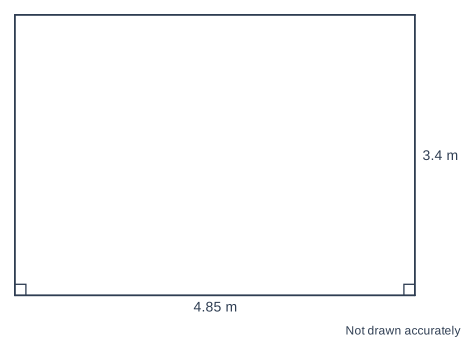
The diagram shows the floor of a room.
The floor is a rectangle.

Estimate the area of the floor.

Geometry diagram, marked "Not drawn accurately". A rectangle (its vertices are not labelled). The angle at an unlabelled point is marked as a right angle (90°). The angle at an unlabelled point is marked as a right angle (90°). The unlabelled side going to the right is labelled 4.85 m. The unlabelled side going upwards is labelled 3.4 m.

Model answer

4.85 m ≈ 5 m and 3.4 m ≈ 3 m
Area ≈ 5 × 3 = 15 m²

Explanation

The area of a rectangle is length × width. Round each length to 1 significant figure (5 m and 3 m) and multiply to get an estimate of 15 m². Area units are squared, so the answer is in m².

Mark scheme
  1. 1 mark

    M1 for 5 × 3

    accept 5 × 3.4 or 4.85 × 3 for M1

  2. 1 mark

    A1 for 15 m²

    accept 17 (from 5 × 3.4) or 14.55 (from 4.85 × 3); do not accept 16.49 (exact)

Question 3

3 marks

Use approximations to show that \(\dfrac{29.8 \times 6.12}{0.198}\) is approximately 900

Model answer

29.8 ≈ 30, 6.12 ≈ 6, 0.198 ≈ 0.2
\(\dfrac{30 \times 6}{0.2} = \dfrac{180}{0.2} = 900\)

Explanation

Round each number to 1 significant figure and show every step. Dividing by 0.2 is the same as multiplying by 5, so 180 ÷ 0.2 = 900. In a 'show that' question the final answer is given, so the marks are for the working.

Mark scheme
  1. 1 mark

    M1 for at least two of 30, 6 and 0.2 seen

  2. 1 mark

    M1dep for 180 ÷ 0.2 or 30 × 30 or 150 × 6

  3. 1 mark

    A1 for 900 with all three approximations seen

    answer only scores 0; working with the exact values (921.09...) scores 0

Question 4

4 marks

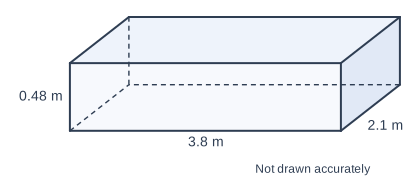
The diagram shows a garden pond in the shape of a cuboid.
The pond is empty.

1 m³ = 1000 litres
A hose fills the pond with water at 19.6 litres per minute.

Use approximations to estimate how long it will take to fill the pond.
Give your answer in minutes.

A cuboid drawn in 3D with hidden edges shown as dashed lines. The length is labelled 3.8 m (along the front bottom edge). The width (the edge going back) is labelled 2.1 m (along the bottom edge going back on the right). The height is labelled 0.48 m (along the front left vertical edge). The diagram is labelled "Not drawn accurately".

Model answer

3.8 ≈ 4, 2.1 ≈ 2, 0.48 ≈ 0.5
Volume ≈ 4 × 2 × 0.5 = 4 m³
4 m³ = 4 × 1000 = 4000 litres
19.6 ≈ 20
Time ≈ 4000 ÷ 20 = 200 minutes

Explanation

Estimate the volume of the cuboid with rounded lengths, change it to litres using 1 m³ = 1000 litres, then divide by the number of litres each minute. Keep the units in mind: the volume must be in litres before dividing by litres per minute.

Mark scheme
  1. 1 mark

    M1 for 4 × 2 × 0.5 (= 4)

    rounded values for at least two of the dimensions, used in length × width × depth

  2. 1 mark

    M1dep for their 4 × 1000 (= 4000 litres)

  3. 1 mark

    M1dep for their 4000 ÷ 20

  4. 1 mark

    A1 for 200 minutes

    accept answers in [190, 210] from a correct method with sensible roundings; do not accept 195.4... (exact values used); an exact method can score the M marks but not the A1

Ready to try the rest? Every answer you write is marked against the mark scheme, so you can see exactly where the marks are.

Study Helper Hints first, answers after you try

Stuck on this one? Ask for a hint and I’ll point you in the right direction, without giving the answer away. Once you’ve checked your answer, I’ll show you how the marks are awarded.