
Level:
Correct: 0
Incorrect: 0
Marks: 0/0
Exam Practice
Course:
Topics:
AQA GCSE Maths (Foundation calculator) Smart practice A mixed round aimed at your weak spots
Unit 1
Number
Unit 2
Algebra
Unit 3
Ratio, proportion and rates of change
Unit 4
Geometry and measures
Unit 5
Probability
Unit 6
Statistics
Avg
score:
–
Topics
done:
0/86

Multiplicative relationships as ratios and fractions

Practise 20 exam-style questions on Multiplicative relationships as ratios and fractions for AQA GCSE Maths (Foundation calculator). Write your answer as you would in the exam and get it marked in seconds against the mark scheme, point by point, with the Study Helper on hand if you get stuck.

  • 20 questions
  • 1–5 marks each
  • Instant marking
  • No sign-up needed
20 questions, marked as you go

Sample questions with model answers

Here are 4 of the questions in this topic, each with a model answer, an explanation of why it earns the marks and the mark scheme an examiner would use.

Question 1

1 mark

The bar model shows the ratio of cats to dogs at an animal rescue centre.

What fraction of the animals are cats?
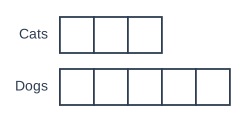
A bar model: 2 bars, one above the other, lined up at the left and drawn to the same scale: bar 1 (labelled "Cats") split into 3 equal boxes; bar 2 (labelled "Dogs") split into 5 equal boxes. The bars have lengths in the ratio 3 : 5 (every box is the same size).

Model answer

Cats : dogs = 3 : 5
There are 3 + 5 = 8 equal parts altogether.
Cats are 3 of the 8 parts.
Fraction of animals that are cats = \(\frac{3}{8}\)

Explanation

The bar model shows 3 equal boxes for cats and 5 for dogs, so there are 8 boxes altogether. The cats are 3 out of the 8 boxes. A common mistake is to write \(\frac{3}{5}\), which compares cats with dogs instead of with all the animals.

Mark scheme
  1. 1 mark

    B1 for \(\frac{3}{8}\) oe

    accept 0.375 or 37.5%; do not accept \(\frac{3}{5}\)

Question 2

2 marks

Write the ratio 5 : 8 in the form 1 : n

Model answer

To make the first number 1, divide both numbers by 5.
5 ÷ 5 = 1
8 ÷ 5 = 1.6
5 : 8 = 1 : 1.6

Explanation

In the form 1 : n the first part must be 1, so divide both parts by the first number, 5. The second part does not have to be a whole number. Dividing 5 by 8 instead gives 0.625, which is the wrong way round.

Mark scheme
  1. 1 mark

    M1 for 8 ÷ 5 or \(\frac{5}{5} : \frac{8}{5}\)

  2. 1 mark

    A1 for 1 : 1.6

    accept n = 1.6 or 1 : \(\frac{8}{5}\) oe; correct answer with no working scores full marks; do not accept 1 : 0.625

Question 3

2 marks

Lucy is asked to write the ratio 1.2 m : 30 cm in its simplest form.

Here is her working.

1.2 : 30
= 12 : 300
= 1 : 25

Lucy's answer is wrong.
What mistake has she made?
Work out the correct answer.

Model answer

Lucy did not change both lengths into the same units.
1.2 m = 120 cm
120 : 30
Divide both parts by 30.
= 4 : 1

Explanation

Before simplifying a ratio, both quantities must be in the same units. Lucy used 1.2 (metres) with 30 (centimetres). Changing 1.2 m to 120 cm gives 120 : 30, which simplifies to 4 : 1.

Mark scheme
  1. 1 mark

    B1 for she has not changed the lengths into the same units

    oe, e.g. 1.2 m should be 120 cm; she has used metres for one length and centimetres for the other

  2. 1 mark

    B1 for 4 : 1

    do not accept 1 : 4 or 120 : 30

Question 4

4 marks

A fruit drink is made from orange juice, mango juice and water.

There is twice as much mango juice as orange juice.
The amount of water is \(\frac{3}{4}\) of the total amount of orange juice and mango juice.

What fraction of the drink is mango juice?

Model answer

Suppose there is 1 part of orange juice.
Mango juice = 2 parts
Total juice = 1 + 2 = 3 parts
Water = \(\frac{3}{4} \times 3 = 2.25\) parts
Total drink = 3 + 2.25 = 5.25 parts
Fraction of mango juice = \(\frac{2}{5.25} = \frac{8}{21}\)

Explanation

Choose an amount for the orange juice (1 part, or 100 ml) and use the facts to find each of the others in turn. Multiplying 1 : 2 : 2.25 by 4 gives the whole-number ratio 4 : 8 : 9, so mango is 8 parts out of 21. Remember the total includes the water.

Mark scheme
  1. 1 mark

    M1 for orange : mango = 1 : 2

    oe, e.g. a correct example such as 100 ml orange and 200 ml mango

  2. 1 mark

    M1 for water = \(\frac{3}{4} \times 3\) (= 2.25) oe

    e.g. \(\frac{3}{4} \times 300 = 225\) ml, or orange : mango : water = 4 : 8 : 9

  3. 1 mark

    M1 for mango ÷ total, e.g. \(\frac{2}{5.25}\) or \(\frac{200}{525}\)

    ft their amounts, provided the total includes all three parts

  4. 1 mark

    A1 for \(\frac{8}{21}\) oe

    correct answer with no working scores full marks; accept 0.38 or 0.381 (0.380952...) for M3 A0

Ready to try the rest? Every answer you write is marked against the mark scheme, so you can see exactly where the marks are.

Study Helper Hints first, answers after you try

Stuck on this one? Ask for a hint and I’ll point you in the right direction, without giving the answer away. Once you’ve checked your answer, I’ll show you how the marks are awarded.