
Level:
Correct: 0
Incorrect: 0
Marks: 0/0
Exam Practice
Course:
Topics:
AQA GCSE Maths (Foundation calculator) Smart practice A mixed round aimed at your weak spots
Unit 1
Number
Unit 2
Algebra
Unit 3
Ratio, proportion and rates of change
Unit 4
Geometry and measures
Unit 5
Probability
Unit 6
Statistics
Avg
score:
–
Topics
done:
0/86

Frequency trees and probability experiments

Practise 28 exam-style questions on Frequency trees and probability experiments for AQA GCSE Maths (Foundation calculator). Write your answer as you would in the exam and get it marked in seconds against the mark scheme, point by point, with the Study Helper on hand if you get stuck.

  • 28 questions
  • 1–5 marks each
  • Instant marking
  • No sign-up needed
20 questions, marked as you go

Sample questions with model answers

Here are 4 of the questions in this topic, each with a model answer, an explanation of why it earns the marks and the mark scheme an examiner would use.

Question 1

1 mark

Kai takes a sweet at random from a jar.
He writes down its colour and puts it back.
He does this 40 times.
The bar chart shows his results.

How many more times did he take a red sweet than a yellow sweet?
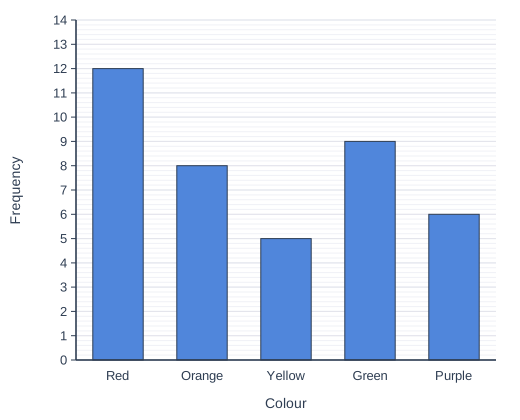
Bar chart of frequency for each colour: Red 12, Orange 8, Yellow 5, Green 9, Purple 6.

Model answer

Red = 12, Yellow = 5
12 − 5 = 7

Explanation

Read the height of the red bar (12) and the yellow bar (5) from the scale on the vertical axis. 'How many more' means find the difference, so subtract.

Mark scheme
  1. 1 mark

    B1 for 7

Question 2

2 marks

There are 60 people in a choir.
24 of the people are men.
The rest are women.
9 of the men wear glasses.
20 of the women wear glasses.

Amy works out how many of the women do not wear glasses.
Here is her working.

60 − 20 = 40

Amy's answer is wrong.
What mistake has she made?
Work out the correct answer.

Model answer

Amy took 20 away from all 60 people, but 20 is part of the women only.
Number of women = 60 − 24 = 36
Women who do not wear glasses = 36 − 20 = 16

Explanation

On a frequency tree the people are first split into men and women, and only then split by glasses. The 20 women with glasses must be taken away from the number of women, 36, not from the whole choir. Drawing a quick frequency tree makes it clear which number each branch splits from.

Mark scheme
  1. 1 mark

    B1 for a correct mistake, e.g. she subtracted 20 from the total number of people (60) instead of from the number of women

    accept she should have used 36 (the number of women) or she should have worked out 60 − 24 first; do not accept 'she subtracted wrongly'

  2. 1 mark

    B1 for 16

Question 3

3 marks

There are 150 people at a cinema.
62 of the people are children.
The rest are adults.

\(\frac{3}{4}\) of the adults buy popcorn.
45 of the children buy popcorn.

How many of the 150 people do not buy popcorn?

Model answer

Adults = 150 − 62 = 88
Adults who buy popcorn = \(\frac{3}{4}\) × 88 = 66
Adults who do not = 88 − 66 = 22
Children who do not = 62 − 45 = 17
Total who do not buy popcorn = 22 + 17 = 39

Explanation

Split the people into adults and children first, as on a frequency tree. Then split each group into those who buy popcorn and those who do not. Add the two 'do not buy' groups together. A common mistake is to find \(\frac{3}{4}\) of all 150 people instead of \(\frac{3}{4}\) of the adults.

Mark scheme
  1. 1 mark

    M1 for 150 − 62 (= 88)

    may be seen on a frequency tree

  2. 1 mark

    M1 for \(\frac{1}{4}\) × their 88 (= 22) or 62 − 45 (= 17)

    or \(\frac{3}{4}\) × their 88 (= 66) and their 88 − their 66

  3. 1 mark

    A1 for 39

    correct answer with no working scores full marks

Question 4

4 marks

Some people were asked if they have a pet.
45% of the people asked were men.
63 men were asked.

40 of the men have a pet.
52 of the women have a pet.

How many of the people asked do not have a pet?

Model answer

45% of the people = 63
1% = 63 ÷ 45 = 1.4
100% = 140 people
Women = 140 − 63 = 77
Men with no pet = 63 − 40 = 23
Women with no pet = 77 − 52 = 25
People with no pet = 23 + 25 = 48

Explanation

63 men are 45% of everyone, so divide 63 by 0.45 to find the total number of people (a reverse percentage). Then find the number of women and complete the frequency tree in your head: subtract the pet owners from each group and add the results. A common mistake is to find 45% of 63.

Mark scheme
  1. 1 mark

    M1 for 63 ÷ 0.45 (= 140)

    oe, e.g. 63 ÷ 45 × 100; the total number of people asked

  2. 1 mark

    M1dep for their 140 − 63 (= 77)

    the number of women; or 0.55 × their 140

  3. 1 mark

    M1 for 63 − 40 (= 23) or their 77 − 52 (= 25)

  4. 1 mark

    A1 for 48

    correct answer with no working scores full marks

Ready to try the rest? Every answer you write is marked against the mark scheme, so you can see exactly where the marks are.

Study Helper Hints first, answers after you try

Stuck on this one? Ask for a hint and I’ll point you in the right direction, without giving the answer away. Once you’ve checked your answer, I’ll show you how the marks are awarded.