Level:
Correct: 0
Incorrect: 0
Marks: 0/0
Exam Practice
Course:
Topics:
AQA GCSE Maths (Foundation calculator) Smart practice A mixed round aimed at your weak spots
Unit 1
Number
Unit 2
Algebra
Unit 3
Ratio, proportion and rates of change
Unit 4
Geometry and measures
Unit 5
Probability
Unit 6
Statistics
Avg
score:
–
Topics
done:
0/86

Areas and volumes of prisms

Practise 37 exam-style questions on Areas and volumes of prisms for AQA GCSE Maths (Foundation calculator). Write your answer as you would in the exam and get it marked in seconds against the mark scheme, point by point, with the Study Helper on hand if you get stuck.

  • 37 questions
  • 1–5 marks each
  • Instant marking
  • No sign-up needed
20 questions, marked as you go

Sample questions with model answers

Here are 4 of the questions in this topic, each with a model answer, an explanation of why it earns the marks and the mark scheme an examiner would use.

Question 1

1 mark

A cube has a volume of 2197 cm³.

Work out the length of one edge of the cube.

Model answer

Edge = \(\sqrt[3]{2197}\) = 13 cm
Check: 13 × 13 × 13 = 2197

Explanation

The volume of a cube is edge × edge × edge, so to go back from the volume to the edge you find the cube root. Use the cube root button on your calculator. A common mistake is to divide by 3, which gives 732.3..., far too big.

Mark scheme
  1. 1 mark

    B1 for 13 cm

Question 2

2 marks

A triangle has an area of 37.8 cm².
The base of the triangle is 10.8 cm.

Work out the perpendicular height of the triangle.

Model answer

\(\frac{1}{2} \times 10.8 \times h = 37.8\)
\(5.4h = 37.8\)
\(h = 37.8 \div 5.4 = 7\)
The height is 7 cm.

Explanation

Put the numbers you know into area = \(\frac{1}{2}\) × base × height and solve for the height. Half of 10.8 is 5.4, so the height is 37.8 ÷ 5.4. If you just divide the area by the base you get 3.5, which is half the right answer.

Mark scheme
  1. 1 mark

    M1 for \(37.8 \times 2 \div 10.8\)

    oe, e.g. \(\frac{1}{2} \times 10.8 \times h = 37.8\) or \(5.4h = 37.8\) or \(75.6 \div 10.8\)

  2. 1 mark

    A1 for 7 cm

    correct answer with no working scores full marks; 3.5 (no doubling) scores 0

Question 3

3 marks

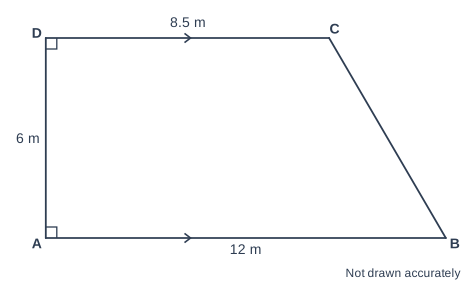
The diagram shows a lawn in the shape of a trapezium.

Rosa wants to cover the whole lawn with new turf.
Turf costs £4.86 per square metre.

Work out the cost of the turf for the lawn.

Geometry diagram, marked "Not drawn accurately". Trapezium ABCD. Angle DAB is marked as a right angle (90°). Angle CDA is marked as a right angle (90°). Side AB is labelled 12 m. Side DC is labelled 8.5 m. Side AD is labelled 6 m. AB and DC are each marked with an arrowhead (parallel lines).

Model answer

Area = \(\frac{1}{2} \times (12 + 8.5) \times 6\)
= \(\frac{1}{2} \times 20.5 \times 6\)
= 61.5 m²
Cost = 61.5 × 4.86 = £298.89

Explanation

First find the area of the lawn with the trapezium formula: add the parallel sides, halve, and multiply by the height between them. Then multiply the area by the cost of one square metre. Write money answers with two decimal places.

Mark scheme
  1. 1 mark

    M1 for \(\frac{1}{2} \times (12 + 8.5) \times 6\) (= 61.5)

    oe, e.g. 8.5 × 6 + \(\frac{1}{2}\) × 3.5 × 6

  2. 1 mark

    M1dep for their 61.5 × 4.86

  3. 1 mark

    A1 for £298.89

    correct answer with no working scores full marks

Question 4

4 marks

Beans are sold in two sizes of cylindrical tin.

Small tin: radius 4 cm, height 10 cm, cost £1.20
Large tin: radius 5 cm, height 12 cm, cost £2.10

Which tin is better value for money?
You must show your working.

Model answer

Small tin: volume = \(\pi \times 4^2 \times 10\) = 502.65... cm³
Large tin: volume = \(\pi \times 5^2 \times 12\) = 942.47... cm³
Small tin: 120 ÷ 502.65... = 0.2387p per cm³
Large tin: 210 ÷ 942.47... = 0.2228p per cm³
The large tin is better value, because each cm³ costs less.

Explanation

To compare value you need the amount in each tin, so first work out both volumes with \(\pi r^2 h\). Then find the cost of 1 cm³ (or how many cm³ you get for £1) for each tin. The lower cost per cm³ (or the most cm³ per £1) is the better value.

Mark scheme
  1. 1 mark

    M1 for \(\pi \times 4^2 \times 10\) (= 502.6...)

    oe, e.g. 160π

  2. 1 mark

    M1 for \(\pi \times 5^2 \times 12\) (= 942.4...)

    oe, e.g. 300π

  3. 1 mark

    M1dep for a correct comparison method for both tins

    e.g. cost per cm³: 120 ÷ 502.6... (= 0.238...p) and 210 ÷ 942.4... (= 0.222...p); or cm³ per £1: 502.6... ÷ 1.2 (= 418.87...) and 942.4... ÷ 2.1 (= 448.79...); or cost per 100 cm³ (23.9p and 22.3p)

  4. 1 mark

    A1 for the large tin, with correct values for both tins

    answer only scores 0

Ready to try the rest? Every answer you write is marked against the mark scheme, so you can see exactly where the marks are.

Study Helper Hints first, answers after you try

Stuck on this one? Ask for a hint and I’ll point you in the right direction, without giving the answer away. Once you’ve checked your answer, I’ll show you how the marks are awarded.