Practise 19 exam-style questions on Ratios, fractions and linear functions for AQA GCSE Maths (Foundation calculator). Write your answer as you would in the exam and get it marked in seconds against the mark scheme, point by point, with the Study Helper on hand if you get stuck.
19 questions
1–5 marks each
Instant marking
No sign-up needed
19 questions, marked as you go
Sample questions with model answers
Here are 4 of the questions in this topic, each with a model answer, an explanation of why it earns the marks and the mark scheme an examiner would use.
Question 1
1 mark
A straight line passes through the origin. For every point \((x, y)\) on the line, \(y : x = 2 : 3\)
Which of these points lies on the line?
Choose your answer.
(4, 6)
(6, 4)
(5, 7)
(2, 5)
Model answer
At (6, 4), \(x = 6\) and \(y = 4\) \(y : x = 4 : 6 = 2 : 3\) So (6, 4) lies on the line.
Explanation
Remember that coordinates are written \((x, y)\), so in (6, 4) the y-coordinate is 4 and the x-coordinate is 6. Then \(y : x = 4 : 6\), which simplifies to 2 : 3. The point (4, 6) has the ratio the wrong way round, and (5, 7) comes from adding 3 to both numbers.
Mark scheme
1 mark
B1 for (6, 4)
Question 2
2 marks
\(x : y = 2 : 5\)
Write an equation for \(y\) in terms of \(x\).
Model answer
For every 2 of \(x\) there are 5 of \(y\). \(y\) is \(\frac{5}{2}\) times \(x\). \(y = 2.5x\)
Explanation
If \(x = 2\) then \(y = 5\), so \(y\) is always 5 ÷ 2 = 2.5 times \(x\). Check the equation with these values: 2.5 × 2 = 5. Dividing the wrong way gives \(y = 0.4x\), which would make \(y\) smaller than \(x\).
Mark scheme
1 mark
M1 for \(\frac{y}{x} = \frac{5}{2}\) or \(2y = 5x\)
oe, e.g. \(\frac{x}{y} = \frac{2}{5}\)
1 mark
A1 for \(y = 2.5x\)
oe, e.g. \(y = \frac{5}{2}x\) or \(y = \frac{5x}{2}\); correct answer with no working scores full marks; do not accept \(y = 0.4x\)
Question 3
2 marks
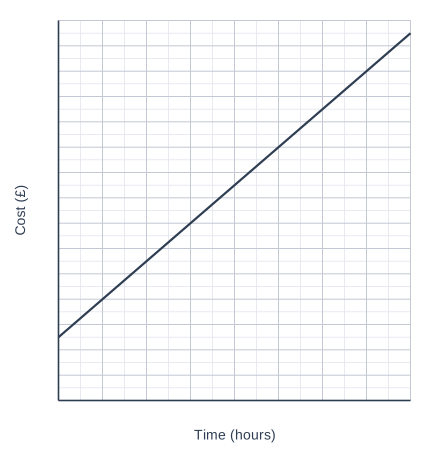
The graph shows the cost of hiring a bike for different numbers of hours.
Mo says, "The ratio of the cost to the number of hours is always the same."
Is Mo correct? Give a reason for your answer.
Model answer
From the graph, 2 hours costs £11 and 4 hours costs £17. 11 : 2 = 5.5 : 1 but 17 : 4 = 4.25 : 1 The ratios are different. Also, the line does not pass through the origin. No, Mo is not correct.
Explanation
Two quantities are always in the same ratio only when the graph is a straight line through the origin. This line starts at £5 for 0 hours (a fixed charge), so doubling the time does not double the cost. Comparing two readings, such as 2 hours and 4 hours, shows the ratio changes.
Mark scheme
1 mark
B1 for a correct fact or values from the graph that show the ratio changes
e.g. the line does not pass through the origin; it costs £5 for 0 hours; 2 hours costs £11 and 4 hours costs £17 (not £22)
1 mark
B1dep for No, with a correct reason
'No' with no reason scores 0
Question 4
3 marks
Two-thirds of the money in Jo's savings account is the same amount as three-quarters of the money in Kim's savings account.
Work out the ratio of the money in Jo's account to the money in Kim's account. Give your answer in its simplest form.
Model answer
Suppose \(\frac{2}{3}\) of Jo's money = \(\frac{3}{4}\) of Kim's money = £60 Jo: \(\frac{2}{3}\) of Jo's money = £60, so Jo has 60 ÷ 2 × 3 = £90 Kim: \(\frac{3}{4}\) of Kim's money = £60, so Kim has 60 ÷ 3 × 4 = £80 Jo : Kim = 90 : 80 = 9 : 8
Explanation
Choose an amount for the equal parts (a number that 2 and 3 divide into, such as £60) and work back to each person's total. Then write the totals as a ratio and simplify. Jo has more money, because a smaller fraction of Jo's money makes the same amount.
Mark scheme
1 mark
M1 for \(\frac{2}{3}J = \frac{3}{4}K\) oe
or a correct example, e.g. Kim has £80, \(\frac{3}{4}\) of £80 = £60 and Jo has £90
1 mark
M1 for \(\frac{3}{4} \div \frac{2}{3}\) (= \(\frac{9}{8}\)) or \(8J = 9K\) oe
or 90 : 80 from a correct example
1 mark
A1 for 9 : 8
correct answer with no working scores full marks; do not accept 8 : 9 or 2 : 3
Ready to try the rest? Every answer you write is marked against the mark scheme, so you can see exactly where the marks are.
Ctrl + Enter to check
Study HelperHints first, answers after you try
Stuck on this one? Ask for a hint and I’ll point you in the right direction, without giving the answer away. Once you’ve checked your answer, I’ll show you how the marks are awarded.