Practise 18 exam-style questions on Sampling and populations for AQA GCSE Maths (Foundation calculator). Write your answer as you would in the exam and get it marked in seconds against the mark scheme, point by point, with the Study Helper on hand if you get stuck.
18 questions
1–5 marks each
Instant marking
No sign-up needed
18 questions, marked as you go
Sample questions with model answers
Here are 4 of the questions in this topic, each with a model answer, an explanation of why it earns the marks and the mark scheme an examiner would use.
Question 1
1 mark
Jenna wants to find out how often people in her town use public transport. She asks 50 people who are waiting at a bus stop.
Give one reason why her sample may be biased.
Model answer
Everyone waiting at a bus stop is about to use public transport, so they are likely to use it more often than most people in the town. People who never use buses have no chance of being asked.
Explanation
A sample is biased if some members of the population are more likely to be included than others, in a way that affects the answers. Asking at a bus stop only reaches people who use buses. A better sample would choose people at random from the whole town.
Mark scheme
1 mark
B1 for people waiting at a bus stop are more likely to use public transport than other people in the town
accept 'people who do not use public transport will not be included' oe; do not accept 'the sample is too small'
Question 2
2 marks
A farmer has 400 bags of potatoes. She weighs a random sample of 25 of the bags. The mean mass of the bags in the sample is 2.48 kg.
Estimate the total mass of all 400 bags.
Model answer
The sample mean is used as an estimate of the mean mass of all the bags. Estimated total mass = 2.48 × 400 = 992 kg
Explanation
A random sample should give a good estimate of the mean of the whole population, so assume each of the 400 bags has a mass of about 2.48 kg. Total = mean × number of bags. The 25 bags in the sample are only used to find the mean.
Mark scheme
1 mark
M1 for 2.48 × 400
1 mark
A1 for 992 kg
accept 992 000 g; correct answer with no working scores full marks; 62 (from 2.48 × 25) scores 0
Question 3
3 marks
A company makes light bulbs. The company says that fewer than 2% of its bulbs are faulty.
A shop tests a random sample of 150 of the bulbs. 4 of the bulbs in the sample are faulty.
Does the sample support what the company says? You must show your working.
Model answer
Percentage faulty in the sample = \(\frac{4}{150}\) × 100 = 2.666...% 2.67% is more than 2%. No, the sample does not support what the company says.
Explanation
Use the sample to estimate the percentage of all the bulbs that are faulty: 4 out of 150 is about 2.7%. This is more than the 2% the company claims. A sample can vary, so this does not prove the company is wrong, but it does not support the claim.
Mark scheme
1 mark
M1 for \(\frac{4}{150}\) or 2% × 150
1 mark
A1 for 2.66...% (accept 2.7% or 0.0266...) or 2% of 150 = 3
accept [2.6, 2.7]%
1 mark
A1 for No, with 2.66...% compared with 2% (or 4 compared with 3)
accept 'No, the sample has more than 2% faulty'; answer only scores 0
Question 4
3 marks
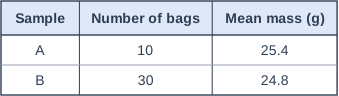
A factory makes bags of crisps. The table shows information about two random samples of the bags.
Use both samples to estimate the mean mass of all the bags.
Model answer
Total mass of sample A = 10 × 25.4 = 254 g Total mass of sample B = 30 × 24.8 = 744 g Total mass of all 40 bags = 254 + 744 = 998 g Estimated mean mass = 998 ÷ 40 = 24.95 g
Explanation
Putting the two samples together gives a larger sample of 40 bags, which gives a more reliable estimate. Find the total mass of each sample (mean × number of bags), add them and divide by 40. Do not just average the two means: sample B has three times as many bags, so it should count more.
Mark scheme
1 mark
M1 for 10 × 25.4 (= 254) or 30 × 24.8 (= 744)
1 mark
M1dep for (254 + 744) ÷ 40
or 998 ÷ 40
1 mark
A1 for 24.95 g
correct answer with no working scores full marks; 25.1 (from (25.4 + 24.8) ÷ 2) scores 0
Ready to try the rest? Every answer you write is marked against the mark scheme, so you can see exactly where the marks are.
Ctrl + Enter to check
Study HelperHints first, answers after you try
Stuck on this one? Ask for a hint and I’ll point you in the right direction, without giving the answer away. Once you’ve checked your answer, I’ll show you how the marks are awarded.