Practise 18 exam-style questions on Parts of a circle for AQA GCSE Maths (Foundation calculator). Write your answer as you would in the exam and get it marked in seconds against the mark scheme, point by point, with the Study Helper on hand if you get stuck.
18 questions
1–5 marks each
Instant marking
No sign-up needed
18 questions, marked as you go
Sample questions with model answers
Here are 4 of the questions in this topic, each with a model answer, an explanation of why it earns the marks and the mark scheme an examiner would use.
Question 1
1 mark
The radius of a circle is 7.4 cm.
Write down the diameter of the circle.
Model answer
Diameter = 2 × radius = 2 × 7.4 = 14.8 cm
Explanation
The diameter goes from one side of the circle to the other through the centre, so it is made of two radii. Double the radius to get the diameter; halve the diameter to get the radius.
Mark scheme
1 mark
B1 for 14.8 cm
Question 2
2 marks
A circular table has a diameter of 1.35 m.
Work out the radius of the table in centimetres.
Model answer
1.35 m = 135 cm Radius = 135 ÷ 2 = 67.5 cm
Explanation
The radius is half the diameter. There are 100 cm in 1 m, so change metres to centimetres by multiplying by 100. You can do the two steps in either order.
Mark scheme
1 mark
M1 for 1.35 ÷ 2 (= 0.675) or 1.35 × 100 (= 135)
1 mark
A1 for 67.5 cm
correct answer with no working scores full marks
Question 3
3 marks
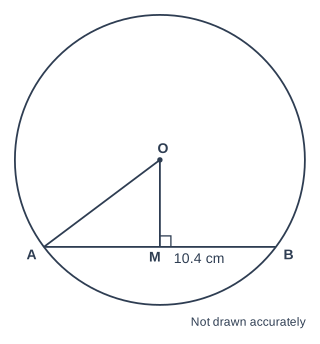
The diagram shows a circle with centre O and radius 6.5 cm. AB is a chord of the circle. M is the midpoint of AB and angle OMB = 90°.
Work out the length of OM.
Model answer
OA is a radius, so OA = 6.5 cm. AM = 10.4 ÷ 2 = 5.2 cm \(OM^2 = 6.5^2 - 5.2^2 = 42.25 - 27.04 = 15.21\) \(OM = \sqrt{15.21} = 3.9\) cm
Explanation
Triangle OAM is right-angled at M. Its hypotenuse OA is a radius (6.5 cm) and AM is half of the chord. Use Pythagoras' theorem, subtracting because OM is a shorter side.
Mark scheme
1 mark
B1 for AM = 5.2 and OA = 6.5
exact values; may be seen in a Pythagoras calculation
1 mark
M1 for \(6.5^2 - 5.2^2\) (= 15.21)
ft their AM
1 mark
A1 for 3.9 cm
correct answer with no working scores full marks
Question 4
4 marks
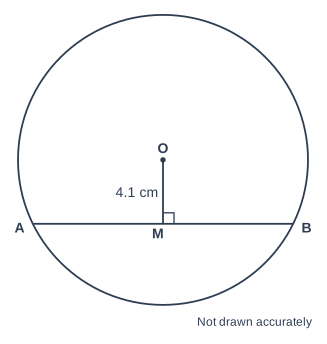
The diagram shows a circle with centre O and radius 9.3 cm. AB is a chord of the circle. M is the midpoint of AB and OM is perpendicular to AB.
Work out the length of the chord AB. Give your answer to 3 significant figures.
Model answer
OA is a radius, so OA = 9.3 cm. In right-angled triangle OAM: \(AM^2 = 9.3^2 - 4.1^2 = 86.49 - 16.81 = 69.68\) \(AM = \sqrt{69.68} = 8.3474...\) cm AB = 2 × 8.3474... = 16.694... cm AB = 16.7 cm (3 s.f.)
Explanation
Join O to A: OA is a radius, so it is 9.3 cm, and triangle OAM is right-angled at M. Use Pythagoras' theorem to find AM, then double it because M is the midpoint of the chord. Keep the full value of AM before doubling, and remember to double.
Mark scheme
1 mark
B1 for OA = 9.3 (or OB = 9.3) as the hypotenuse of a right-angled triangle
exact value; may be implied by a correct Pythagoras calculation
1 mark
M1 for \(9.3^2 - 4.1^2\) (= 69.68)
1 mark
M1dep for \(2 \times \sqrt{69.68}\)
\(\sqrt{69.68}\) = 8.347...
1 mark
A1 for 16.7 cm
accept 16.7 or a more accurate value in [16.69, 16.7] (16.694...); correct answer with no working scores full marks
Ready to try the rest? Every answer you write is marked against the mark scheme, so you can see exactly where the marks are.
Ctrl + Enter to check
Study HelperHints first, answers after you try
Stuck on this one? Ask for a hint and I’ll point you in the right direction, without giving the answer away. Once you’ve checked your answer, I’ll show you how the marks are awarded.