Practise 38 exam-style questions on Pythagoras' theorem and trigonometry for AQA GCSE Maths (Foundation calculator). Write your answer as you would in the exam and get it marked in seconds against the mark scheme, point by point, with the Study Helper on hand if you get stuck.
38 questions
1–5 marks each
Instant marking
No sign-up needed
20 questions, marked as you go
Sample questions with model answers
Here are 4 of the questions in this topic, each with a model answer, an explanation of why it earns the marks and the mark scheme an examiner would use.
Question 1
1 mark
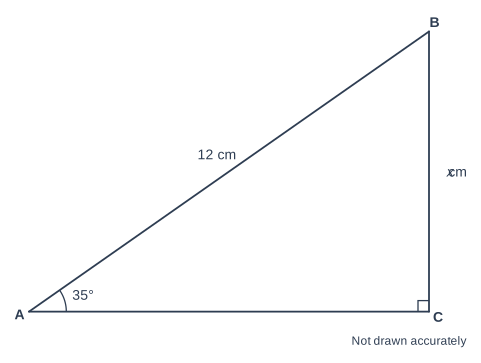
The diagram shows a right-angled triangle.
Which calculation gives the value of x?
Choose your answer.
12 × sin 35°
12 × cos 35°
12 ÷ sin 35°
12 × tan 35°
Model answer
The 12 cm side is the hypotenuse. The side x is opposite the 35° angle. \(\sin 35^\circ = \dfrac{x}{12}\) \(x = 12 \times \sin 35^\circ\)
Explanation
Label the sides from the 35° angle: 12 cm is the hypotenuse (opposite the right angle) and x is the opposite side. Opposite and hypotenuse go with sine, so \(\sin 35^\circ = \frac{x}{12}\), and multiplying both sides by 12 gives \(x = 12 \times \sin 35^\circ\). Cos would be used for the adjacent side.
Mark scheme
1 mark
B1 for 12 × sin 35°
Question 2
2 marks
A boat sails 7.5 km due west from a harbour. It then sails 4 km due south.
How far is the boat from the harbour now?
Model answer
West and south are at right angles, so the journey makes a right-angled triangle. \(d^2 = 7.5^2 + 4^2 = 56.25 + 16 = 72.25\) \(d = \sqrt{72.25} = 8.5\) The boat is 8.5 km from the harbour.
Explanation
Due west and due south are at 90° to each other, so the straight line back to the harbour is the hypotenuse of a right-angled triangle. Square the two distances, add, then square root. Adding the distances (11.5 km) gives how far the boat sailed, not how far it is from the harbour.
Mark scheme
1 mark
M1 for \(7.5^2 + 4^2\) (= 72.25)
or \(56.25 + 16\)
1 mark
A1 for 8.5 km
correct answer with no working scores full marks
Question 3
3 marks
An aeroplane takes off from a horizontal runway and climbs in a straight line. When it has flown 2400 m through the air, it is 350 m above the ground.
Work out the angle between the path of the aeroplane and the ground. Give your answer to 1 decimal place.
Model answer
The 2400 m path is the hypotenuse and the 350 m height is opposite the angle. \(\sin \theta = \dfrac{350}{2400}\) \(\theta = \sin^{-1}\left(\dfrac{350}{2400}\right) = 8.385...^\circ\) The angle is 8.4° (1 d.p.).
Explanation
The path of the aeroplane, its height and the ground make a right-angled triangle. The distance flown through the air is the sloping side (the hypotenuse) and the height is opposite the angle, so use sin and then inverse sin. Using tan would treat 2400 m as a horizontal distance, which it is not.
Mark scheme
1 mark
M1 for \(\sin \theta = \dfrac{350}{2400}\)
oe
1 mark
M1dep for \(\sin^{-1}\left(\dfrac{350}{2400}\right)\)
oe
1 mark
A1 for 8.4°
accept a more accurate value in [8.38, 8.39] (8.385...); correct answer with no working scores full marks; 8.3 (from \(\tan^{-1}\left(\frac{350}{2400}\right)\)) scores 0
Question 4
4 marks
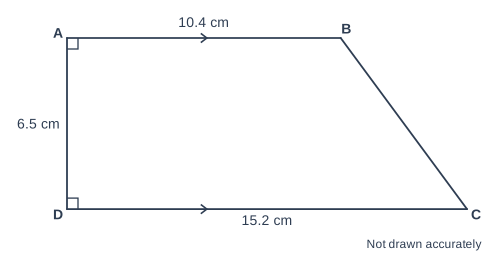
The diagram shows a trapezium ABCD. AB is parallel to DC. Angle DAB and angle ADC are right angles.
Work out the perimeter of the trapezium. Give your answer to 3 significant figures.
Model answer
Draw a line from B straight down to DC. It is 6.5 cm long and cuts off 15.2 − 10.4 = 4.8 cm of DC. \(BC^2 = 4.8^2 + 6.5^2 = 23.04 + 42.25 = 65.29\) \(BC = \sqrt{65.29} = 8.0802...\) cm Perimeter = 10.4 + 6.5 + 15.2 + 8.0802... = 40.180... Perimeter = 40.2 cm (3 s.f.)
Explanation
The sloping side BC is the hypotenuse of a right-angled triangle you can make by dropping a vertical line from B. Its height is the same as AD (6.5 cm) and its base is the difference between the parallel sides (4.8 cm). Find BC with Pythagoras' theorem, then add all four sides.
Mark scheme
1 mark
M1 for 15.2 − 10.4 (= 4.8)
may be seen on a diagram or used in Pythagoras
1 mark
M1dep for \(4.8^2 + 6.5^2\) (= 65.29)
1 mark
A1 for BC = 8.08...
accept [8.08, 8.081] (8.0802...); accept 8.1
1 mark
A1 for 40.2 cm
accept a value in [40.18, 40.2] (40.180...); correct answer with no working scores full marks
Ready to try the rest? Every answer you write is marked against the mark scheme, so you can see exactly where the marks are.
Ctrl + Enter to check
Study HelperHints first, answers after you try
Stuck on this one? Ask for a hint and I’ll point you in the right direction, without giving the answer away. Once you’ve checked your answer, I’ll show you how the marks are awarded.