Practise 36 exam-style questions on Averages and range for AQA GCSE Maths (Foundation calculator). Write your answer as you would in the exam and get it marked in seconds against the mark scheme, point by point, with the Study Helper on hand if you get stuck.
36 questions
1–5 marks each
Instant marking
No sign-up needed
20 questions, marked as you go
Sample questions with model answers
Here are 4 of the questions in this topic, each with a model answer, an explanation of why it earns the marks and the mark scheme an examiner would use.
Question 1
1 mark
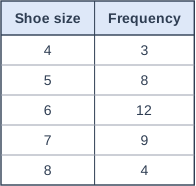
The table shows the shoe sizes of some students.
What is the mode of the shoe sizes?
Choose your answer.
6
8
12
36
Model answer
The highest frequency is 12, for shoe size 6. The mode is shoe size 6.
Explanation
In a frequency table the mode is the value with the highest frequency. Size 6 has the highest frequency (12 students), so the mode is 6. A common mistake is to give the frequency, 12, instead of the shoe size; 8 is the largest size and 36 is the total number of students.
Mark scheme
1 mark
B1 for 6
Question 2
2 marks
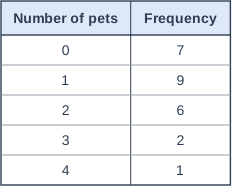
The table shows the number of pets owned by each of 25 students.
Work out the median number of pets.
Model answer
There are 25 students, so the median is the (25 + 1) ÷ 2 = 13th value. The first 7 values are 0 pets. The 8th to 16th values are 1 pet. The 13th value is 1, so the median is 1 pet.
Explanation
Find the position of the middle value, (n + 1) ÷ 2, then count down the frequencies with a running total until you reach that position. 7 students have 0 pets and 7 + 9 = 16 have 0 or 1 pets, so the 13th student has 1 pet. Do not just pick the middle row of the table.
Mark scheme
1 mark
M1 for the 13th value or (25 + 1) ÷ 2 identified
or running totals 7, 16, ... seen
1 mark
A1 for 1
correct answer with no working scores full marks; do not accept 2 (the middle of the list 0 to 4) or 6 (the middle frequency)
Question 3
3 marks
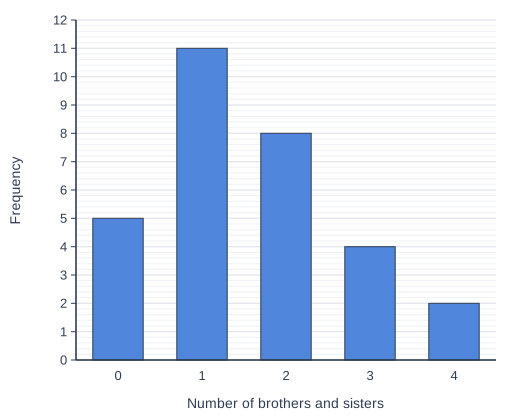
The bar chart shows the number of brothers and sisters that each student in a class has.
Work out the mean number of brothers and sisters. Give your answer to 1 decimal place.
Model answer
Number of students = 5 + 11 + 8 + 4 + 2 = 30 Total = 0 × 5 + 1 × 11 + 2 × 8 + 3 × 4 + 4 × 2 = 0 + 11 + 16 + 12 + 8 = 47 Mean = 47 ÷ 30 = 1.566... Mean = 1.6 (1 d.p.)
Explanation
Read the frequency for each number of brothers and sisters from the bar chart. Multiply each number by its frequency and add to get the total, then divide by the number of students (the total of the frequencies). The 5 students with 0 brothers and sisters still count in the number of students.
Mark scheme
1 mark
M1 for at least three correct products, e.g. 1 × 11, 2 × 8, 3 × 4, 4 × 2
condone one error in a product or in reading a bar
1 mark
A1 for 1.6
accept 1.6 or a more accurate value in [1.56, 1.57] (1.566...); correct answer with no working scores full marks
Question 4
4 marks
Three whole numbers have
a mean of 9 a median of 8 a range of 13
Work out the three numbers.
Model answer
Total = 3 × 9 = 27 The median is 8, so the middle number is 8. The smallest and largest add up to 27 − 8 = 19. The range is 13, so largest − smallest = 13. 19 − 13 = 6, 6 ÷ 2 = 3, so the smallest is 3 and the largest is 3 + 13 = 16. The numbers are 3, 8, 16 Check: (3 + 8 + 16) ÷ 3 = 9, median 8, range 16 − 3 = 13
Explanation
Use each average in turn: the mean tells you the total (3 × 9 = 27), the median tells you the middle number, and the range tells you the gap between the smallest and largest. Find two numbers that add up to 19 and differ by 13. Always check your numbers against all three facts.
Mark scheme
1 mark
M1 for 3 × 9 (= 27)
1 mark
M1 for the middle number is 8 and the other two add up to 27 − 8 (= 19)
or a trial of three numbers with total 27 and middle number 8
1 mark
M1 for two numbers with a total of 19 and a difference of 13
or a trial with total 27, median 8 and range 13 checked
1 mark
A1 for 3, 8, 16
in any order; correct answer with no working scores full marks
Ready to try the rest? Every answer you write is marked against the mark scheme, so you can see exactly where the marks are.
Ctrl + Enter to check
Study HelperHints first, answers after you try
Stuck on this one? Ask for a hint and I’ll point you in the right direction, without giving the answer away. Once you’ve checked your answer, I’ll show you how the marks are awarded.