Practise 36 exam-style questions on Scale drawings and bearings for AQA GCSE Maths (Foundation calculator). Write your answer as you would in the exam and get it marked in seconds against the mark scheme, point by point, with the Study Helper on hand if you get stuck.
36 questions
1–5 marks each
Instant marking
No sign-up needed
20 questions, marked as you go
Sample questions with model answers
Here are 4 of the questions in this topic, each with a model answer, an explanation of why it earns the marks and the mark scheme an examiner would use.
Question 1
1 mark
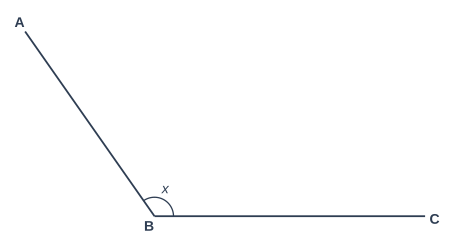
The diagram is drawn accurately.
Which of these is the best estimate of the size of angle x?
Choose your answer.
35°
55°
125°
235°
Model answer
Angle x is bigger than a right angle but smaller than a straight line, so it is obtuse. The only obtuse angle in the list is 125°.
Explanation
First decide what type of angle it is. Angle x is more than 90° and less than 180°, so it is obtuse. 35° and 55° are acute, and 235° is a reflex angle (more than 180°), so 125° is the only sensible estimate.
Mark scheme
1 mark
B1 for 125°
Question 2
2 marks
A model of a car is made using a scale of 1 : 24 The model is 18.5 cm long.
Work out the length of the real car. Give your answer in metres.
Model answer
Real length = 18.5 × 24 = 444 cm 444 ÷ 100 = 4.44 m
Explanation
1 : 24 means the real car is 24 times as long as the model. Multiply by 24 to get the real length in centimetres, then divide by 100 to change centimetres to metres. A real car being about 4 to 5 m long is a good check.
Mark scheme
1 mark
M1 for 18.5 × 24 (= 444)
1 mark
A1 for 4.44 m
correct answer with no working scores full marks; 444 cm with no conversion scores M1 A0
Question 3
3 marks
A map has a scale of 1 : 200 000
Ewan says, "5 cm on the map represents 1 km in real life."
Is Ewan correct? You must show your working.
Model answer
5 cm represents 5 × 200 000 = 1 000 000 cm 1 000 000 cm = 10 000 m = 10 km No, Ewan is wrong. 5 cm represents 10 km.
Explanation
1 : 200 000 means 1 cm on the map is 200 000 cm in real life. Multiply 5 cm by 200 000, then change centimetres to kilometres by dividing by 100 000. The answer is 10 km, so Ewan is not correct.
Mark scheme
1 mark
M1 for 5 × 200 000 (= 1 000 000)
or 1 km = 100 000 cm and 100 000 ÷ 200 000
1 mark
M1dep for their 1 000 000 ÷ 100 000 (= 10)
converting cm to km; or their 100 000 ÷ 200 000 (= 0.5)
1 mark
A1 for No, with 10 km (or 1 km is 0.5 cm on the map)
answer only scores 0
Question 4
4 marks
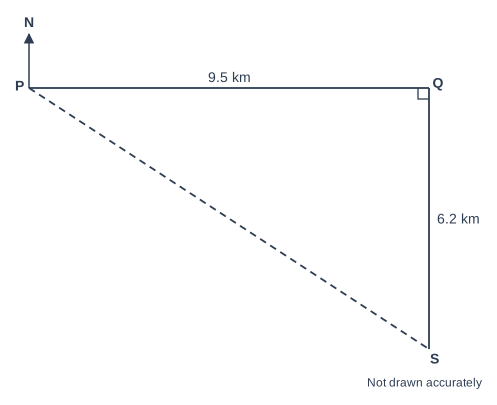
A ship sails from a port, P. It sails 9.5 km due east to Q. It then sails 6.2 km due south to S. The diagram shows the journey.
Work out the bearing of P from S. Give your answer to the nearest degree.
Model answer
At S, north is along SQ. \(\tan(\angle PSQ) = \dfrac{9.5}{6.2}\) Angle PSQ = \(\tan^{-1}\left(\dfrac{9.5}{6.2}\right) = 56.870...^\circ\) P is to the north-west of S, so the bearing is measured all the way round clockwise: Bearing = 360° − 56.870...° = 303.129...° Bearing of P from S = 303° (to the nearest degree)
Explanation
Q is due north of S, so the line SQ is the north line at S. The angle PSQ is measured anticlockwise from north, so the bearing (clockwise from north) is 360° minus that angle. Use tan because 9.5 km is opposite angle PSQ and 6.2 km is adjacent to it.
Mark scheme
1 mark
M1 for \(\tan(\angle PSQ) = \dfrac{9.5}{6.2}\)
or \(\tan(\angle SPQ) = \dfrac{6.2}{9.5}\)
1 mark
M1dep for angle PSQ = 56.8...° or 56.9° (or angle SPQ = 33.1...°)
1 mark
M1 for 360 − their 56.9 (or 270 + their 33.1, or 90 + their 33.1 + 180)
a correct method to turn their angle into the bearing of P from S
1 mark
A1 for 303°
accept a more accurate value in [303.1, 303.2] (303.129...); correct answer with no working scores full marks
Ready to try the rest? Every answer you write is marked against the mark scheme, so you can see exactly where the marks are.
Ctrl + Enter to check
Study HelperHints first, answers after you try
Stuck on this one? Ask for a hint and I’ll point you in the right direction, without giving the answer away. Once you’ve checked your answer, I’ll show you how the marks are awarded.