Practise 30 exam-style questions on Angles, parallel lines and polygons for AQA GCSE Maths (Foundation calculator). Write your answer as you would in the exam and get it marked in seconds against the mark scheme, point by point, with the Study Helper on hand if you get stuck.
30 questions
1–5 marks each
Instant marking
No sign-up needed
20 questions, marked as you go
Sample questions with model answers
Here are 4 of the questions in this topic, each with a model answer, an explanation of why it earns the marks and the mark scheme an examiner would use.
Question 1
1 mark
Work out the size of each exterior angle of a regular octagon.
Model answer
The exterior angles of a polygon add up to 360°. A regular octagon has 8 equal exterior angles. 360° ÷ 8 = 45°
Explanation
The exterior angles of any polygon add up to 360°. In a regular polygon they are all equal, so divide 360° by the number of sides. An octagon has 8 sides.
Mark scheme
1 mark
B1 for 45°
Question 2
2 marks
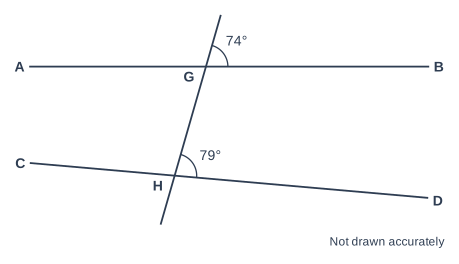
The diagram shows two straight lines, AB and CD. Another straight line crosses them at G and H.
Are lines AB and CD parallel? Give a reason for your answer.
Model answer
No. The 74° and 79° angles are corresponding angles. If AB and CD were parallel, corresponding angles would be equal, but 74° ≠ 79°.
Explanation
If two lines are parallel, corresponding angles are equal. The marked angles are in the same position at each crossing, so they are corresponding angles. They are different sizes, so the lines are not parallel, even if they look parallel on the diagram.
Mark scheme
1 mark
B1 for No
1 mark
B1dep for a correct reason, e.g. corresponding angles are not equal (74° ≠ 79°), or if the lines were parallel the corresponding angles would be equal
must refer to corresponding angles (or work out a pair of alternate angles, 74° and 79°, and say they are not equal)
Question 3
3 marks
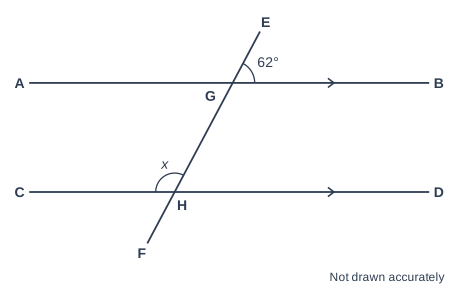
The diagram shows two parallel lines, AB and CD. A straight line EF crosses AB at G and CD at H.
Work out the size of angle x. Give a reason for each stage of your working.
Model answer
Angle GHD = 62° (corresponding angles are equal) x = 180° − 62° = 118° (angles on a straight line add up to 180°)
Explanation
Find an angle at H first: the 62° angle at G and angle GHD are corresponding angles, so angle GHD is also 62°. Angle x and angle GHD lie on the straight line CD, so they add up to 180°. Each reason must name the angle fact properly.
Mark scheme
1 mark
M1 for angle GHD = 62° or angle AGH = 118°
may be marked on the diagram or seen in working
1 mark
A1 for x = 118°
1 mark
B1 for correct reasons for their method, e.g. corresponding angles are equal and angles on a straight line add up to 180°
or angles on a straight line add up to 180° and alternate angles are equal; do not accept Z angles or F angles
Question 4
4 marks
Each interior angle of a regular polygon is 4 times the size of each exterior angle.
Work out the number of sides of the polygon.
Model answer
An interior angle and an exterior angle add up to 180°. Let the exterior angle be e: \(e + 4e = 180\) \(5e = 180\), so \(e = 36\) Number of sides = 360° ÷ 36° = 10 Check: interior angle = 144° = 4 × 36°
Explanation
At each vertex the interior and exterior angles make a straight line, so together they are 180°. Splitting 180° in the ratio 4 : 1 gives an exterior angle of 36°. The exterior angles add up to 360°, so there are 360 ÷ 36 = 10 sides.
Mark scheme
1 mark
M1 for e + 4e = 180 oe
where e is the exterior angle; or 180 ÷ 5
1 mark
A1 for exterior angle = 36°
or interior angle = 144°
1 mark
M1 for 360 ÷ their 36
or a correct method using their interior angle, e.g. (n − 2) × 180 = 144n
1 mark
A1 for 10
correct answer with no working scores full marks
Ready to try the rest? Every answer you write is marked against the mark scheme, so you can see exactly where the marks are.
Ctrl + Enter to check
Study HelperHints first, answers after you try
Stuck on this one? Ask for a hint and I’ll point you in the right direction, without giving the answer away. Once you’ve checked your answer, I’ll show you how the marks are awarded.