Level:
Correct: 0
Incorrect: 0
Marks: 0/0
Exam Practice
Course:
Topics:
AQA GCSE Maths (Foundation calculator) Smart practice A mixed round aimed at your weak spots
Unit 1
Number
Unit 2
Algebra
Unit 3
Ratio, proportion and rates of change
Unit 4
Geometry and measures
Unit 5
Probability
Unit 6
Statistics
Avg
score:
–
Topics
done:
0/86

Congruence and similar shapes

Practise 29 exam-style questions on Congruence and similar shapes for AQA GCSE Maths (Foundation calculator). Write your answer as you would in the exam and get it marked in seconds against the mark scheme, point by point, with the Study Helper on hand if you get stuck.

  • 29 questions
  • 1–5 marks each
  • Instant marking
  • No sign-up needed
20 questions, marked as you go

Sample questions with model answers

Here are 4 of the questions in this topic, each with a model answer, an explanation of why it earns the marks and the mark scheme an examiner would use.

Question 1

1 mark

Rectangle A is 3 cm wide and 5 cm long.

Which of these rectangles is similar to rectangle A?

Choose your answer.

  • 4 cm by 6 cm
  • 6 cm by 8 cm
  • 6 cm by 10 cm
  • 9 cm by 12 cm

Model answer

6 ÷ 3 = 2 and 10 ÷ 5 = 2
Both sides are multiplied by 2, so the 6 cm by 10 cm rectangle is similar to A.

Explanation

Similar shapes have all their lengths multiplied by the same scale factor. For 6 cm by 10 cm, both sides are doubled. For the other rectangles the two sides are multiplied by different numbers (or have the same number added), so they are not similar.

Mark scheme
  1. 1 mark

    B1 for 6 cm by 10 cm

Question 2

2 marks

Rectangle A is 5 cm by 8 cm.
Rectangle B is 7.5 cm by 12 cm.

Show that rectangle A and rectangle B are similar.

Model answer

7.5 ÷ 5 = 1.5
12 ÷ 8 = 1.5
Both pairs of matching sides have the same scale factor, 1.5, so the rectangles are similar.

Explanation

To show two shapes are similar, show that every pair of matching sides is multiplied by the same scale factor. Match the short sides with each other and the long sides with each other.

Mark scheme
  1. 1 mark

    M1 for 7.5 ÷ 5 and 12 ÷ 8

    oe, e.g. 5 ÷ 8 and 7.5 ÷ 12, or 5 × 1.5 = 7.5 and 8 × 1.5 = 12

  2. 1 mark

    A1 for both equal to 1.5 (or both 0.625), with a statement that the scale factors are the same

    answer only scores 0

Question 3

3 marks

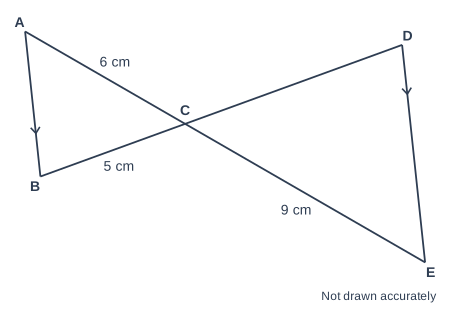
In the diagram, AB is parallel to DE.
The lines AE and BD cross at C.
Triangle ABC is similar to triangle EDC.

Work out the length of BD.

Geometry diagram, marked "Not drawn accurately". Line segments AB, DE, AE and BD are drawn. C lies on AE and BD. AC is labelled 6 cm. CE is labelled 9 cm. BC is labelled 5 cm. BA and ED are each marked with an arrowhead (parallel lines).

Model answer

AC = 6 cm matches CE = 9 cm.
Scale factor = 9 ÷ 6 = 1.5
CD matches BC, so CD = 5 × 1.5 = 7.5 cm
BD = BC + CD = 5 + 7.5 = 12.5 cm

Explanation

The two triangles meet at C. AC matches CE and BC matches CD, so the scale factor is 9 ÷ 6 = 1.5. Use it to find CD, then add BC because BD goes all the way across.

Mark scheme
  1. 1 mark

    M1 for 9 ÷ 6 (= 1.5)

    oe, scale factor from CE ÷ AC

  2. 1 mark

    M1dep for 5 × 1.5 (= 7.5)

    length of CD

  3. 1 mark

    A1 for 12.5 cm

    correct answer with no working scores full marks; 7.5 (CD only) scores M2 A0

Question 4

4 marks

Flag A is a triangle with sides 30 cm, 40 cm and 50 cm.
Flag B is similar to flag A.
The longest side of flag B is 1.2 m.

Ribbon is sewn all the way round the edge of flag B.
Ribbon costs £2.40 per metre.

Work out the cost of the ribbon for flag B.

Model answer

1.2 m = 120 cm
Scale factor = 120 ÷ 50 = 2.4
Sides of flag B: 30 × 2.4 = 72 cm, 40 × 2.4 = 96 cm, 120 cm
Perimeter = 72 + 96 + 120 = 288 cm = 2.88 m
Cost = 2.88 × £2.40 = £6.912 = £6.91

Explanation

Change 1.2 m to 120 cm so the lengths are in the same units, then find the scale factor from the longest sides. Multiply the other sides (or the whole perimeter of flag A, 120 cm) by the scale factor. Change the perimeter to metres before multiplying by the price per metre.

Mark scheme
  1. 1 mark

    M1 for 1.2 m = 120 cm and 120 ÷ 50 (= 2.4)

    or 50 cm = 0.5 m and 1.2 ÷ 0.5 (= 2.4)

  2. 1 mark

    M1dep for the perimeter of B: 72 + 96 + 120 (= 288 cm) or 120 × 2.4

    oe, e.g. 0.72 + 0.96 + 1.2 = 2.88 m

  3. 1 mark

    M1 for their 2.88 × 2.40

    their perimeter must be in metres

  4. 1 mark

    A1 for £6.91

    accept £6.91 or 6.912; correct answer with no working scores full marks

Ready to try the rest? Every answer you write is marked against the mark scheme, so you can see exactly where the marks are.

Study Helper Hints first, answers after you try

Stuck on this one? Ask for a hint and I’ll point you in the right direction, without giving the answer away. Once you’ve checked your answer, I’ll show you how the marks are awarded.