Level:
Correct: 0
Incorrect: 0
Marks: 0/0
Exam Practice
Course:
Topics:
AQA GCSE Maths (Foundation calculator) Smart practice A mixed round aimed at your weak spots
Unit 1
Number
Unit 2
Algebra
Unit 3
Ratio, proportion and rates of change
Unit 4
Geometry and measures
Unit 5
Probability
Unit 6
Statistics
Avg
score:
–
Topics
done:
0/86

Primes, factors, multiples, HCF and LCM

Practise 28 exam-style questions on Primes, factors, multiples, HCF and LCM for AQA GCSE Maths (Foundation calculator). Write your answer as you would in the exam and get it marked in seconds against the mark scheme, point by point, with the Study Helper on hand if you get stuck.

  • 28 questions
  • 1–5 marks each
  • Instant marking
  • No sign-up needed
20 questions, marked as you go

Sample questions with model answers

Here are 4 of the questions in this topic, each with a model answer, an explanation of why it earns the marks and the mark scheme an examiner would use.

Question 1

1 mark

Work out the value of \(2^4 \times 3^2 \times 7\)

Choose your answer.

  • 32
  • 126
  • 336
  • 1008

Model answer

\(2^4 = 16\) and \(3^2 = 9\)
16 × 9 × 7 = 1008

Explanation

Work out each power first: \(2^4 = 2 \times 2 \times 2 \times 2 = 16\) and \(3^2 = 9\). Then multiply everything together. 336 comes from the mistake of working out \(2^4\) as 2 × 4 and \(3^2\) as 3 × 2, and 32 comes from adding instead of multiplying.

Mark scheme
  1. 1 mark

    B1 for 1008

Question 2

2 marks

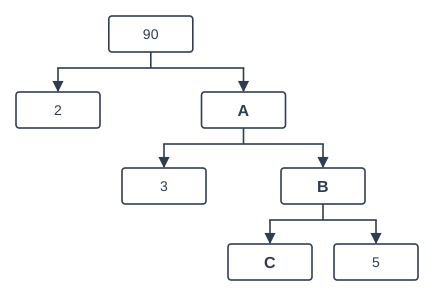
Here is a factor tree for 90.

Work out the values of A, B and C.

Flow chart of 7 boxes joined by arrows, read from top to bottom. The first box is "90". From "90", 2 arrows branch out side by side: the left arrow leads to "2"; the right arrow leads to box A. From box A, 2 arrows branch out side by side: the left arrow leads to "3"; the right arrow leads to box B. From box B, 2 arrows branch out side by side: the left arrow leads to box C; the right arrow leads to "5".

Model answer

90 = 2 × A, so A = 90 ÷ 2 = 45
45 = 3 × B, so B = 45 ÷ 3 = 15
15 = C × 5, so C = 15 ÷ 5 = 3

Explanation

In a factor tree, the two numbers under each number multiply to make it. So divide to find each missing number, working down the tree. The numbers at the ends of the branches are all prime: 90 = 2 × 3 × 3 × 5.

Mark scheme
  1. 2 marks

    B2 for A = 45, B = 15 and C = 3

    B1 for two of these correct

Question 3

2 marks

\(A = 2^3 \times 3 \times 5^2\)
\(B = 2^2 \times 3^2 \times 7\)

Write the lowest common multiple of A and B as a product of prime factors.
Give your answer in index form.

Model answer

Take the highest power of each prime that appears in A or B:
\(2^3\), \(3^2\), \(5^2\) and 7
LCM = \(2^3 \times 3^2 \times 5^2 \times 7\)

Explanation

The LCM must contain all the prime factors of A and all the prime factors of B. So for each prime, use the highest power that appears in either number. A common mistake is to use the lowest powers, which gives the highest common factor, \(2^2 \times 3\).

Mark scheme
  1. 2 marks

    B2 for \(2^3 \times 3^2 \times 5^2 \times 7\)

    factors in any order; B1 for a product with three of the four prime powers correct, or for 12 600 (the LCM worked out)

Question 4

4 marks

Ella has two pieces of ribbon.
One piece is 84 cm long.
The other piece is 126 cm long.

She cuts both pieces into smaller pieces.
All the smaller pieces are the same length, and none of the ribbon is left over.
Each smaller piece is as long as possible.

How many smaller pieces does Ella get altogether?

Model answer

84 = 2 × 2 × 3 × 7
126 = 2 × 3 × 3 × 7
HCF = 2 × 3 × 7 = 42
Each piece is 42 cm long.
84 ÷ 42 = 2 pieces and 126 ÷ 42 = 3 pieces
2 + 3 = 5 pieces altogether

Explanation

The length of each piece must divide exactly into 84 and into 126, so it is a common factor. The longest possible piece is the highest common factor, 42 cm. Then work out how many pieces come from each ribbon and add them.

Mark scheme
  1. 1 mark

    M1 for a correct method for the HCF of 84 and 126, e.g. prime factorisations \(2^2 \times 3 \times 7\) and \(2 \times 3^2 \times 7\), or factors of both listed

  2. 1 mark

    A1 for 42 (cm)

  3. 1 mark

    M1 for 84 ÷ their 42 + 126 ÷ their 42

    their 42 must be a common factor of 84 and 126 greater than 1

  4. 1 mark

    A1 for 5

    correct answer with no working scores full marks

Ready to try the rest? Every answer you write is marked against the mark scheme, so you can see exactly where the marks are.

Study Helper Hints first, answers after you try

Stuck on this one? Ask for a hint and I’ll point you in the right direction, without giving the answer away. Once you’ve checked your answer, I’ll show you how the marks are awarded.