Practise 11 exam-style questions on The National Grid for AQA GCSE Combined Science (Physics Paper 1). Write your answer as you would in the exam and get it marked in seconds against the mark scheme, point by point, with the Study Helper on hand if you get stuck.
11 questions
1–6 marks each
Instant marking
No sign-up needed
11 questions, marked as you go
Sample questions with model answers
Here are 4 of the questions in this topic, each with a model answer, an explanation of why it earns the marks and the mark scheme an examiner would use.
Question 1
2 marks
The flow chart shows how electrical power is transferred from a power station to homes.
Name the devices A and B.
Model answer
A is a step-up transformer. B is a step-down transformer.
Explanation
A step-up transformer increases the potential difference from the power station to the very high value used in the transmission cables. A step-down transformer then decreases it to a much lower value for use in homes. Just writing "transformer" is not enough - say which type.
Mark scheme
1 mark
A: step-up transformer
do not accept transformer on its own for either mark; do not accept generator
1 mark
B: step-down transformer
Question 2
3 marks
The National Grid transmits electrical power at a very high potential difference.
Explain why this makes the National Grid an efficient way to transfer energy.
Model answer
The power transmitted is equal to potential difference × current, so for the same power a very high potential difference means a very small current in the cables. A smaller current heats the cables less, so less energy is transferred to the thermal energy store of the cables and surroundings. This means less energy is wasted, so more of the energy from the power station reaches consumers.
Explanation
The key chain of reasoning is: high potential difference → low current → less heating of the cables → less energy wasted. Because the power wasted in a cable is I² R, halving the current cuts the wasted power to a quarter. A common error is to say a high potential difference "reduces resistance" - it does not.
Mark scheme
1 mark
for a given power, a higher potential difference means a lower current (in the cables)
allow P = V × I so increasing V decreases I
1 mark
a lower current causes less heating of the cables
allow less energy transferred to the thermal energy store of the cables / surroundings; allow less power lost (P = I² R)
1 mark
so less energy is wasted / a greater proportion of the energy reaches consumers
Question 3
3 marks
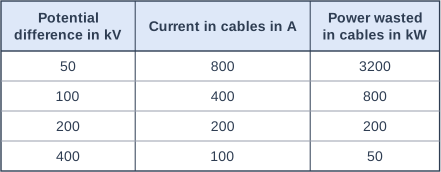
An engineer modelled the transmission of 40 MW of electrical power through cables with a total resistance of 5.0 Ω at different potential differences. The table shows the results.
Use the table to describe how the power wasted in the cables depends on the transmission potential difference. Give data from the table in your answer.
Model answer
As the transmission potential difference increases, the power wasted in the cables decreases. Each time the potential difference doubles, the current halves and the power wasted falls to one quarter: for example, at 50 kV the power wasted is 3200 kW, but at 100 kV it is only 800 kW. At 400 kV it is just 50 kW.
Explanation
Doubling the potential difference halves the current for the same power, and because wasted power = I² R, halving the current reduces the wasted power to a quarter. This is why such high potential differences are used in the National Grid. Always quote values with units when asked for data.
Mark scheme
1 mark
as the potential difference increases, the power wasted decreases
allow negative correlation; do not accept inversely proportional
1 mark
each time the potential difference doubles, the power wasted falls to one quarter
allow decreases by a factor of 4
1 mark
correct supporting data, e.g. 3200 kW at 50 kV and 800 kW at 100 kV
allow any correct pair of rows quoted with values and units
Question 4
4 marks
A farm is a long way from the National Grid. It uses its own small generator, which is joined to the farmhouse by a short cable. The cable carries a small power at 230 V.
Explain why it is acceptable to transfer power at 230 V through this short cable, but the National Grid must use very high potential differences to transfer power across the country.
Model answer
The National Grid cables are hundreds of kilometres long, so they have a much greater resistance than the short farm cable. The National Grid also transfers a huge power, so if it used 230 V the current would be enormous, because P = V × I. The power wasted heating a cable is I² R, so a large current in a long cable would waste most of the energy. The farm cable is short and carries a small current, so very little energy is wasted even at 230 V. Using a very high potential difference keeps the current in the National Grid small, so it wastes little energy.
Explanation
Energy wasted in cables depends on both the current and the resistance of the cable (P = I² R). A short cable carrying a small current wastes little energy at any potential difference, but long national transmission lines carrying huge powers would waste most of the energy at a low potential difference. Stepping the potential difference up reduces the current, which tackles the biggest factor.
Mark scheme
1 mark
the National Grid cables are very long, so they have a much greater resistance
max 4; allow resistance of a wire increases with length
1 mark
the National Grid transfers a much greater power, so at 230 V the current would be enormous
allow P = V × I, so a large power at a low potential difference needs a large current
1 mark
the power wasted heating a cable depends on the current and the resistance
allow P = I² R
1 mark
in the short farm cable the current and resistance are small, so little energy is wasted
1 mark
the very high potential difference in the National Grid keeps the current small, so the energy wasted is small
allow so the National Grid is efficient
Ready to try the rest? Every answer you write is marked against the mark scheme, so you can see exactly where the marks are.
Ctrl + Enter to check
Study HelperHints first, answers after you try
Stuck on this one? Ask for a hint and I’ll point you in the right direction, without giving the answer away. Once you’ve checked your answer, I’ll show you how the marks are awarded.