Level:
Correct: 0
Incorrect: 0
Marks: 0/0
Exam Practice
Course:
Topics:
Avg
score:
–
Topics
done:
0/30

Energy stores and systems

Practise 13 exam-style questions on Energy stores and systems for AQA GCSE Combined Science (Physics Paper 1). Write your answer as you would in the exam and get it marked in seconds against the mark scheme, point by point, with the Study Helper on hand if you get stuck.

  • 13 questions
  • 1–6 marks each
  • Instant marking
  • No sign-up needed
13 questions, marked as you go

Sample questions with model answers

Here are 4 of the questions in this topic, each with a model answer, an explanation of why it earns the marks and the mark scheme an examiner would use.

Question 1

2 marks

A tennis ball is thrown vertically upwards. Air resistance can be ignored.

Describe how the way energy is stored changes as the ball rises to its highest point.

Model answer

As the ball rises it slows down, so the energy in its kinetic energy store decreases. Its height increases, so the energy in its gravitational potential energy store increases by the same amount.

Explanation

With no air resistance, the energy lost from the kinetic store is all transferred to the gravitational potential energy store. At the top of its flight the ball is momentarily at rest, so its kinetic energy is zero and its gravitational potential energy is greatest.

Mark scheme
  1. 1 mark

    the energy in the kinetic energy store of the ball decreases

    allow the ball slows down so its kinetic energy decreases; allow 'kinetic energy is transferred to gravitational potential energy' for 2 marks

  2. 1 mark

    the energy in the gravitational potential energy store of the ball increases

    allow at the highest point the kinetic energy is zero and the gravitational potential energy is at its maximum

Question 2

3 marks

A car is travelling along a level road. The driver applies the brakes and the car slows down and stops.

Describe the changes in the way energy is stored while the car is braking. Your answer should include how the energy is transferred.

Model answer

As the car slows down, the energy in its kinetic energy store decreases. Work is done by the friction force between the brake pads and the brake discs, so energy is transferred mechanically to the thermal energy store of the brakes, which get hot. This energy is then dissipated by heating to the thermal energy store of the surroundings.

Explanation

Braking does not destroy the car's kinetic energy: the work done by friction transfers it to thermal energy stores, first in the brakes and then in the surrounding air. That is why brakes can become very hot after a long descent.

Mark scheme
  1. 1 mark

    the energy in the kinetic energy store of the car decreases

    max 3

  2. 1 mark

    work is done by the friction force between the brake pads and the brake discs / wheels

    allow energy is transferred mechanically by friction in the brakes

  3. 1 mark

    the energy in the thermal energy store of the brakes increases

    allow the brakes get hot / the temperature of the brakes increases

  4. 1 mark

    energy is then dissipated to the thermal energy store of the surroundings

    allow energy transferred to the surroundings by heating or by sound; allow energy is wasted

Question 3

3 marks

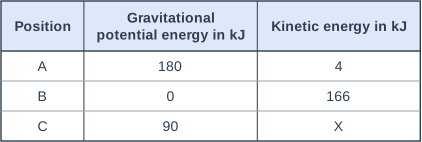
A roller coaster car moves along a track from position A down to position B at the bottom of a dip and then up to position C. The table shows the energy in two of the car's energy stores at each position.

Between B and C a further 6 kJ of energy is dissipated by friction and air resistance.

Calculate the value of X in the table.

Table with columns "Position", "Gravitational potential energy in kJ", "Kinetic energy in kJ". Position: A; Gravitational potential energy in kJ: 180; Kinetic energy in kJ: 4 | Position: B; Gravitational potential energy in kJ: 0; Kinetic energy in kJ: 166 | Position: C; Gravitational potential energy in kJ: 90; Kinetic energy in kJ: X.

Model answer

Total energy in the two stores at B = 0 + 166 = 166 kJ
Total energy at C = 166 − 6 = 160 kJ
X = 160 − 90 = 70 kJ

Explanation

The kinetic and gravitational potential energy stores together lose energy only by the work done against friction and air resistance. Subtract the dissipated energy from the total at B, then subtract the gravitational potential energy at C to find what is left in the kinetic store. A common mistake is to use the total at A (184 kJ) instead of B.

Mark scheme
  1. 1 mark

    total energy at B = 0 + 166 = 166 (kJ)

    an answer of 70 (kJ) scores 3 marks

  2. 1 mark

    total energy at C = 166 − 6 = 160 (kJ)

    allow ecf

  3. 1 mark

    X = 160 − 90 = 70 (kJ)

    allow ecf from their total energy at C

Question 4

4 marks

A go-kart and its driver have a total mass of 240 kg. The go-kart starts from rest. A constant resultant force of 150 N acts on it over a distance of 20 m.

All the work done by the resultant force is transferred to the kinetic energy store of the go-kart.

Calculate the speed of the go-kart after it has travelled 20 m.

Model answer

Work done = force × distance = 150 × 20 = 3000 J
Kinetic energy gained = 3000 J
3000 = 0.5 × 240 × v²
v² = 3000 ÷ 120 = 25
v = 5.0 m/s

Explanation

The work done by the resultant force is the energy transferred to the go-kart's kinetic store, so Eₖ = W = F s. Then rearrange Eₖ = ½ m v² for v: divide by ½ m and take the square root. Forgetting the square root (giving 25 m/s) is a common error.

Mark scheme
  1. 1 mark

    work done = 150 × 20 = 3000 (J)

    an answer of 5.0 (m/s) scores 4 marks

  2. 1 mark

    3000 = 0.5 × 240 × v²

    kinetic energy gained = work done; allow ecf from their work done

  3. 1 mark

    v² = 3000 ÷ 120 = 25

    allow ecf

  4. 1 mark

    v = 5.0 (m/s)

    allow 5 (m/s); allow ecf from their v²

Ready to try the rest? Every answer you write is marked against the mark scheme, so you can see exactly where the marks are.

Revision notes

Energy stores and systems

The big idea

A system is an object or a group of objects, such as a falling ball, or a car and its brakes. When a system changes, the way its energy is stored changes: energy moves from one energy store to another, but the total stays the same. In the exam you describe these changes store by store, and use calculations to show how the energy is shared out.

Energy stores

Energy storeWhere the energy is storedExample
Kineticin a moving objecta rolling trolley
Gravitational potentialin an object raised above the grounda book on a high shelf
Elastic potentialin an object that is stretched, squashed, bent or twisteda stretched spring, a bent bow
Thermal (internal)in the particles of an object; it rises with temperaturehot water
Chemicalin fuels, food and batteriesa battery, petrol
Nuclearin the nuclei of atomsuranium fuel

Magnets and electric charges that attract or repel each other also store energy, in magnetic and electrostatic stores.

How energy is transferred

Energy moves between stores in four main ways:

  • mechanically: a force does work, such as a push, a pull or friction;
  • electrically: work is done when a current flows;
  • by heating: from a hotter object to a cooler one;
  • by radiation: waves such as light and infrared carry energy away, as from a flame.

A good description names the store, the object it belongs to, and whether it increases or decreases: "the kinetic energy store of the car decreases", not just "kinetic energy".

Describing the changes in common situations

SituationStore that decreasesStore that increases
An object projected upwardsthe kinetic store of the object, as it slows downthe gravitational potential store of the object, as it gains height
A moving object hitting an obstaclethe kinetic store of the objectthe thermal stores of the object and the obstacle (both warm up); some energy is carried away by sound
An object accelerated by a constant forcethe store that supplies the force, such as the chemical store of a battery or of a person's musclesthe kinetic store of the object, because the force does work on it
A vehicle slowing downthe kinetic store of the vehiclethe thermal store of the brakes, because friction in the brakes does work
Bringing water to a boil in an electric kettleenergy is transferred electrically from the mains supplythe thermal store of the heating element, which heats the water: the thermal store of the water increases

In every real change some energy is dissipated: it spreads out into the surroundings, usually as thermal energy, and is stored in less useful ways (see also: Energy transfers in a system).

Calculating changes on a common scale

Throughout the Energy topic you calculate the energy transferred when a system is changed by heating, by work done by forces or by work done when a current flows. Working out every store in joules puts them on a common scale, so you can show how the total is redistributed. You must recall these two equations:

  • \(\text{work done} = \text{force} \times \text{distance}\), or \(W = Fs\): work done, W, in joules, J; force, F, in newtons, N; distance, s, in metres, m, measured along the line of action of the force.
  • \(\text{energy transferred} = \text{charge flow} \times \text{potential difference}\), or \(E = QV\): energy transferred, E, in joules, J; charge flow, Q, in coulombs, C; potential difference, V, in volts, V.

For heating, \(\Delta E = mc\Delta\theta\) is given on the Physics equation sheet (see also: Energy changes in systems). The kinetic and gravitational potential energy equations, which you must also recall, are in Changes in energy.

Sharing out the energy on an electric bike

An electric bike and its rider have a total mass of 100 kg. They ride up a hill 45 m high at a steady speed, and the rider does not pedal. During the climb a charge of 2000 C flows from the bike's 36 V battery through the motor. Gravitational field strength = 9.8 N/kg. Show how the energy transferred electrically is redistributed.

Energy transferred electrically: \(E = QV = 2000 \times 36 = 72\,000\) J

Increase in the gravitational potential store: \(E_p = mgh = 100 \times 9.8 \times 45 = 44\,100\) J

The speed is steady, so the kinetic store does not change. The rest, \(72\,000 - 44\,100 = 27\,900\) J, is dissipated by air resistance, friction and heating in the motor, ending up in the thermal store of the surroundings.

On a common scale, about 61% of the energy ends up in the gravitational potential store and about 39% is dissipated.

Energy transfer (Sankey) diagram. An arrow on the left labelled "Energy transferred electrically 72 kJ" splits into an arrow that continues straight on, labelled "Gravitational potential store 44.1 kJ", and an arrow that bends downwards, labelled "Dissipated to the surroundings 27.9 kJ". The width of each arrow is proportional to its value. The straight-on arrow is the useful energy output; the bent arrows are wasted energy.
The widths of the arrows show the energy on a common scale: the two outputs add up to the 72 kJ supplied.

Common mistakes

  • Writing "movement energy" or "heat energy". Use the store names: the kinetic energy store and the thermal energy store.
  • Writing "potential energy" without saying which kind. Write gravitational potential or elastic potential.
  • Saying energy is "used up" or "lost". Energy is transferred or dissipated; it is never destroyed.
  • Leaving out the wasted energy. Brakes, motors and kettles all warm up, so end with the energy dissipated to the surroundings.
  • Saying a ball thrown upwards has no energy at its highest point. Its kinetic store is empty there, but the energy is now in its gravitational potential store.

Exam tip

For "describe the changes in the way energy is stored" questions, take the event in order. For each stage, give the store that decreases and the store that increases, naming the object each time. In 4- to 6-mark answers, the energy dissipated to the surroundings is often the last marking point.

Study Helper Hints first, answers after you try

Stuck on this one? Ask for a hint and I’ll point you in the right direction, without giving the answer away. Once you’ve checked your answer, I’ll show you how the marks are awarded.