The big idea
You can calculate the energy in three stores: the kinetic store of a moving object, the elastic potential store of a stretched spring and the gravitational potential store of an object raised above the ground. Each has its own equation. Most marks are lost on units, so convert to kilograms and metres before you substitute.
Kinetic energy
\[\text{kinetic energy} = 0.5 \times \text{mass} \times (\text{speed})^2 \qquad E_k = \dfrac{1}{2}mv^2\]
- kinetic energy, \(E_k\), in joules, J
- mass, m, in kilograms, kg
- speed, v, in metres per second, m/s
You must recall this equation. Only the speed is squared, so square it first. Doubling the mass doubles the kinetic energy, but doubling the speed gives four times the kinetic energy.
The same energy, a different mass
A hockey puck of mass 160 g slides across the ice at 20 m/s. A ball of mass 40 g has the same kinetic energy as the puck. Calculate the speed of the ball.
Convert the masses: 160 g = 0.160 kg and 40 g = 0.040 kg
Kinetic energy of the puck: \(E_k = 0.5 \times 0.160 \times 20^2 = 32\) J
For the ball: \(32 = 0.5 \times 0.040 \times v^2\), so \(v^2 = \dfrac{32}{0.020} = 1600\)
\(v = \sqrt{1600} = 40\) m/s. The ball has a quarter of the mass, so it needs twice the speed, not four times.
Elastic potential energy
\[\text{elastic potential energy} = 0.5 \times \text{spring constant} \times (\text{extension})^2 \qquad E_e = \dfrac{1}{2}ke^2\]
- elastic potential energy, \(E_e\), in joules, J
- spring constant, k, in newtons per metre, N/m
- extension, e, in metres, m
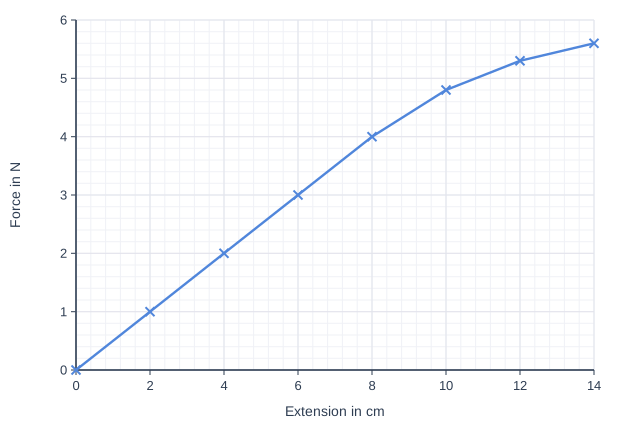
This equation is given on the Physics equation sheet. The extension is how much longer the spring is than its unstretched length. The equation only works if the limit of proportionality has not been exceeded: beyond it, the force is no longer proportional to the extension, so k is no longer constant. A stiffer spring has a bigger spring constant.
Which spring stores more energy?
Spring A has a spring constant of 100 N/m and is stretched by 20 cm. Spring B has a spring constant of 400 N/m and is stretched by 10 cm. Neither passes its limit of proportionality. Compare the energy they store.
Convert: 20 cm = 0.20 m and 10 cm = 0.10 m
Spring A: \(E_e = 0.5 \times 100 \times 0.20^2 = 2.0\) J
Spring B: \(E_e = 0.5 \times 400 \times 0.10^2 = 2.0\) J
They store the same energy. B is four times as stiff, but its extension is half as big, and halving the extension quarters the energy.
Gravitational potential energy
\[\text{g.p.e.} = \text{mass} \times \text{gravitational field strength} \times \text{height} \qquad E_p = mgh\]
- gravitational potential energy, \(E_p\), in joules, J
- mass, m, in kilograms, kg
- gravitational field strength, g, in newtons per kilogram, N/kg
- height, h, in metres, m
You must recall this equation. The value of g is always given in the question: use 9.8 N/kg for the Earth if that is what you are told, and a smaller value on the Moon. The height is the vertical height gained, not the distance along a path or a slope. Every quantity is to the power one, so doubling the height doubles the gravitational potential energy.
A hill walker
A walker of mass 65 kg starts at a car park 125 m above sea level and climbs a winding path 6 km long to a summit 1085 m above sea level. Take g as 9.8 N/kg. How much gravitational potential energy does she gain? Give your answer in kilojoules.
Only the vertical height counts: \(h = 1085 - 125 = 960\) m
\(E_p = 65 \times 9.8 \times 960 = 611\,520\) J
\(611\,520 \div 1000 = 610\) kJ (2 significant figures)
Linking the stores
When no energy is dissipated, the energy lost from one store equals the energy gained by another. For an object falling with no air resistance, the gravitational potential energy lost equals the kinetic energy gained. If you are asked for energy dissipated, work out the energy in each store and subtract.
Remember
- Recall \(E_k = \dfrac{1}{2}mv^2\) and \(E_p = mgh\). \(E_e = \dfrac{1}{2}ke^2\) is on the equation sheet.
- Kinetic energy depends on speed squared; elastic potential energy depends on extension squared.
- Use kilograms, metres and metres per second to get an answer in joules.
Common mistakes
- Squaring the whole of \(0.5 \times m \times v\), or not squaring the speed at all. Only the speed (or the extension) is squared.
- Leaving a mass in grams or an extension in centimetres. Convert to kilograms and metres first, or the answer will be 1000 or 10 000 times too big.
- Forgetting the square root when finding a speed: \(v^2 = 1600\) gives \(v = 40\) m/s, not 1600 m/s.
- Using the change in speed to find a change in kinetic energy. Work out the kinetic energy at each speed, then subtract.
- Using the stretched length of a spring instead of its extension.
Exam tip
Write the equation, then the substitution with converted units, then the answer with its unit. Most calculation questions give a mark for the substitution, so it pays even if your final answer is wrong. In "show that" questions, give your answer to more significant figures than the value in the question.