Practise 9 exam-style questions on Direct and alternating potential difference for AQA GCSE Combined Science (Physics Paper 1). Write your answer as you would in the exam and get it marked in seconds against the mark scheme, point by point, with the Study Helper on hand if you get stuck.
9 questions
1–3 marks each
Instant marking
No sign-up needed
9 questions, marked as you go
Sample questions with model answers
Here are 4 of the questions in this topic, each with a model answer, an explanation of why it earns the marks and the mark scheme an examiner would use.
Question 1
2 marks
State the frequency and the potential difference of the domestic mains electricity supply in the United Kingdom.
Model answer
The UK mains supply has a frequency of 50 Hz and a potential difference of about 230 V.
Explanation
Mains electricity is an alternating supply. Its frequency of 50 Hz means it goes through 50 complete cycles every second.
Mark scheme
1 mark
frequency: 50 Hz
1 mark
potential difference: about 230 V
allow 230 V; allow 240 V
Question 2
2 marks
The mains supply in the UK is an alternating supply with a frequency of 50 Hz.
Explain what is meant by a frequency of 50 Hz for the mains supply.
Model answer
A frequency of 50 Hz means the alternating potential difference goes through 50 complete cycles every second. In each cycle it is positive, then negative, then back to positive.
Explanation
One hertz is one cycle per second. Each cycle includes two changes of direction, so the current in a mains appliance reverses 100 times a second.
Mark scheme
1 mark
the potential difference goes through 50 complete cycles
allow the current changes direction and back again 50 times
1 mark
every second
Question 3
3 marks
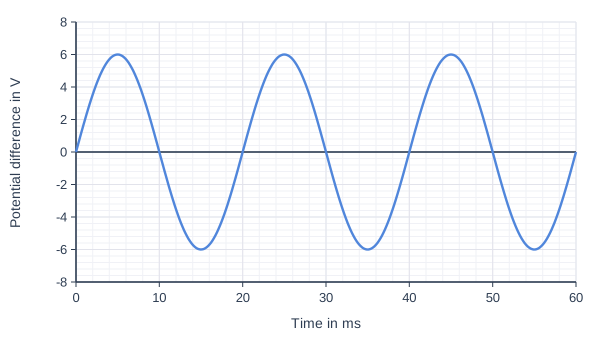
The graph shows how the potential difference of an alternating supply changes with time.
The equation linking period and frequency is: period = 1 ÷ frequency
Use the graph to determine the frequency of the supply.
Model answer
From the graph, one complete cycle takes 20 ms, so the period is 20 ms = 0.020 s. frequency = 1 ÷ period = 1 ÷ 0.020 frequency = 50 Hz
Explanation
The period is the time for one complete cycle, for example from one peak to the next. Convert milliseconds to seconds before calculating the frequency, so that the answer is in hertz. This supply has the same frequency as the UK mains.
Mark scheme
1 mark
period = 20 ms
an answer of 50 (Hz) scores 3 marks; allow time for one complete cycle read from the graph
1 mark
period = 0.020 s
conversion of ms to s
1 mark
frequency = 1 ÷ 0.020 = 50 (Hz)
allow ecf from their period; an answer of 0.05 (Hz) scores 2 marks
Question 4
3 marks
A lamp can be connected either to a battery or to the mains supply.
Describe how the current in the lamp is different when it is connected to the mains supply compared with the battery.
Model answer
When the lamp is connected to the battery, the current flows in one direction only, because the battery supplies a direct potential difference. When it is connected to the mains, the current repeatedly changes direction, because the mains supply is alternating, with a frequency of 50 Hz: it goes through 50 complete cycles every second.
Explanation
A lamp works on both supplies because heating the filament does not depend on which way the current flows. The difference is that the mains current reverses direction many times every second.
Mark scheme
1 mark
with the battery the current flows in one direction only (direct current)
1 mark
with the mains the current repeatedly changes direction (alternating current)
1 mark
the mains current goes through 50 cycles each second / changes direction 100 times a second
allow frequency of 50 Hz
Ready to try the rest? Every answer you write is marked against the mark scheme, so you can see exactly where the marks are.
Ctrl + Enter to check
Study HelperHints first, answers after you try
Stuck on this one? Ask for a hint and I’ll point you in the right direction, without giving the answer away. Once you’ve checked your answer, I’ll show you how the marks are awarded.