Level:
Correct: 0
Incorrect: 0
Marks: 0/0
Exam Practice
Course:
Topics:
Avg
score:
–
Topics
done:
0/30

Density of materials

Practise 15 exam-style questions on Density of materials for AQA GCSE Combined Science (Physics Paper 1). Write your answer as you would in the exam and get it marked in seconds against the mark scheme, point by point, with the Study Helper on hand if you get stuck.

  • 15 questions
  • 1–6 marks each
  • Instant marking
  • No sign-up needed
15 questions, marked as you go

Sample questions with model answers

Here are 4 of the questions in this topic, each with a model answer, an explanation of why it earns the marks and the mark scheme an examiner would use.

Question 1

2 marks

A block of aluminium has a mass of 5.4 kg and a volume of 0.0020 m³.

Calculate the density of aluminium.

Model answer

density = mass ÷ volume
ρ = 5.4 ÷ 0.0020
ρ = 2700 kg/m³

Explanation

Divide the mass in kilograms by the volume in metres cubed to get the density in kg/m³. Dividing by a small number such as 0.0020 gives a large answer, so check your answer is sensible: most metals have densities of thousands of kg/m³.

Mark scheme
  1. 1 mark

    ρ = 5.4 ÷ 0.0020

    an answer of 2700 kg/m³ scores 2 marks

  2. 1 mark

    2700 (kg/m³)

Question 2

2 marks

A student says: "A large block of oak has a greater density than a small piece of oak because the large block is heavier."

Explain why the student is wrong.

Model answer

The large block has a greater mass, but it also has a greater volume. Mass and volume increase in the same proportion, so mass ÷ volume is the same and both pieces have the same density. Density depends on the material, not on how much of it there is.

Explanation

Density is a property of a material. Doubling the size of a block doubles both its mass and its volume, so their ratio, the density, does not change. A common misconception is to confuse density with mass or weight.

Mark scheme
  1. 1 mark

    the large block also has a greater volume

  2. 1 mark

    mass and volume increase in the same proportion, so mass ÷ volume / density stays the same

    allow density depends only on the material, not on the size / amount

Question 3

3 marks

A student measured the density of cooking oil.
Mass of empty measuring cylinder = 112.0 g
Mass of measuring cylinder containing 50.0 cm³ of oil = 158.0 g

Calculate the density of the oil in kg/m³.

Model answer

mass of oil = 158.0 − 112.0 = 46.0 g
density = mass ÷ volume = 46.0 ÷ 50.0 = 0.92 g/cm³
0.92 g/cm³ × 1000 = 920 kg/m³

Explanation

The balance measures the cylinder and oil together, so subtract the mass of the empty cylinder to find the mass of the oil alone. The volume of a liquid is read directly from the measuring cylinder. Oil is less dense than water (1000 kg/m³), which is why it floats on water.

Mark scheme
  1. 1 mark

    mass of oil = 158.0 − 112.0 = 46.0 (g)

    an answer of 920 kg/m³ scores 3 marks

  2. 1 mark

    density = 46.0 ÷ 50.0 = 0.92 (g/cm³)

    allow 0.046 ÷ 5.0 × 10⁻⁵; allow ecf from an incorrect mass

  3. 1 mark

    920 (kg/m³)

    allow ecf from their density in g/cm³ × 1000

Question 4

5 marks

A student used Vernier callipers to measure a metal cuboid. It measured 4.00 cm × 2.50 cm × 2.00 cm. The mass of the cuboid was 178 g.

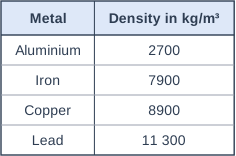
The table shows the densities of four metals.

Use the measurements to identify the metal. Show your working.

Table with columns "Metal", "Density in kg/m³". Metal: Aluminium; Density in kg/m³: 2700 | Metal: Iron; Density in kg/m³: 7900 | Metal: Copper; Density in kg/m³: 8900 | Metal: Lead; Density in kg/m³: 11 300.

Model answer

volume = 4.00 × 2.50 × 2.00 = 20.0 cm³ = 20.0 × 10⁻⁶ m³ = 2.0 × 10⁻⁵ m³
mass = 178 g = 0.178 kg
density = mass ÷ volume = 0.178 ÷ 2.0 × 10⁻⁵ = 8900 kg/m³
This matches the density of copper, so the metal is copper.

Explanation

For a regular object, volume = length × width × height. Convert the units so the density can be compared with the table in kg/m³ (or work in g/cm³ and multiply by 1000). Density is a property of the material, so it identifies the metal whatever the size of the cuboid.

Mark scheme
  1. 1 mark

    volume = 4.00 × 2.50 × 2.00 = 20.0 (cm³)

    an answer of 8900 kg/m³ with copper identified scores 5 marks

  2. 1 mark

    volume = 2.0 × 10⁻⁵ (m³)

    allow 0.000 02 m³; allow density = 178 ÷ 20.0 = 8.9 g/cm³ for this mark and the next

  3. 1 mark

    mass = 0.178 (kg)

  4. 1 mark

    density = 0.178 ÷ 2.0 × 10⁻⁵ = 8900 (kg/m³)

    allow 8.9 g/cm³ × 1000 = 8900 kg/m³; allow ecf from incorrect volume or mass

  5. 1 mark

    copper

    allow ecf for the metal in the table closest to their calculated density

Ready to try the rest? Every answer you write is marked against the mark scheme, so you can see exactly where the marks are.

Revision notes

Density of materials

The big idea

Density tells you how much mass is packed into each unit of volume. A small steel bolt sinks in water but a large wooden log floats, because steel is denser than water and wood is less dense than water. The particle model explains why one substance has very different densities as a solid, a liquid and a gas, and the required practical shows how to measure the density of any solid or liquid.

The density equation

\[\text{density} = \dfrac{\text{mass}}{\text{volume}} \qquad \rho = \dfrac{m}{V}\]
  • density, \(\rho\) (the Greek letter rho), in kilograms per metre cubed, kg/m³
  • mass, \(m\), in kilograms, kg
  • volume, \(V\), in metres cubed, m³

You must recall this equation: it is not on the Physics equation sheet. Rearranged, it gives \(m = \rho V\) and \(V = \dfrac{m}{\rho}\).

Small objects are often measured in grams and cm³, which gives a density in g/cm³. Because 1 m³ = 100 cm × 100 cm × 100 cm = 1 000 000 cm³:

  • volume in cm³ ÷ 1 000 000 = volume in m³ (and 1 litre = 1000 cm³)
  • density in g/cm³ × 1000 = density in kg/m³, so water's 1 g/cm³ is 1000 kg/m³

Density depends on the material (and its state), not on the size of the piece. Half a brick has half the mass and half the volume, so it has the same density as a whole brick.

Finding a mass from a volume in litres

A fish tank holds 60 litres of seawater. The density of seawater is 1030 kg/m³. Calculate the mass of the seawater.

Convert the volume: 60 litres = 60 × 1000 = 60 000 cm³, and 60 000 ÷ 1 000 000 = 0.060 m³

\(m = \rho \times V = 1030 \times 0.060 = 61.8\) kg, which is about 62 kg

Density and the states of matter

Particle diagram: box Solid shows single atoms of one element (all the same colour) in a regular, closely packed arrangement (solid); box Liquid shows single atoms of one element (all the same colour) close together but randomly arranged (liquid); box Gas shows single atoms of one element (all the same colour) far apart and randomly arranged (gas).
The same particles in three states: only their arrangement and spacing change.
StateArrangement of particlesMovement of particlesDensity
SolidClose together, in a regular patternVibrate about fixed positionsHigh
LiquidClose together (mostly touching), arranged randomlyMove around and slide past each otherHigh, usually a little lower than the solid
GasFar apart, arranged randomlyMove quickly in random directionsVery low

A given mass of a substance has the same number of particles in every state. Only the spacing changes. In a gas the particles are far apart, so the same mass takes up a much larger volume (steam takes up well over 1000 times the volume of the same mass of water), and its density is much lower. Particles in solids and liquids are about the same distance apart, so their densities are similar. Water is unusual: ice is less dense than liquid water, which is why ice floats.

Measuring the density of very small objects

One steel ball bearing hardly changes the reading on a measuring cylinder. So a student lowers 20 identical ball bearings into water in a measuring cylinder. The reading rises from 30.0 cm³ to 34.2 cm³. The 20 ball bearings have a total mass of 33.6 g. Calculate the density of the steel in kg/m³.

Volume of the 20 ball bearings: \(34.2 - 30.0 = 4.2\) cm³

\(\rho = \dfrac{m}{V} = \dfrac{33.6}{4.2} = 8.0\) g/cm³

\(8.0 \times 1000 = 8000\) kg/m³

Using 20 ball bearings gives a volume big enough to read precisely. One ball bearing has a volume of only \(4.2 \div 20 = 0.21\) cm³.

Required practical: Density

  • Regular solid (such as a cuboid): measure the mass on a top-pan balance. Measure the length, width and height with a ruler, or with Vernier callipers or a micrometer for a small object (they have a higher resolution). Volume = length × width × height.
  • Irregular solid (such as a stone): measure the mass, then find the volume by displacement. Read a measuring cylinder of water before and after lowering the object in, or fill a eureka can to its spout and collect the displaced water in a measuring cylinder.
  • Liquid: find the mass of an empty measuring cylinder, pour in some liquid and read its volume, then find the mass again. The mass of the liquid is the difference.
  • Calculate density = mass ÷ volume. Repeat and calculate a mean.
  • Read the measuring cylinder at eye level, from the bottom of the meniscus, to avoid parallax error. Lower objects gently on a thread so no water splashes out and the glass does not crack.
  • Errors: water splashed out or left in the spout makes the measured volume too small, so the density comes out too large. Air bubbles stuck to the object make the volume too large.
Diagram of a eureka (displacement) can used to find the volume of an irregular object. The object hangs on a thread completely under the water in the can; the water it pushes out flows from the spout into a measuring cylinder. Labelled parts: Thread, Eureka can, Irregular object, Water, Spout, Measuring cylinder.
The object pushes out its own volume of water, which runs from the spout into the measuring cylinder.

Common mistakes

  • Converting cm³ to m³ by dividing by 100 or 1000. Divide by 1 000 000.
  • Saying a bigger piece of a material has a greater density. Its mass and its volume go up in proportion, so the density is the same.
  • Saying the particles get bigger when a substance becomes a gas. The particles stay the same size; the spaces between them get bigger.
  • Describing liquid particles as "in rows" or "far apart". They are close together but randomly arranged.
  • Naming a beaker for collecting the displaced water. Use a measuring cylinder, which has a scale to read the volume.

Exam tip

In "describe how to find the density" questions, name each instrument and what it measures, say how the volume is found (from the dimensions or by displacement), and finish with density = mass ÷ volume. If the answer must be in kg/m³, convert at the end: g/cm³ × 1000.

Study Helper Hints first, answers after you try

Stuck on this one? Ask for a hint and I’ll point you in the right direction, without giving the answer away. Once you’ve checked your answer, I’ll show you how the marks are awarded.