Level:
Correct: 0
Incorrect: 0
Marks: 0/0
Exam Practice
Course:
Topics:
Avg
score:
–
Topics
done:
0/30

Mass number, atomic number and isotopes

Practise 13 exam-style questions on Mass number, atomic number and isotopes for AQA GCSE Combined Science (Physics Paper 1). Write your answer as you would in the exam and get it marked in seconds against the mark scheme, point by point, with the Study Helper on hand if you get stuck.

  • 13 questions
  • 1–5 marks each
  • Instant marking
  • No sign-up needed
13 questions, marked as you go

Sample questions with model answers

Here are 4 of the questions in this topic, each with a model answer, an explanation of why it earns the marks and the mark scheme an examiner would use.

Question 1

2 marks

Atoms have no overall electrical charge.

Explain why.

Model answer

In an atom the number of electrons is equal to the number of protons. Each proton has a positive charge and each electron has an equal negative charge, so the charges cancel and the atom has no overall charge.

Explanation

Neutrons have no charge, so only protons and electrons matter. An atom becomes an ion when the numbers are no longer equal - for example, losing an electron leaves more protons than electrons, giving a positive ion.

Mark scheme
  1. 1 mark

    an atom has equal numbers of protons and electrons

    allow number of electrons = number of protons

  2. 1 mark

    protons are positive and electrons are negative (with equal size charges), so the charges cancel

    allow the positive and negative charges balance

Question 2

2 marks

A sodium atom can become a sodium ion, Na⁺.

Explain how this happens.

Model answer

The sodium atom loses its outer electron. It now has 11 protons but only 10 electrons, so it has one more positive charge than negative charge and an overall charge of +1.

Explanation

Atoms turn into positive ions when they lose one or more outer electrons. The nucleus does not change, so the number of protons stays the same; the charge comes from having fewer electrons than protons.

Mark scheme
  1. 1 mark

    the atom loses one (outer) electron

    do not accept gains a proton

  2. 1 mark

    so it has one more proton than electrons, giving an overall charge of +1

    allow more protons than electrons so it is positive

Question 3

3 marks

An aluminium ion can be represented as ²⁷₁₃Al³⁺.

Give the number of protons, neutrons and electrons in this ion.

Model answer

Protons = 13
Neutrons = 27 − 13 = 14
Electrons = 13 − 3 = 10

Explanation

The atomic number (13) gives the protons and the mass number (27) gives protons + neutrons. The 3+ charge means the atom has lost 3 electrons, so it has 13 − 3 = 10 electrons. A common mistake is to add 3 electrons instead of taking them away.

Mark scheme
  1. 1 mark

    protons = 13

  2. 1 mark

    neutrons = 14

    allow ecf for 27 − their number of protons

  3. 1 mark

    electrons = 10

    do not accept 13 or 16

Question 4

4 marks

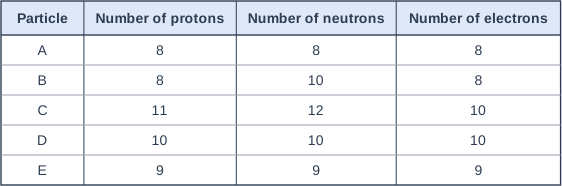
The table shows the numbers of protons, neutrons and electrons in five particles, A to E.

Which two particles are isotopes of the same element?
Which particle is a positive ion?
Give reasons for your answers.

Table with columns "Particle", "Number of protons", "Number of neutrons", "Number of electrons". Particle: A; Number of protons: 8; Number of neutrons: 8; Number of electrons: 8 | Particle: B; Number of protons: 8; Number of neutrons: 10; Number of electrons: 8 | Particle: C; Number of protons: 11; Number of neutrons: 12; Number of electrons: 10 | Particle: D; Number of protons: 10; Number of neutrons: 10; Number of electrons: 10 | Particle: E; Number of protons: 9; Number of neutrons: 9; Number of electrons: 9.

Model answer

A and B are isotopes of the same element, because they both have 8 protons but they have different numbers of neutrons (8 and 10). C is a positive ion, because it has 11 protons but only 10 electrons, so it has an overall positive charge.

Explanation

Isotopes must have the same number of protons; B and E both have a mass number of 18, but they have different numbers of protons, so they are different elements. A particle with fewer electrons than protons is a positive ion; equal numbers means a neutral atom.

Mark scheme
  1. 1 mark

    A and B

  2. 1 mark

    same number of protons (8) but different numbers of neutrons (8 and 10)

    do not accept B and E have the same mass number as a reason

  3. 1 mark

    C

  4. 1 mark

    it has more protons (11) than electrons (10)

    allow it has lost an electron

Ready to try the rest? Every answer you write is marked against the mark scheme, so you can see exactly where the marks are.

Revision notes

Mass number, atomic number and isotopes

The big idea

Every atom can be described by two numbers: its atomic number (how many protons it has) and its mass number (how many protons and neutrons it has). The number of protons decides which element an atom is. Changing the number of neutrons gives a different isotope of the same element, and losing electrons turns an atom into a positive ion.

Atomic number and mass number

  • The atomic number is the number of protons in the nucleus. All atoms of a particular element have the same number of protons, and atoms of different elements have different numbers.
  • The mass number is the total number of protons and neutrons in the atom.
  • In an atom, the number of electrons is equal to the number of protons. Protons (+1) and electrons (−1) have equal and opposite charges, so atoms have no overall electrical charge.

So: \(\text{number of neutrons} = \text{mass number} - \text{atomic number}\)

In nuclear notation, the mass number is written at the top left of the element's symbol and the atomic number at the bottom left. For example, fluorine-19 is written \({}^{19}_{9}\text{F}\):

  • atomic number 9, so 9 protons (and, in the atom, 9 electrons);
  • mass number 19, so \(19 - 9 = 10\) neutrons.

The name "fluorine-19" gives the same information in words: the number after the name is the mass number.

Isotopes

Isotopes are atoms of the same element (the same number of protons) with different numbers of neutrons. So isotopes have the same atomic number but different mass numbers.

Diagram of two atoms side by side. Left - Lithium-6: a nucleus of 3 protons (+) and 3 neutrons, with 3 electrons (−) on 2 energy levels (2, 1 from the inside out). Right - Lithium-7: a nucleus of 3 protons (+) and 4 neutrons, with 3 electrons (−) on 2 energy levels (2, 1 from the inside out). A key shows: orange circle with + = proton, grey circle = neutron, blue circle with − = electron.
Two isotopes of lithium: both have 3 protons and 3 electrons, but lithium-7 has one more neutron.

Lithium-6, \({}^{6}_{3}\text{Li}\), and lithium-7, \({}^{7}_{3}\text{Li}\), show how isotopes compare:

  • Identity: both have 3 protons, so both are lithium. The bottom numbers are the same.
  • Mass: lithium-7 has 4 neutrons instead of 3, so it has a greater mass. The top numbers are different.
  • Charge: neutrons have no charge, so both nuclei have the same charge (+3), and both atoms are neutral.

Ions

Atoms turn into positive ions if they lose one or more outer electrons. The nucleus does not change, so the ion is still the same element with the same mass number. It now has more protons than electrons, and its charge tells you how many electrons were lost:

\(\text{charge of the ion} = \text{number of protons} - \text{number of electrons}\)

If you change the number of ...What changesYou get
ProtonsThe atomic numberA different element
NeutronsThe mass number (and the mass)A different isotope of the same element
ElectronsThe chargeAn ion of the same element

Writing the symbol for an ion

A calcium atom has atomic number 20 and mass number 40. It loses its two outer electrons. Give the numbers of protons, neutrons and electrons in the particle formed, and write its symbol.

Protons: 20 (the atomic number, which does not change)

Neutrons: \(40 - 20 = 20\) (losing electrons does not change the nucleus)

Electrons: the atom had 20, and it lost 2, so \(20 - 2 = 18\)

Charge: \(20 - 18 = +2\), so the symbol is \({}^{40}_{20}\text{Ca}^{2+}\)

Remember

  • Atomic number = number of protons. It decides the element.
  • Mass number = number of protons + number of neutrons.
  • Isotopes: same number of protons, different numbers of neutrons.
  • A positive ion forms when an atom loses outer electrons; the nucleus stays the same.

Common mistakes

  • Saying isotopes have different numbers of protons. Then they would be different elements: isotopes have the same number of protons and different numbers of neutrons.
  • Defining the mass number as the number of neutrons, or as the mass of the atom. It is the total number of protons and neutrons.
  • Defining the atomic number as the number of electrons. It is the number of protons; electrons only equal it in a neutral atom.
  • Calling two atoms with the same mass number isotopes, such as \({}^{40}_{18}\text{Ar}\) and \({}^{40}_{20}\text{Ca}\). They have different numbers of protons, so they are different elements.
  • Saying an ion forms by gaining protons or losing neutrons. A positive ion forms by losing electrons.
  • Saying isotopes have different charges. Neutrons are uncharged, so isotopes differ in mass, not charge.

Exam tip

When asked why two atoms are isotopes, make both points and quote the numbers: "both have 10 protons, so they are the same element, but one has 10 neutrons and the other has 12". To read nuclear notation quickly: the top number (the mass number) is never smaller than the bottom one (the number of protons).

Study Helper Hints first, answers after you try

Stuck on this one? Ask for a hint and I’ll point you in the right direction, without giving the answer away. Once you’ve checked your answer, I’ll show you how the marks are awarded.