Practise 11 exam-style questions on Particle motion in gases for AQA GCSE Combined Science (Physics Paper 1). Write your answer as you would in the exam and get it marked in seconds against the mark scheme, point by point, with the Study Helper on hand if you get stuck.
11 questions
1–6 marks each
Instant marking
No sign-up needed
11 questions, marked as you go
Sample questions with model answers
Here are 4 of the questions in this topic, each with a model answer, an explanation of why it earns the marks and the mark scheme an examiner would use.
Question 1
1 mark
The temperature of a gas is related to one property of its molecules.
Name this property.
Model answer
The average kinetic energy of the molecules.
Explanation
The higher the temperature of a gas, the greater the average kinetic energy of its molecules, so the faster they move on average. Cooling a gas reduces the average kinetic energy of its molecules.
Mark scheme
1 mark
(average) kinetic energy (of the molecules)
allow average speed; do not accept potential energy
Question 2
2 marks
The molecules in a gas move randomly in all directions.
Explain why a gas at a constant temperature exerts a steady pressure on every wall of its container, even though the molecules move randomly.
Model answer
There are an enormous number of molecules in the gas. Because there are so many, moving randomly in all directions, on average the same number of molecules hit each part of the walls every second with the same average force, so the pressure is steady and the same on every wall.
Explanation
Random motion of a few molecules would give an uneven, fluctuating force, but a real gas contains so many molecules that their effects average out. At a constant temperature the average speed of the molecules is constant, so the pressure stays steady.
Mark scheme
1 mark
there are a very large number of molecules
allow billions of molecules
1 mark
so on average the same number of collisions per second, with the same average force, happen on each wall
allow the random motions average out
Question 3
3 marks
A sealed metal cylinder of gas is moved from a warm room into a cold store. The volume of the cylinder does not change.
Explain why the pressure of the gas in the cylinder decreases.
Model answer
In the cold store the temperature of the gas falls, so the average kinetic energy of the molecules decreases and they move more slowly. This means they collide with the walls of the cylinder less often, and each collision exerts a smaller force. So the total force on the walls is smaller and the pressure decreases.
Explanation
At constant volume, the pressure of a gas depends on its temperature. Lower temperature means slower molecules, giving fewer collisions per second and less force per collision. Write "less often" or "fewer per second" - just "fewer collisions" does not mention time.
Mark scheme
1 mark
the temperature of the gas decreases so the (average) kinetic energy of the molecules decreases
allow the molecules move more slowly
1 mark
so the molecules collide with the walls less often
allow fewer collisions per second; do not accept fewer collisions
1 mark
and each collision exerts a smaller force on the walls
allow collisions are less forceful / with less force
Question 4
4 marks
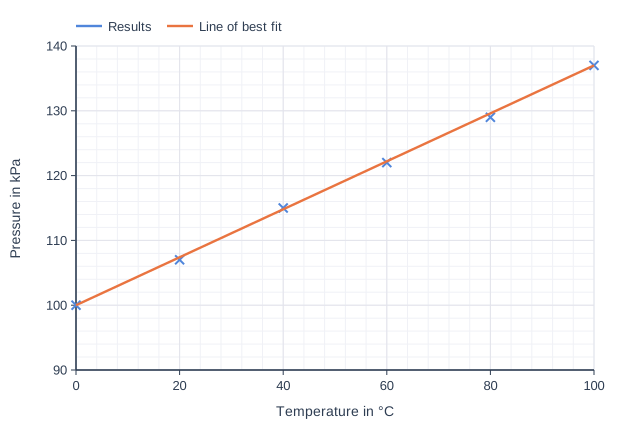
A student heated some air in a sealed container of fixed volume. The graph shows how the pressure of the air changed as she increased its temperature.
Describe the relationship shown by the graph, and explain it in terms of the motion of the air molecules.
Model answer
As the temperature increases, the pressure of the air increases steadily: the line is straight, rising by about 7 kPa for every 20 °C, from 100 kPa at 0 °C to about 137 kPa at 100 °C. This happens because at a higher temperature the air molecules have more kinetic energy and move faster. They collide with the walls of the container more often and each collision exerts more force, so the pressure is greater.
Explanation
Describing a graph means giving the trend and some detail (shape or values); explaining means giving the science. Pressure does increase with temperature at constant volume, but because the temperature scale is in °C the line does not pass through the origin, so pressure is not directly proportional to the Celsius temperature.
Mark scheme
1 mark
as the temperature increases, the pressure increases
allow positive correlation
1 mark
the pressure increases steadily / linearly, by about 7 kPa for every 20 °C
allow straight line; allow but it is not directly proportional because the line does not pass through (0, 0); allow correct data quoted, e.g. 100 kPa at 0 °C and 137 kPa at 100 °C
1 mark
at a higher temperature the molecules have more kinetic energy / move faster
1 mark
so they collide with the walls more often and with more force (causing a greater pressure)
allow more collisions per second, each with greater force
Ready to try the rest? Every answer you write is marked against the mark scheme, so you can see exactly where the marks are.
Ctrl + Enter to check
Study HelperHints first, answers after you try
Stuck on this one? Ask for a hint and I’ll point you in the right direction, without giving the answer away. Once you’ve checked your answer, I’ll show you how the marks are awarded.