Level:
Correct: 0
Incorrect: 0
Marks: 0/0
Exam Practice
Course:
Topics:
Avg
score:
–
Topics
done:
0/30

Power

Practise 12 exam-style questions on Power for AQA GCSE Combined Science (Physics Paper 1). Write your answer as you would in the exam and get it marked in seconds against the mark scheme, point by point, with the Study Helper on hand if you get stuck.

  • 12 questions
  • 1–5 marks each
  • Instant marking
  • No sign-up needed
12 questions, marked as you go

Sample questions with model answers

Here are 4 of the questions in this topic, each with a model answer, an explanation of why it earns the marks and the mark scheme an examiner would use.

Question 1

2 marks

An electric kettle has a power rating of 1500 W.

Explain what this tells you about the kettle.

Model answer

The kettle transfers 1500 J of energy every second, because a power of 1 watt is an energy transfer of 1 joule per second.

Explanation

The watt is defined as one joule per second. So the power rating tells you how many joules the appliance transfers each second when it is working normally.

Mark scheme
  1. 1 mark

    the kettle transfers 1500 J of energy

  2. 1 mark

    every second

    allow 1 watt is 1 joule per second, so 1500 W is 1500 J per second for 2 marks

Question 2

3 marks

A microwave oven transfers 81 kJ of energy in 1.5 minutes.

Calculate the power of the microwave oven in watts.

Model answer

energy = 81 kJ = 81 000 J
time = 1.5 minutes = 90 s
P = E ÷ t = 81 000 ÷ 90
P = 900 W

Explanation

To get a power in watts, the energy must be in joules and the time in seconds. Converting only one of them gives an answer that is wrong by a factor of 60 or 1000.

Mark scheme
  1. 1 mark

    energy = 81 000 J and time = 90 s

    both conversions needed; an answer of 900 (W) scores 3 marks

  2. 1 mark

    P = 81 000 ÷ 90

    allow ecf from incorrect conversions

  3. 1 mark

    900 (W)

    allow ecf; an answer of 0.9 (W) or 54 000 (W), from missing one conversion, scores 2 marks

Question 3

3 marks

Two students have the same weight. They both go up the same flight of stairs. One student walks up the stairs and the other runs up.

Compare the work done by the two students and the power they develop.

Model answer

Both students do the same amount of work, because they have the same weight and are raised through the same height, so they gain the same gravitational potential energy. The student who runs does this work in less time, so the runner develops a greater power.

Explanation

Work done depends on the force and the distance, not on the time taken. Power is work done ÷ time, so doing the same work faster means a greater power.

Mark scheme
  1. 1 mark

    both students do the same amount of work

    allow both gain the same gravitational potential energy

  2. 1 mark

    because they have the same weight and rise through the same height

  3. 1 mark

    the student who runs develops more power because they do the work in less time

    allow the runner transfers energy at a greater rate

Question 4

4 marks

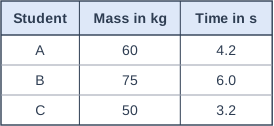
Three students ran up a flight of stairs. The vertical height of the stairs is 3.5 m. The table shows the mass of each student and the time each took.

gravitational field strength = 9.8 N/kg

Which student developed the greatest power?
Show how you work out your answer.

Table with columns "Student", "Mass in kg", "Time in s". Student: A; Mass in kg: 60; Time in s: 4.2 | Student: B; Mass in kg: 75; Time in s: 6.0 | Student: C; Mass in kg: 50; Time in s: 3.2.

Model answer

Power = m g h ÷ t
A: 60 × 9.8 × 3.5 ÷ 4.2 = 2058 ÷ 4.2 = 490 W
B: 75 × 9.8 × 3.5 ÷ 6.0 = 2572.5 ÷ 6.0 = 429 W
C: 50 × 9.8 × 3.5 ÷ 3.2 = 1715 ÷ 3.2 = 536 W
Student C developed the greatest power.

Explanation

Each student does work equal to their gain in gravitational potential energy (m g h), and power is that energy divided by the time. Student C is the lightest but was quick enough to transfer energy at the greatest rate; student B did the most work but was slowest.

Mark scheme
  1. 1 mark

    A: P = 60 × 9.8 × 3.5 ÷ 4.2 = 490 (W)

    allow energies of 2058 J, 2572.5 J and 1715 J calculated correctly for 1 mark if no powers are calculated

  2. 1 mark

    B: P = 75 × 9.8 × 3.5 ÷ 6.0 = 429 (W)

    allow 428.75 (W)

  3. 1 mark

    C: P = 50 × 9.8 × 3.5 ÷ 3.2 = 536 (W)

    allow 535.9 (W)

  4. 1 mark

    student C

    allow ecf from their calculated powers if all three are attempted

Ready to try the rest? Every answer you write is marked against the mark scheme, so you can see exactly where the marks are.

Revision notes

Power

The big idea

Power is the rate at which energy is transferred, or the rate at which work is done. It tells you how quickly energy is transferred, not how much is transferred in total. A powerful kettle boils water faster than a less powerful one, but given enough time the weaker kettle can transfer just as much energy.

The equations

\[\text{power} = \dfrac{\text{energy transferred}}{\text{time}} \qquad P = \dfrac{E}{t}\]
\[\text{power} = \dfrac{\text{work done}}{\text{time}} \qquad P = \dfrac{W}{t}\]
  • power, P, in watts, W
  • energy transferred, E, in joules, J
  • work done, W, in joules, J
  • time, t, in seconds, s

You must recall both equations. Doing work is one way of transferring energy, so they are really the same idea. Rearranged, they give \(E = Pt\) and \(t = \dfrac{E}{P}\).

Take care with the letter W: in \(P = \dfrac{W}{t}\) it stands for work done (a quantity), but after a number, as in 60 W, it is the unit watt.

What a watt means

An energy transfer of 1 joule per second is a power of 1 watt. So a 45 W laptop charger transfers 45 J of energy every second, and a 2.2 kW fan heater transfers 2200 J every second.

Convert before you substitute:

  • 1 kW = 1000 W, 1 MW = 1 000 000 W and 1 GW = 1 000 000 000 W
  • minutes × 60 = seconds; hours × 3600 = seconds
  • 1 kJ = 1000 J and 1 MJ = 1 000 000 J

Comparing powers

Picture two electric motors that each lift the same weight through the same height. They do the same work, so they transfer the same energy. If one motor does it in less time, it transfers energy at a faster rate, so it has the greater power.

On a graph of energy transferred against time, the gradient is the power, so the steeper line belongs to the more powerful device.

A horse pulling a cart

A horse pulls a cart along a level road with a steady force of 450 N. It pulls the cart 1.2 km in 10 minutes. Calculate the useful power of the horse.

Convert: 1.2 km = 1200 m and 10 minutes = \(10 \times 60 = 600\) s

Work done, using \(\text{work done} = \text{force} \times \text{distance}\) (an equation you must recall): \(W = Fs = 450 \times 1200 = 540\,000\) J

Power: \(P = \dfrac{W}{t} = \dfrac{540\,000}{600} = 900\) W

More power does not mean more energy

A jet hand dryer has a power of 1.6 kW and runs for 10 s. A warm-air hand dryer has a power of 1.2 kW and runs for 40 s. Which dryer transfers more energy each time it is used?

Jet dryer: \(E = Pt = 1600 \times 10 = 16\,000\) J

Warm-air dryer: \(E = Pt = 1200 \times 40 = 48\,000\) J

The jet dryer has the greater power, but it runs for a much shorter time, so the warm-air dryer transfers three times as much energy.

How long will it last?

Winding up a torch for 30 s stores 90 J of energy in its battery. The torch's LED has a power of 0.25 W. Assuming all the stored energy reaches the LED, how long will it stay lit?

\(t = \dfrac{E}{P} = \dfrac{90}{0.25} = 360\) s, which is 6.0 minutes

Common mistakes

  • Defining power as "the amount of energy used". It is the rate of energy transfer: the energy transferred per second.
  • Leaving power in kilowatts or time in minutes. Use watts and seconds, or the answer will be 1000 or 60 times out.
  • Thinking a more powerful device always transfers more energy. The energy also depends on how long it runs.
  • Using the distance along a slope or a staircase to find the work done in lifting something. Use the vertical height.

Exam tip

Many power questions hide a step. If you are given a force and a distance, or a mass and a height, work out the work done first (\(W = Fs\) or \(E_p = mgh\)), then divide by the time in seconds. If the answer must be in kW, convert only at the end, and check the unit: W for a power, J for an energy.

Study Helper Hints first, answers after you try

Stuck on this one? Ask for a hint and I’ll point you in the right direction, without giving the answer away. Once you’ve checked your answer, I’ll show you how the marks are awarded.