The big idea
Electrical appliances are designed to transfer energy: from batteries or the a.c. mains to the kinetic energy store of a motor, or to the thermal energy store of a heating device. How much energy an appliance transfers depends on its power and how long it is switched on. Two equations let you calculate it.
What appliances do
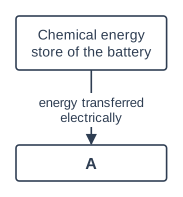
Energy is transferred electrically (by the current) from the supply to the appliance. "Electrical" describes the way the energy is transferred, not an energy store.
| Appliance | Energy comes from | Useful energy goes to |
|---|
| Electric kettle, toaster, heater | The a.c. mains | The thermal energy store of the heating element, then of the water, bread or room |
| Electric fan, vacuum cleaner | The a.c. mains | The kinetic energy store of the motor and blades |
| Cordless drill, electric toothbrush | The chemical energy store of the battery | The kinetic energy store of the motor |
| Hairdryer (hot setting) | The a.c. mains | The kinetic store of the fan and the thermal store of the element and the air |
No appliance is perfect: some energy is always dissipated, for example heating a motor's coils or the air around a kettle, or as sound.
Work done by flowing charge
Work is done when charge flows in a circuit. The supply transfers energy to the charge, and the charge transfers it to each component it passes through, such as heating a kettle element.
\[\text{energy transferred} = \text{charge flow} \times \text{potential difference} \qquad E = QV\]
- energy transferred, \(E\), in joules, J
- charge flow, \(Q\), in coulombs, C
- potential difference, \(V\), in volts, V
You must recall this equation. It shows what potential difference means: a p.d. of 1 V means 1 joule of energy is transferred for each coulomb of charge.
An electric fence
An electric fence for farm animals sends short pulses through the wire. Each pulse transfers 4.0 J of energy, and the potential difference of the fence is 8.0 kV. Calculate the charge that flows in each pulse.
\(V = 8.0 \times 1000 = 8000\) V
\(E = QV\), so \(Q = \dfrac{E}{V} = \dfrac{4.0}{8000} = 0.0005\) C
\(Q = 5.0 \times 10^{-4}\) C
Energy, power and time
\[\text{energy transferred} = \text{power} \times \text{time} \qquad E = Pt\]
- energy transferred, \(E\), in joules, J
- power, \(P\), in watts, W
- time, \(t\), in seconds, s
You must recall this equation too. The power of a device is linked to:
- the potential difference across it and the current through it: \(P = VI\);
- the energy it transfers in a given time: \(P = \dfrac{E}{t}\).
Heating soup in a microwave oven
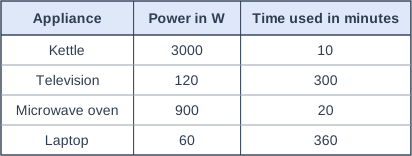
A microwave oven with a power of 900 W heats a bowl of soup for 2 minutes 30 seconds. Calculate the energy transferred, in kilojoules.
\(t = (2 \times 60) + 30 = 150\) s
\(E = Pt = 900 \times 150 = 135\,000\) J
\(135\,000 \div 1000 = 135\) kJ
Power ratings and stored energy
The power rating tells you how much energy an appliance transfers each second, so it tells you how quickly it changes the energy stores it is connected to.
- A 2.4 kW kettle transfers 2400 J each second to the thermal energy store of the water, so it boils a cupful faster than a 1.2 kW travel kettle. Both need about the same energy, because the mass of water and its temperature rise are the same.
- A 3 kW fan heater switched on for 20 minutes transfers the same energy to the thermal store of a room as a 1 kW heater switched on for an hour: it transfers the energy three times as fast.
- A 5 W LED lamp gives about the same light as a 40 W filament lamp but transfers far less energy each second, because much less is wasted heating the surroundings.
- A low-power fridge, switched on day and night, can transfer more energy in a day than a high-power toaster used for a few minutes.
Common mistakes
- Leaving the time in minutes or hours in \(E = Pt\). Convert to seconds to get joules.
- Writing "electrical energy store". Energy is transferred electrically; the stores are chemical, kinetic, thermal and so on.
- Saying a higher-power appliance always transfers more energy. It transfers energy faster; the total also depends on the time.
- Describing a potential difference as energy per second. That is power: a volt is a joule per coulomb.
- Forgetting kilo and mega: 1 kJ = 1000 J, 1 MJ = 1 000 000 J, 1 kW = 1000 W.
Exam tip
For "describe the energy transfers" questions, name the store the energy comes from, say it is transferred electrically, and name the store it goes to; add where energy is wasted. Two-step calculations (find \(P = VI\), then \(E = Pt\)) can also be done with \(Q = It\) then \(E = QV\): both routes score.