Level:
Correct: 0
Incorrect: 0
Marks: 0/0
Exam Practice
Course:
Topics:
Avg
score:
–
Topics
done:
0/30

Electrical charge and current

Practise 11 exam-style questions on Electrical charge and current for AQA GCSE Combined Science (Physics Paper 1). Write your answer as you would in the exam and get it marked in seconds against the mark scheme, point by point, with the Study Helper on hand if you get stuck.

  • 11 questions
  • 1–4 marks each
  • Instant marking
  • No sign-up needed
11 questions, marked as you go

Sample questions with model answers

Here are 4 of the questions in this topic, each with a model answer, an explanation of why it earns the marks and the mark scheme an examiner would use.

Question 1

1 mark

Write down the equation that links charge flow (Q), current (I) and time (t).

Model answer

charge flow = current × time
Q = I t

Explanation

Current is the rate of flow of charge, so the total charge that flows is the current multiplied by the time. Charge is in coulombs (C), current in amperes (A) and time in seconds (s).

Mark scheme
  1. 1 mark

    charge flow = current × time

    allow Q = I t; allow Q = I × t

Question 2

2 marks

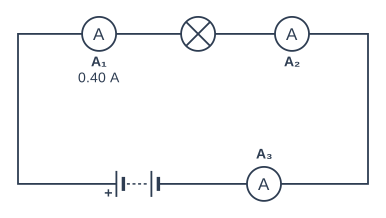
The circuit diagram shows a lamp connected in a single loop with a battery and three ammeters, A₁, A₂ and A₃. Ammeter A₁ reads 0.40 A.

What are the readings on ammeters A₂ and A₃? Give a reason for your answer.

Circuit diagram. All the components are connected in series in a single loop. Going round the loop from the + terminal of the battery: ammeter A₁ (reading 0.40 A); then a lamp; then ammeter A₂; then ammeter A₃; and back to the − terminal of the battery.

Model answer

A₂ and A₃ both read 0.40 A, because the current has the same value at any point in a single closed loop.

Explanation

Charge is not used up as it flows round a circuit. In a single loop the same charge passes every point each second, so all three ammeters show the same current, whether they are before or after the lamp.

Mark scheme
  1. 1 mark

    A₂ and A₃ both read 0.40 A

  2. 1 mark

    the current is the same at every point in a single closed loop

    allow current is not used up by the lamp

Question 3

3 marks

A charge of 36 C flows through a motor in 2.0 minutes.

Calculate the current in the motor.

Model answer

time = 2.0 × 60 = 120 s
Q = I t
36 = I × 120
I = 36 ÷ 120 = 0.30 A

Explanation

Rearrange Q = I t to give I = Q ÷ t. Current is the rate of flow of charge: here 0.30 coulombs pass each second.

Mark scheme
  1. 1 mark

    time = 120 s

    conversion of minutes to seconds; an answer of 0.30 (A) scores 3 marks

  2. 1 mark

    36 = I × 120

    allow I = 36 ÷ 120; allow ecf from an incorrect conversion

  3. 1 mark

    I = 0.30 (A)

    allow 0.3 (A); allow ecf; an answer of 18 (A) scores 2 marks

Question 4

3 marks

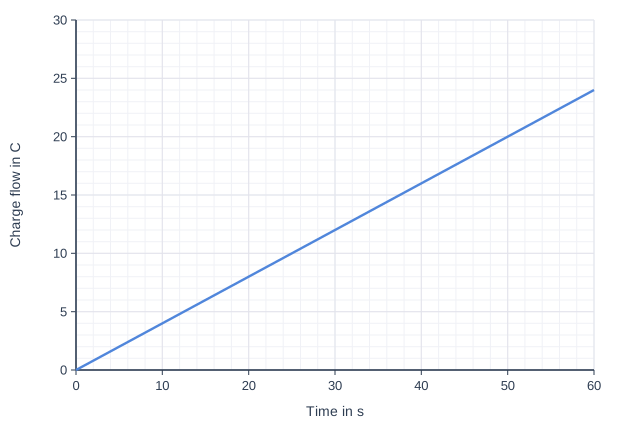
The graph shows how the total charge that has flowed through a resistor changes with time.

Use the graph to determine the current in the resistor.

Line graph of Charge flow in C (y-axis, 0 to 30) against time in s (x-axis, 0 to 60). The line joins the points (0, 0), (60, 24).

Model answer

From the graph, 24 C of charge flows in 60 s.
Q = I t, so I = Q ÷ t
I = 24 ÷ 60 = 0.40 A

Explanation

Current is the rate of flow of charge, so it is the gradient of a charge-time graph. The straight line shows the current is constant. Using the largest pair of readings you can read accurately reduces the error.

Mark scheme
  1. 1 mark

    a correct pair of readings, e.g. 24 C in 60 s

    an answer of 0.40 (A) scores 3 marks; allow any correct pair from the line, e.g. 12 C at 30 s

  2. 1 mark

    I = 24 ÷ 60

    allow ecf from their readings; allow I = gradient of the line

  3. 1 mark

    I = 0.40 (A)

    allow 0.4 (A); allow 0.38-0.42 (A)

Ready to try the rest? Every answer you write is marked against the mark scheme, so you can see exactly where the marks are.

Revision notes

Electrical charge and current

The big idea

An electric current is a flow of electrical charge. The size of the current tells you how quickly the charge flows: it is the rate of flow of charge. Charge only flows round a complete circuit that has a source of potential difference to drive it, and in a single loop the current is the same everywhere.

What makes charge flow

For charge to flow through a closed circuit, the circuit must include a source of potential difference, such as a cell, a battery or a power supply. A complete loop of wire on its own is not enough: with no potential difference, the charges have nothing to make them move, so the current is zero.

In metal wires the moving charges are free electrons. They are already in every part of the circuit, so when a switch is closed, charge starts to flow everywhere at almost the same moment. Insulators such as plastic have no charges that are free to move, so no current flows through them.

By agreement, circuit diagrams show conventional current, which flows from the positive terminal of the supply, round the circuit, to the negative terminal. Electrons are negatively charged, so they actually move the opposite way.

Charge, current and time

\[\text{charge flow} = \text{current} \times \text{time} \qquad Q = It\]
  • charge flow, \(Q\), in coulombs, C
  • current, \(I\), in amperes, A (amp is also fine)
  • time, \(t\), in seconds, s

You must recall this equation. It shows that a current of 1 A means 1 coulomb of charge passes a point every second. Rearranged, \(I = \dfrac{Q}{t}\) and \(t = \dfrac{Q}{I}\).

Convert before you substitute: milliamps to amps (÷ 1000), minutes to seconds (× 60), hours to seconds (× 3600) and kilocoulombs to coulombs (× 1000).

Starting a car

A car's starter motor takes a current of 150 A for 0.80 s while the engine starts. Calculate the charge that flows through the motor.

\(Q = It\)

\(Q = 150 \times 0.80 = 120\) C

Charging an electric toothbrush

The motor of an electric toothbrush takes a current of 250 mA. When fully charged, its battery can deliver 1.8 kC of charge. Each brushing session lasts 2 minutes. How many sessions does one full charge give?

\(I = 250 \div 1000 = 0.25\) A and \(Q = 1.8 \times 1000 = 1800\) C

\(Q = It\), so \(t = \dfrac{Q}{I} = \dfrac{1800}{0.25} = 7200\) s

\(7200 \div 60 = 120\) minutes, and \(120 \div 2 = 60\) sessions

On a graph of charge flow against time, the gradient is the current: a steeper line means a bigger current.

Current in a single loop

A current has the same value at any point in a single closed loop. Charge is not used up as it passes through a lamp or a resistor: every coulomb that goes in also comes out. What the components do is transfer energy. So an ammeter gives the same reading wherever you put it in a series loop.

Circuit diagram. All the components are connected in series in a single loop. Going round the loop from the + terminal of the battery (labelled 6 V), in the direction conventional current flows: an arrow labelled I on the wire pointing forwards (the way we are going round; it shows the direction of the conventional current); then ammeter A₁ (reading 0.20 A); then a lamp; then ammeter A₂ (reading 0.20 A); then a resistor; then a closed switch; and back to the − terminal of the battery.
Ammeters before and after the lamp read the same: the current is not used up.

If two ammeters in the same loop give slightly different readings, such as 0.48 A and 0.49 A, the difference comes from the meters themselves (their calibration and resolution), not from the circuit.

Remember

  • Current is the rate of flow of charge: 1 A = 1 C every second.
  • A closed circuit needs a source of potential difference for charge to flow.
  • The current is the same at every point in a single closed loop.
  • \(Q = It\) must be learned; use amperes and seconds to get coulombs.

Common mistakes

  • Saying the current is "used up" by a lamp. The current out equals the current in; it is energy that is transferred.
  • Forgetting to change minutes or hours into seconds. The answer is then wrong by a factor of 60 or 3600.
  • Using milliamps in \(Q = It\). Divide by 1000 first.
  • Calling the coulomb the unit of current. Charge is in coulombs; current is in amperes.
  • Defining current as "a flow of energy" or "electricity being used". It is a flow of charge.

Exam tip

In calculations, write \(Q = It\), show any change of units (milliamps to amps, minutes to seconds) on its own line, then substitute. If the question asks for the answer in a particular unit, such as kilocoulombs or minutes, convert at the end and give that unit.

Study Helper Hints first, answers after you try

Stuck on this one? Ask for a hint and I’ll point you in the right direction, without giving the answer away. Once you’ve checked your answer, I’ll show you how the marks are awarded.