Practise 14 exam-style questions on Energy changes in systems for AQA GCSE Combined Science (Physics Paper 1). Write your answer as you would in the exam and get it marked in seconds against the mark scheme, point by point, with the Study Helper on hand if you get stuck.
14 questions
1–6 marks each
Instant marking
No sign-up needed
14 questions, marked as you go
Sample questions with model answers
Here are 4 of the questions in this topic, each with a model answer, an explanation of why it earns the marks and the mark scheme an examiner would use.
Question 1
2 marks
A hot water bottle contains 1.2 kg of water. The water cools from 70 °C to 30 °C.
specific heat capacity of water = 4200 J/kg °C
The equation linking change in thermal energy, mass, specific heat capacity and temperature change is: change in thermal energy = mass × specific heat capacity × temperature change
Calculate the energy transferred from the water to the surroundings.
Model answer
temperature change = 70 − 30 = 40 °C ΔE = m × c × Δθ ΔE = 1.2 × 4200 × 40 ΔE = 201 600 J
Explanation
The equation uses the temperature change (70 − 30 = 40 °C), not either temperature on its own. The same equation gives the energy released when a substance cools as the energy needed to heat it through the same temperature change.
Mark scheme
1 mark
ΔE = 1.2 × 4200 × 40
an answer of 201 600 (J) scores 2 marks; temperature change of 40 °C must be used
1 mark
201 600 (J)
allow 2.0 × 10⁵ (J); allow 201.6 kJ
Question 2
3 marks
A pan contains 0.80 kg of cooking oil at 20 °C. The oil is heated and 24 000 J of energy is transferred to it.
specific heat capacity of cooking oil = 2000 J/kg °C
The equation linking change in thermal energy, mass, specific heat capacity and temperature change is: change in thermal energy = mass × specific heat capacity × temperature change
Calculate the final temperature of the oil.
Model answer
ΔE = m × c × Δθ 24 000 = 0.80 × 2000 × Δθ Δθ = 24 000 ÷ 1600 = 15 °C Final temperature = 20 + 15 = 35 °C
Explanation
The equation gives the temperature change, not the final temperature. Add the temperature change to the starting temperature to get the final temperature.
Mark scheme
1 mark
24 000 = 0.80 × 2000 × Δθ
an answer of 35 (°C) scores 3 marks
1 mark
Δθ = 24 000 ÷ 1600 = 15 (°C)
1 mark
final temperature = 20 + 15 = 35 (°C)
allow ecf from their temperature change; an answer of 15 (°C) scores 2 marks
Question 3
3 marks
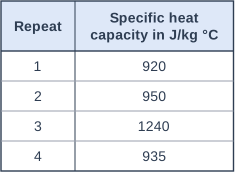
A student did an experiment four times to determine the specific heat capacity of a metal. The table shows her results.
Identify the anomalous result and calculate the mean value of the specific heat capacity.
Model answer
The anomalous result is 1240 J/kg °C (repeat 3), because it is much higher than the others. Mean = (920 + 950 + 935) ÷ 3 = 2805 ÷ 3 = 935 J/kg °C
Explanation
An anomalous result does not fit the pattern of the other repeats, so it is left out when calculating the mean. Including it would make the mean much too high.
Mark scheme
1 mark
the anomalous result is 1240 (J/kg °C) / repeat 3
an answer of 1240 and 935 (J/kg °C) scores 3 marks
1 mark
mean = (920 + 950 + 935) ÷ 3
the anomalous result must be left out
1 mark
935 (J/kg °C)
do not accept 1011 (the mean of all four results)
Question 4
4 marks
A storage heater contains 60 kg of clay bricks. Overnight the bricks are heated from 20 °C to 220 °C. During the next 8.0 hours the bricks cool back down to 20 °C.
specific heat capacity of the clay bricks = 920 J/kg °C
The equation linking change in thermal energy, mass, specific heat capacity and temperature change is: change in thermal energy = mass × specific heat capacity × temperature change
Calculate the mean power output of the storage heater during the 8.0 hours.
Model answer
ΔE = m × c × Δθ = 60 × 920 × (220 − 20) ΔE = 11 040 000 J time = 8.0 × 3600 = 28 800 s P = E ÷ t = 11 040 000 ÷ 28 800 P = 383 W
Explanation
The energy released as the bricks cool equals the energy stored when they were heated, ΔE = m c Δθ. Dividing by the time in seconds gives the mean rate of energy transfer, which is the power in watts.
Mark scheme
1 mark
ΔE = 60 × 920 × 200
an answer of 383 (W) scores 4 marks; allow 380 (W)
1 mark
ΔE = 11 040 000 (J)
allow 1.104 × 10⁷ (J)
1 mark
time = 8.0 × 60 × 60 = 28 800 (s)
1 mark
P = 11 040 000 ÷ 28 800 = 383 (W)
allow 380-384 (W); allow ecf from their energy and time
Ready to try the rest? Every answer you write is marked against the mark scheme, so you can see exactly where the marks are.
Ctrl + Enter to check
Study HelperHints first, answers after you try
Stuck on this one? Ask for a hint and I’ll point you in the right direction, without giving the answer away. Once you’ve checked your answer, I’ll show you how the marks are awarded.